
The Liberal International Order
A post-1945 global system built around rules, institutions, markets, alliances, and liberal principles
The Liberal International Order is the post-1945 system shaped by U.S. power and built around international institutions, open markets, alliances, rule-based cooperation, and liberal political principles.
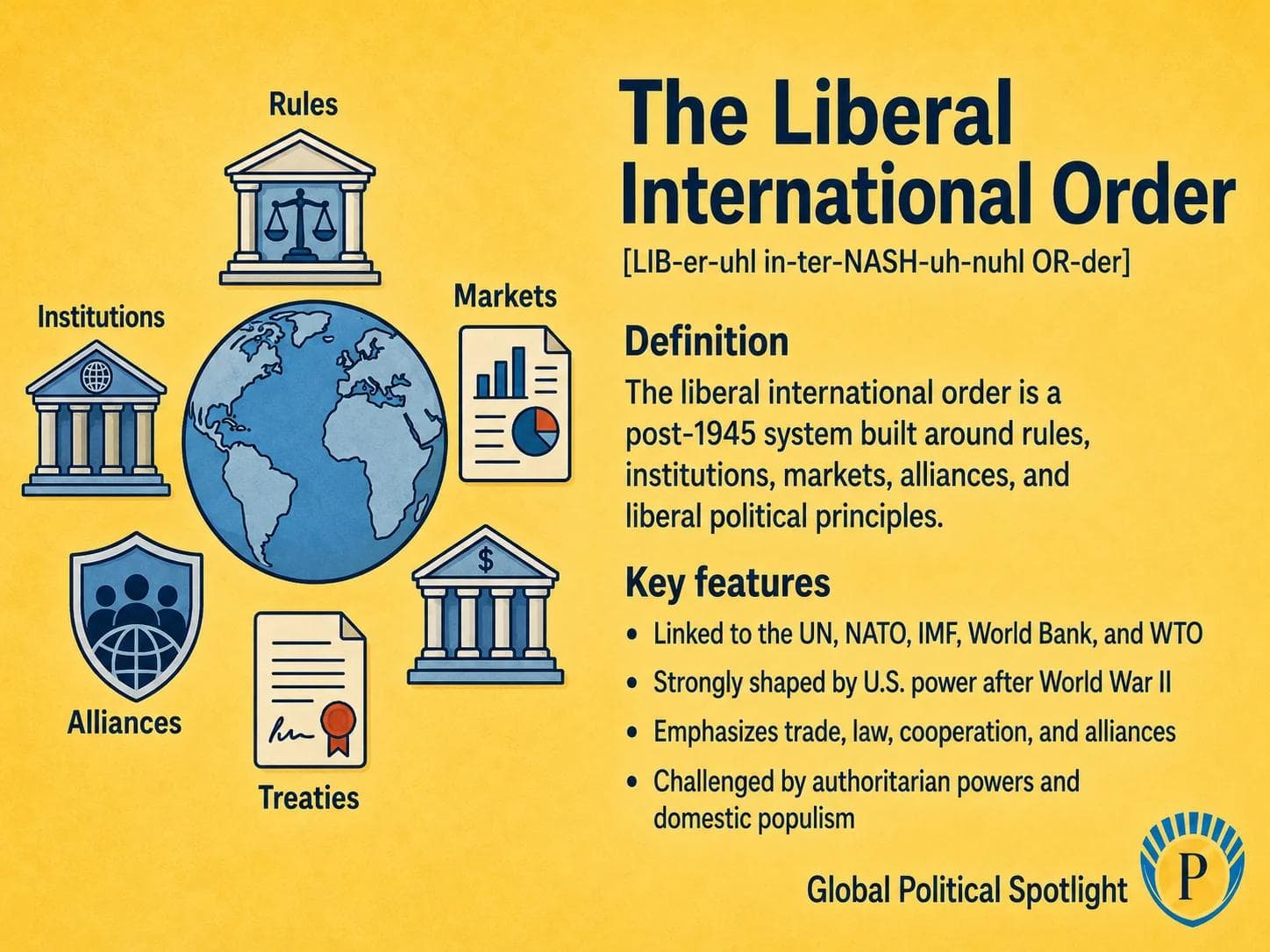
Definition
The Liberal International Order is a term used to describe the post-1945 international system built around rules, institutions, open markets, alliances, multilateral cooperation, and liberal political principles. It emerged after World War II and was shaped heavily by U.S. power, Western alliances, and the creation of major global institutions.
Core institutions associated with the order include the United Nations, NATO, the International Monetary Fund, the World Bank, and the World Trade Organization. These institutions were designed to support collective security, economic stability, trade cooperation, development finance, and dispute management.
The order is called liberal because it emphasizes principles such as rule-based cooperation, relatively open trade, legal commitments, political rights, market economics, and constraints on pure great-power domination. In practice, however, the order has always combined liberal ideas with power politics, military alliances, economic hierarchy, and contested interpretations of rules.
Why It Matters
The Liberal International Order matters because it shaped much of the modern global system. Trade rules, development finance, human rights language, security alliances, international law, and multilateral diplomacy all operate within institutions and norms that grew out of the postwar order.
It also matters because the order is under pressure. Authoritarian powers challenge parts of the system, rising states demand more influence, and domestic populist movements in democracies often criticize trade, globalization, migration, alliances, and international institutions.
For policymakers, the central question is not only whether the order survives, but which parts are preserved, reformed, fragmented, or replaced by more regional, transactional, or power-based arrangements.
The Liberal International Order is a core GPS framework for understanding the post-1945 international system and its current stress points. GPS should track institutional reform, alliance cohesion, WTO paralysis, UN Security Council deadlock, trade fragmentation, sanctions coalitions, democratic backsliding, authoritarian counter-narratives, and whether middle powers defend, revise, or hedge within the existing order.
Key Facts
- Type
- International order and global governance concept
- Core idea
- A post-1945 system built around rules, institutions, markets, alliances, and liberal political principles
- Historical origin
- Developed after World War II and shaped heavily by U.S. power and Western-led institution building
- Key institutions
- United Nations, NATO, IMF, World Bank, WTO, and related regional and legal institutions
- Main principles
- Rule-based cooperation, open trade, collective security, legal commitments, market economics, and political rights
- Security dimension
- U.S.-led alliances and security guarantees helped anchor the order in Europe and parts of Asia
- Economic dimension
- The order promoted trade liberalization, financial stability, development lending, and global economic integration
- Current challenges
- Authoritarian revisionism, domestic populism, trade fragmentation, institutional gridlock, and disputes over Western dominance
FAQ
What is the Liberal International Order?
The Liberal International Order is the post-1945 global system built around rules, institutions, markets, alliances, multilateral cooperation, and liberal political principles. It was shaped heavily by U.S. power after World War II.
Why is it called liberal?
It is called liberal because it emphasizes principles such as rule-based cooperation, open markets, legal commitments, political rights, international institutions, and constraints on raw power politics. The term does not mean the order has always operated consistently with those ideals.
Which institutions are part of the Liberal International Order?
Major institutions associated with the order include the United Nations, NATO, the International Monetary Fund, the World Bank, the World Trade Organization, and a broader network of treaties, alliances, courts, development banks, and regional organizations.
Who created the Liberal International Order?
The order was built after World War II by the United States and its allies, with participation from many other states. U.S. economic power, military alliances, and diplomatic leadership were especially important in shaping its institutions and rules.
What challenges the Liberal International Order?
Challenges include authoritarian powers contesting Western influence, rising states demanding more representation, populist criticism of globalization, trade disputes, institutional gridlock, democratic backsliding, and disagreement over when rules are applied consistently.
Is the Liberal International Order the same as U.S. dominance?
No, but they are closely connected. The order includes international institutions and rules that involve many countries, but it has also depended heavily on U.S. power, U.S.-led alliances, the dollar-centered financial system, and American diplomatic leadership.
Recent Developments
U.S. strategy described the post-Cold War era as over
The 2022 U.S. National Security Strategy stated that the post-Cold War era was over and framed the international environment around strategic competition, democracy, alliances, and the defense of a rules-based order.
The White HouseNATO reaffirmed alliance commitments in a contested order
NATO’s 2024 Washington Summit Declaration emphasized deterrence, defense, Ukraine support, and challenges from Russia and China, reflecting how alliances remain central to debates over the liberal international order.
NATOSources6 references
- United Nations Charter
Primary source for the post-1945 legal framework of sovereign equality, collective security, and international cooperation.
- NATO
Institutional background on NATO enlargement and the alliance’s role in the postwar security order.
- International Monetary Fund
Official overview of the IMF’s role in international monetary cooperation and financial stability.
- World Bank
Official source on the World Bank’s development mandate and role in postwar economic governance.
- World Trade Organization
Official source on the WTO’s role in global trade rules and dispute settlement.
- The White House
Official U.S. strategy document discussing alliances, democracy, strategic competition, and the rules-based international order.

GPSNews App
Read GPSNews on iPhone
Daily geopolitical briefings, government updates, and prediction signals in one focused app.
Newsletter
Stay Ahead Of The Next Signal
Get briefings in your inbox when new analysis and reports are published.