
World Bank
A global development finance institution for poverty reduction, infrastructure, climate, health, education, and institutional capacity
The World Bank is a global development finance institution that provides loans, grants, guarantees, policy advice, and technical support for poverty reduction, infrastructure, climate, health, education, and institutional capacity.
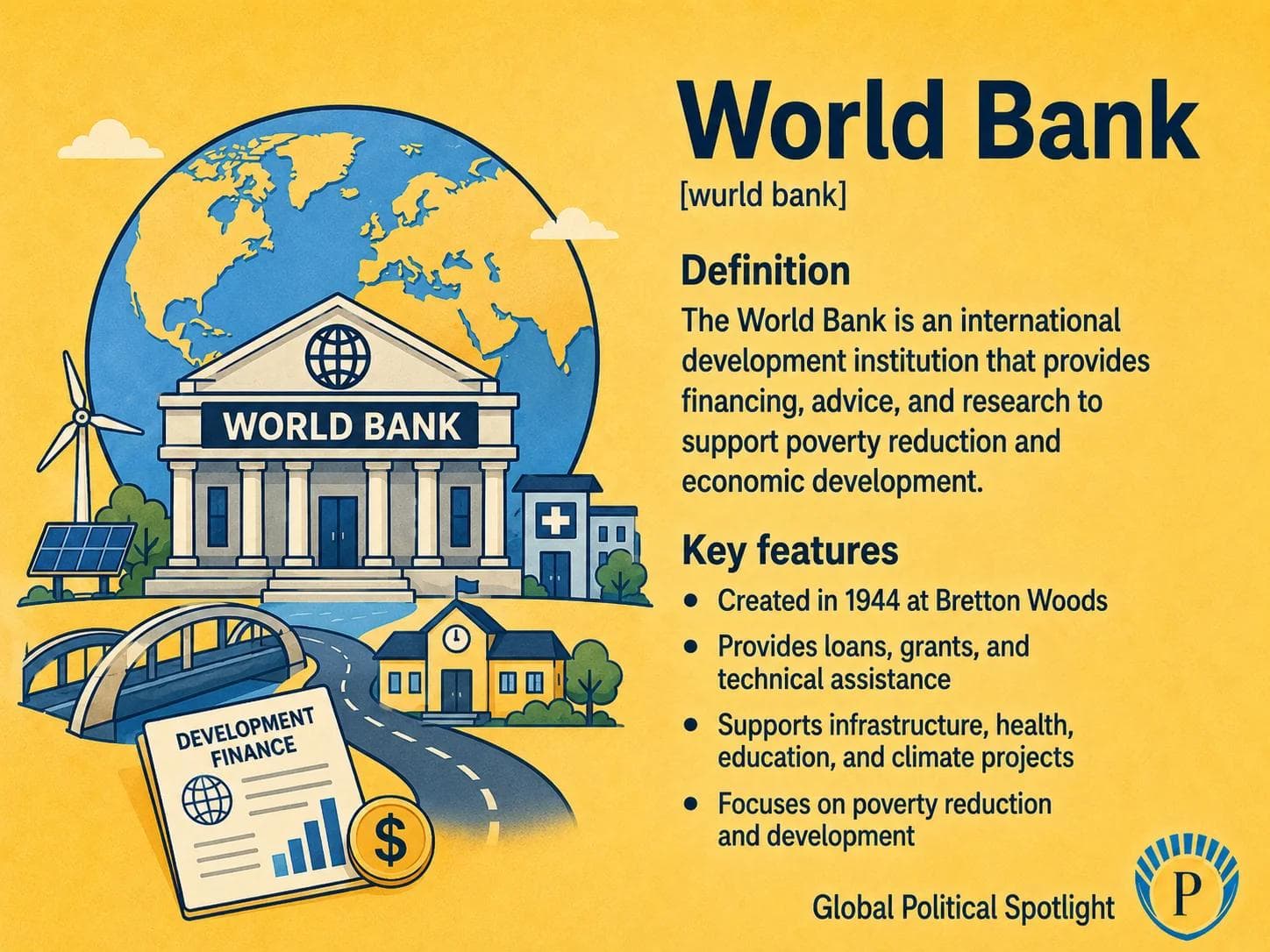
Definition
The World Bank is a global development finance institution headquartered in Washington, D.C. It provides financing, policy advice, research, and technical assistance to help countries reduce poverty, expand economic opportunity, build institutions, and invest in public goods such as infrastructure, health, education, water, energy, and climate resilience.
The term World Bank usually refers to two institutions within the wider World Bank Group: the International Bank for Reconstruction and Development, or IBRD, and the International Development Association, or IDA. IBRD lends mainly to middle-income and creditworthy lower-income countries, while IDA provides grants and concessional loans to the poorest countries.
The World Bank is not a charity or a world government. It is a shareholder-owned multilateral lender whose influence comes from capital markets, donor contributions, project finance, policy conditions, development expertise, country partnerships, and coordination with institutions such as the IMF, regional development banks, and the G20.
Why It Matters
The World Bank matters because development finance affects state capacity, economic growth, infrastructure access, climate resilience, health systems, education outcomes, and poverty reduction. Its projects can shape roads, power grids, hospitals, schools, digital systems, water networks, agricultural productivity, and public-sector reforms.
Its IBRD and IDA financing is especially important when countries face high borrowing costs, limited fiscal space, or weak access to private capital. IDA's concessional loans and grants can support countries that cannot safely borrow on ordinary market terms, while IBRD uses its balance sheet and credit rating to provide relatively affordable financing.
Geopolitically, the World Bank sits at the center of debates over climate finance, debt distress, development priorities, shareholder power, conditionality, private-capital mobilization, and reform of the multilateral development bank system. Its lending choices can influence how countries fund growth without relying only on bilateral creditors or commercial debt.
GPS should track the World Bank as a central institution in development finance, climate finance, infrastructure investment, poverty reduction, and debt-related policy debates. Key watchpoints include IBRD and IDA lending volumes, IDA replenishments, climate-finance targets, debt sustainability concerns, reforms to expand lending capacity, coordination with the IMF and G20, private-capital mobilization, and how shareholder priorities shape development projects in low- and middle-income countries.
Key Facts
- Type
- Multilateral development finance institution
- Founded
- Created at Bretton Woods in 1944; IBRD began operations in 1946
- Headquarters
- Washington, D.C., United States
- Core institutions
- The World Bank consists of IBRD and IDA within the wider World Bank Group
- IBRD role
- Provides loans, guarantees, risk-management products, and policy advice mainly to middle-income and creditworthy lower-income countries
- IDA role
- Provides grants and concessional loans to the poorest countries, with long maturities and low or zero interest
- Main sectors
- Infrastructure, climate, health, education, social protection, agriculture, water, energy, governance, and private-sector enabling reforms
- Strategic limit
- World Bank impact depends on borrower capacity, debt sustainability, project governance, donor support, shareholder priorities, and domestic implementation
FAQ
What is the World Bank?
The World Bank is a multilateral development finance institution that provides loans, grants, guarantees, policy advice, and technical assistance to support poverty reduction, infrastructure, climate resilience, health, education, and institutional capacity in developing countries.
What is the difference between IBRD and IDA?
IBRD lends mainly to middle-income and creditworthy lower-income countries, while IDA provides grants and concessional loans to the poorest countries. Together, they form what is commonly called the World Bank.
How is the World Bank different from the IMF?
The World Bank focuses on long-term development finance, poverty reduction, infrastructure, climate, and institutional capacity. The IMF focuses more on macroeconomic surveillance, balance-of-payments crises, exchange-rate pressure, debt sustainability, and short- to medium-term financial stabilization.
Why does the World Bank matter for climate finance?
The World Bank matters for climate finance because many developing countries need external support for adaptation, resilience, clean energy, disaster risk reduction, water security, and climate-smart infrastructure. The Bank can combine financing, policy advice, and project expertise at large scale.
Why is World Bank lending linked to debt concerns?
World Bank lending can help finance development, but countries already facing high debt must manage repayment risks carefully. IDA concessional finance can reduce borrowing pressure for poorer countries, while broader debt sustainability depends on growth, fiscal policy, creditor coordination, and project quality.
What are the main reform debates around the World Bank?
Reform debates focus on expanding lending capacity, increasing climate finance, mobilizing private capital, making projects faster, improving debt sustainability, updating shareholder influence, and balancing poverty reduction with global challenges such as climate change, pandemics, fragility, and food security.
Recent Developments
World Bank shareholders advanced reform of the multilateral development bank model
The Development Committee discussed implementation of the World Bank Group evolution agenda, including efforts to expand lending capacity, address global challenges, integrate climate and development, and improve operational efficiency. The reform debate remains central to how the Bank responds to climate, debt, fragility, and development needs.
Development CommitteeWorld Bank Group reported record climate finance in fiscal year 2025
The World Bank Group reported that climate finance reached 50.8 billion dollars in fiscal year 2025, including 22.5 billion dollars from IBRD and 16.7 billion dollars from IDA. The figures reinforced climate finance as a major pillar of the Bank's development-finance agenda.
World BankSources6 references
- World Bank
Official overview of the World Bank Group, its mission, institutions, and development role.
- World Bank
Official World Bank annual-report overview of IBRD and IDA.
- World Bank
Official page for the International Bank for Reconstruction and Development.
- International Development Association
Official explanation of IDA's concessional financing role for low-income countries.
- World Bank
Official World Bank page on climate change, adaptation, resilience, and climate-related finance.
- Development Committee
Official document on implementing the World Bank Group evolution agenda.

GPSNews App
Read GPSNews on iPhone
Daily geopolitical briefings, government updates, and prediction signals in one focused app.
Newsletter
Stay Ahead Of The Next Signal
Get briefings in your inbox when new analysis and reports are published.