
World Trade Organization
The global institution for trade rules, dispute settlement, negotiations, and monitoring
The World Trade Organization is the global institution that sets and administers trade rules, monitors trade policy, supports negotiations, and provides a forum for resolving trade disputes among member governments.
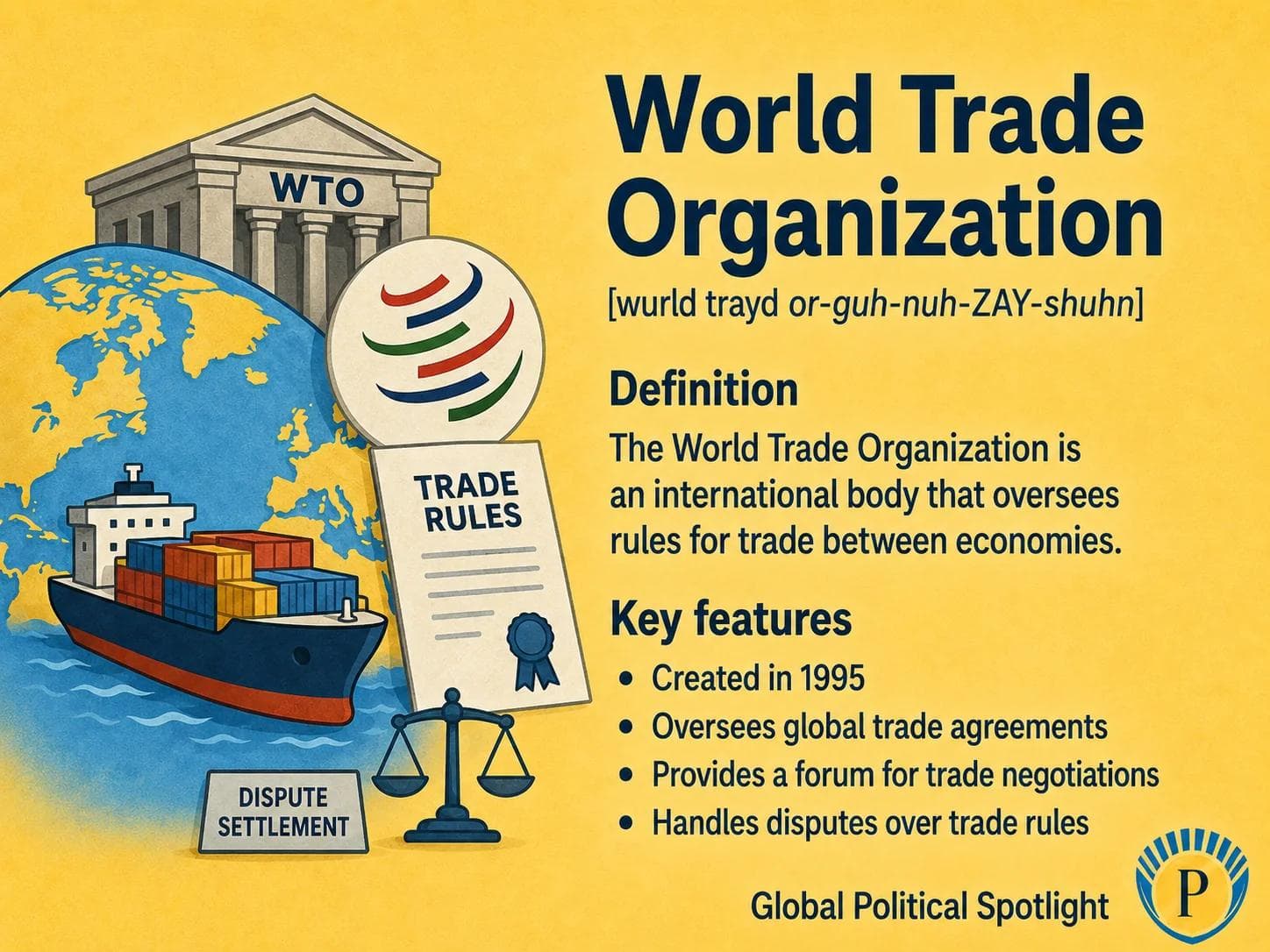
Definition
The World Trade Organization, or WTO, is the main global institution for rules-based international trade. It administers trade agreements, provides a forum for negotiations, monitors national trade policies, and offers a dispute-settlement system for conflicts between member governments.
The WTO was established in 1995, succeeding the General Agreement on Tariffs and Trade system. Its rules cover trade in goods, services, intellectual property, agriculture, subsidies, customs procedures, technical barriers, sanitary measures, and other policies that affect cross-border commerce.
A core WTO principle is non-discrimination, especially most-favored-nation treatment, which generally requires a member to treat like products from all WTO members equally. The system also allows exceptions, special rules, safeguards, trade remedies, and preferential agreements under defined conditions.
Why It Matters
The WTO matters because trade rules shape tariffs, supply chains, export markets, industrial policy, food systems, technology access, and the cost of goods. Even when governments disagree politically, WTO commitments provide a common legal framework for managing trade frictions.
Its dispute-settlement system has historically been one of the most important legal mechanisms in global economic governance. However, the paralysis of the Appellate Body has weakened final appeals and raised questions about how trade disputes can be resolved when major powers disagree.
Geopolitically, the WTO sits at the center of tensions over subsidies, tariffs, industrial policy, national security exceptions, export controls, supply-chain resilience, and U.S.-China competition. Its influence depends on whether members still see rules-based trade as preferable to unilateral retaliation.
GPS should track the WTO as a core institution of global economic order and a key arena for disputes over tariffs, subsidies, industrial policy, national security exceptions, supply chains, and U.S.-China trade tensions. Key watchpoints include Appellate Body reform, dispute-settlement workarounds, subsidy rules, e-commerce negotiations, fisheries disciplines, trade fragmentation, and whether WTO members can update rules for climate, technology, and economic security pressures.
Key Facts
- Type
- Global trade institution
- Founded
- 1995, after the Uruguay Round of trade negotiations
- Headquarters
- Geneva, Switzerland
- Core role
- Administers trade agreements, supports negotiations, monitors trade policy, and provides dispute settlement
- Key principle
- Most-favored-nation treatment, meaning WTO members generally must treat like products from other members equally
- Tariff role
- Members bind many tariff ceilings in WTO schedules, creating legal limits on how high tariffs can normally rise
- Dispute issue
- The Appellate Body has been unable to hear new appeals since December 2019 because appointments have been blocked
- Strategic limit
- The WTO depends on member consensus, national implementation, and political willingness to respect rulings and negotiate new rules
FAQ
What is the World Trade Organization?
The World Trade Organization is the global institution for trade rules. It administers trade agreements, hosts negotiations, monitors members' trade policies, and provides a dispute-settlement forum for trade conflicts between governments.
What does the WTO do with tariffs?
The WTO does not set one global tariff rate. Instead, members make tariff commitments in schedules, often binding maximum rates for specific goods. These commitments help make trade policy more predictable and limit arbitrary increases.
What does most-favored-nation mean in the WTO?
Most-favored-nation treatment means that if a WTO member gives a trade advantage to one member, it generally must give the same treatment to like products from all other WTO members. There are exceptions, including free trade agreements and certain preferential arrangements.
Why is the WTO dispute system in crisis?
The WTO dispute system is weakened because the Appellate Body has been unable to hear new appeals since 2019. This means some disputes can be appealed into a legal void, delaying or preventing final resolution unless members use alternative arrangements.
How does the WTO relate to U.S.-China trade tensions?
The WTO provides the legal background for many U.S.-China trade disputes over tariffs, subsidies, intellectual property, market access, state-owned enterprises, and industrial policy. However, many tensions go beyond existing WTO rules or are difficult to resolve through the current dispute system.
What are the limits of the WTO?
The WTO's limits include consensus-based negotiations, weakened appellate review, uneven compliance, and difficulty updating rules for subsidies, digital trade, climate policy, national security measures, and strategic competition between major economies.
Recent Developments
The WTO Appellate Body lost the quorum needed to hear new appeals
The WTO Appellate Body became unable to hear new appeals after the number of sitting members fell below the required quorum. The paralysis has remained a central challenge for WTO dispute settlement and has encouraged alternative appeal arrangements among some members.
World Trade OrganizationWTO members concluded the Thirteenth Ministerial Conference in Abu Dhabi
At the Thirteenth Ministerial Conference, WTO members addressed issues including dispute-settlement reform, e-commerce, development, least-developed-country graduation, and fisheries subsidies. The outcome showed both the continuing relevance of the WTO and the difficulty of reaching consensus across a divided membership.
World Trade OrganizationSources6 references
- World Trade Organization
Official WTO overview explaining the organization, its functions, and its role in the global trading system.
- World Trade Organization
Official WTO explanation of basic principles including most-favored-nation treatment and national treatment.
- World Trade Organization
Official WTO information on tariffs and tariff commitments.
- World Trade Organization
Official WTO dispute-settlement portal.
- World Trade Organization
Official WTO page on the Appellate Body and its current status.
- World Trade Organization
Official WTO information on subsidies and countervailing measures.

GPSNews App
Read GPSNews on iPhone
Daily geopolitical briefings, government updates, and prediction signals in one focused app.
Newsletter
Stay Ahead Of The Next Signal
Get briefings in your inbox when new analysis and reports are published.