
Great Power Competition
Rivalry among major states over security, economics, technology, and political order
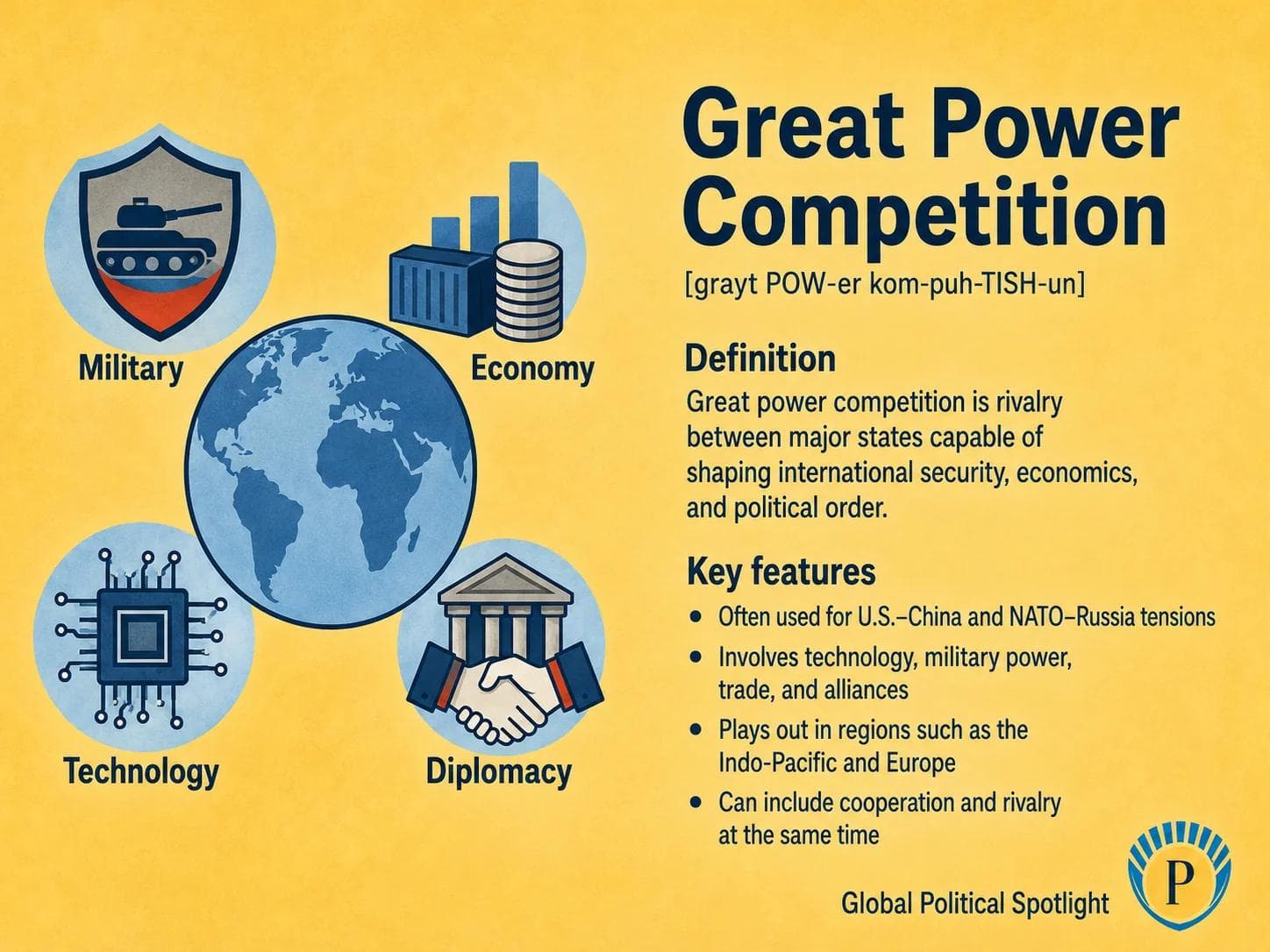
Great power competition is rivalry among major states with the capacity to shape international security, economic systems, technology standards, institutions, and political order.
Definition
Great power competition refers to rivalry among major states that have the resources, military capabilities, economic weight, diplomatic reach, and technological capacity to influence the international system. It is not limited to war or crisis; it also includes long-term competition over rules, institutions, markets, alliances, and strategic narratives.
In contemporary geopolitics, the term is often used to describe U.S.-China strategic competition, NATO-Russia tensions, and broader rivalry among established and rising powers. These rivalries can involve deterrence, sanctions, industrial policy, arms modernization, infrastructure finance, technology controls, and diplomatic coalition-building.
Great powers may compete and cooperate at the same time. States can clash over military posture or technology standards while still maintaining trade, climate talks, crisis hotlines, arms-control discussions, or diplomatic engagement.
Why It Matters
Great power competition matters because it shapes the security environment for nearly every region. Military deployments, alliance commitments, arms races, and deterrence strategies often reflect how major states perceive one another's intentions and capabilities.
It also affects markets and supply chains. Competition over semiconductors, energy, shipping routes, critical minerals, sanctions, investment screening, and technology standards can influence global trade, industrial strategy, and corporate risk.
For middle and smaller powers, great power competition creates difficult choices. They may seek protection from one major power, hedge between blocs, pursue strategic autonomy, or use competition among larger states to gain investment and diplomatic leverage.
Great power competition is a central GPS framework for tracking how major states contest influence across military, economic, technological, diplomatic, and institutional domains. GPS should monitor alliance cohesion, defense modernization, trade controls, sanctions, technology standards, regional flashpoints, and efforts by middle powers to hedge or align.
Key Facts
- Type
- Geopolitical rivalry concept
- Core actors
- Major states with global or regional power-projection capacity
- Main domains
- Military power, economics, technology, diplomacy, institutions, and information
- Modern examples
- U.S.-China competition and NATO-Russia tensions are prominent contemporary cases
- Strategic regions
- The Indo-Pacific, Europe, the Arctic, the Middle East, and global maritime routes are frequent arenas of competition
- Economic tools
- Sanctions, export controls, investment screening, industrial policy, infrastructure finance, and supply-chain restrictions
- Security tools
- Alliances, military exercises, basing access, deterrence, arms modernization, intelligence sharing, and defense partnerships
- Key feature
- Competition can coexist with selective cooperation on trade, climate, arms control, health, and crisis management
FAQ
What is Great Power Competition?
Great Power Competition is rivalry among major states that can shape international security, economics, technology, diplomacy, and political order. It includes both direct strategic rivalry and indirect competition through alliances, markets, institutions, and regional influence.
Which countries are involved in Great Power Competition?
The concept is most often applied to the United States, China, and Russia, but other influential actors such as the European Union, India, Japan, and major regional powers also shape the competitive environment.
Is Great Power Competition the same as war?
No. Great Power Competition can include military rivalry, but it also involves trade, technology, sanctions, diplomacy, infrastructure, finance, and institutional influence. Competition can occur below the threshold of open war.
Why does Great Power Competition matter for smaller states?
Smaller and middle powers may face pressure to align with one side, but they can also gain leverage by hedging, diversifying partnerships, attracting investment, or participating in regional institutions.
Can great powers cooperate while competing?
Yes. Great powers often compete in some areas while cooperating in others. For example, rival states may maintain trade ties, negotiate climate commitments, manage crises, or discuss arms control even while competing militarily or technologically.
How does Great Power Competition affect the global economy?
It can reshape supply chains, investment flows, technology access, sanctions exposure, energy security, and trade rules. Competition over semiconductors, critical minerals, shipping routes, and digital infrastructure is especially important.
Recent Developments
U.S. strategy framed the international environment around major-power competition
The 2022 U.S. National Security Strategy stated that the post-Cold War era was over and described strategic competition with major powers, especially China and Russia, as a defining feature of the current international environment.
The White HouseNATO described a more contested strategic environment
NATO's 2024 Washington Summit Declaration identified Russia as the most significant and direct threat to Allied security and described China as posing systemic challenges, reflecting a durable great-power competition framework in alliance planning.
NATOSources6 references
- The White House
Official U.S. strategy document describing major-power competition and the contemporary strategic environment.
- NATO
Official NATO declaration outlining alliance views on Russia, China, deterrence, and the contested security environment.
- U.S. Department of Defense
Official U.S. defense strategy document emphasizing strategic competition, deterrence, and defense priorities.
- European Union External Action Service
EU institutional source on the Strategic Compass and Europe’s security and defense posture in a more competitive environment.
- SIPRI
Reference database for military expenditure trends, an important indicator in great-power competition analysis.
- World Bank
Reference data for comparing economic scale across major states.

GPSNews App
Read GPSNews on iPhone
Daily geopolitical briefings, government updates, and prediction signals in one focused app.
Newsletter
Stay Ahead Of The Next Signal
Get briefings in your inbox when new analysis and reports are published.