
Unipolar Moment
The post-Cold War period when one state held overwhelming global influence
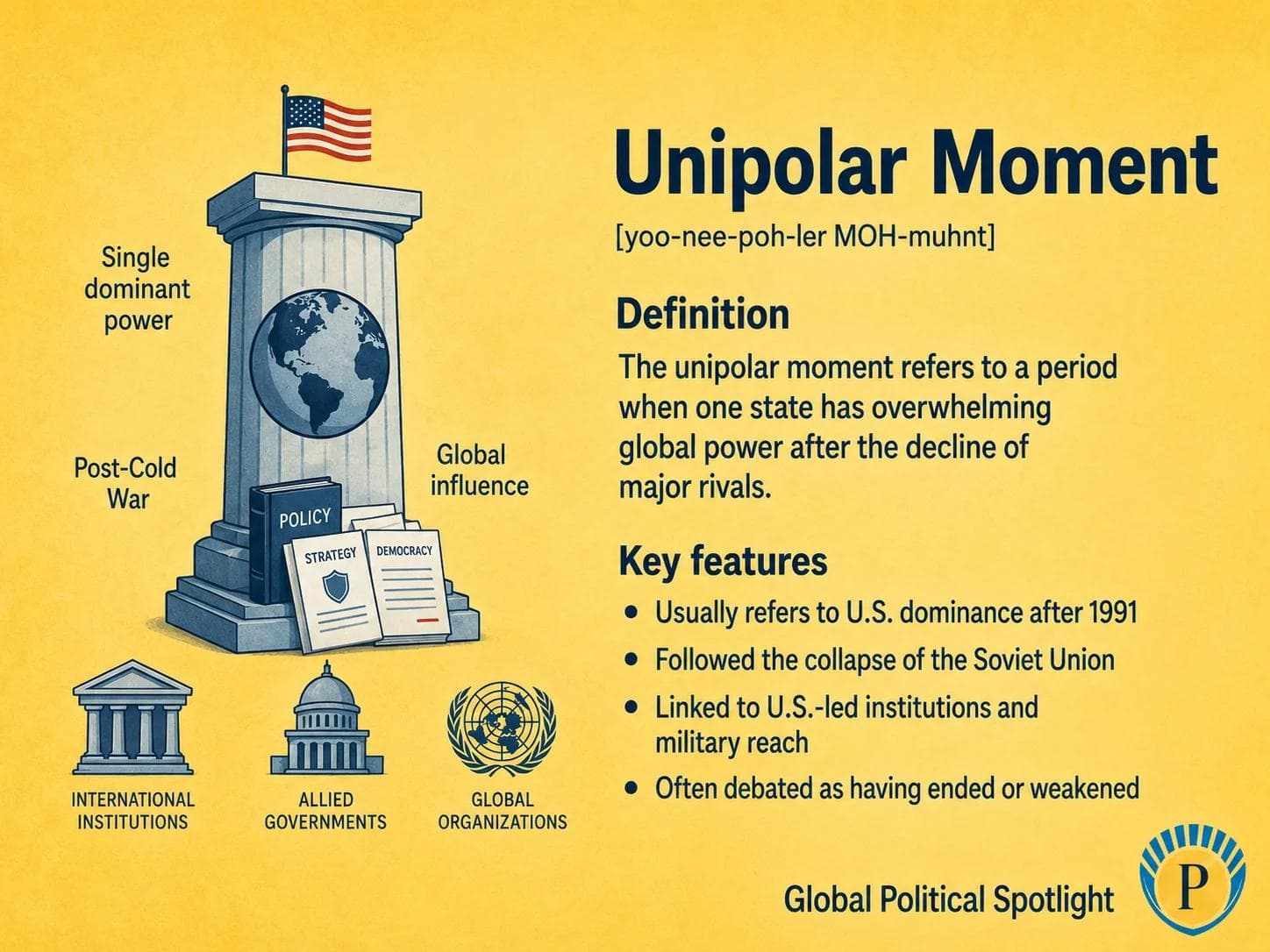
The unipolar moment refers to the period after the Cold War when the United States held unmatched global military, economic, diplomatic, and institutional influence.
Definition
The Unipolar Moment is a term used in international relations to describe the period after the Cold War when the United States emerged as the world’s dominant power following the collapse of the Soviet Union. It refers to a system in which one state had unmatched reach across military, economic, diplomatic, technological, and institutional domains.
The concept is closely associated with the early post-1991 era, when U.S. power was reinforced by its alliance network, global military presence, role in international financial institutions, influence over security institutions, and central position in the liberal international order.
The term does not mean the United States controlled all global outcomes. It means that no other single state or coalition could consistently match the overall scale of U.S. power during the early post-Cold War period.
Why It Matters
The Unipolar Moment matters because it shaped the institutions, alliances, interventions, economic rules, and security assumptions of the post-Cold War order. Many contemporary debates about U.S. power, China’s rise, Russia’s challenge to European security, and institutional reform are framed against this earlier period of U.S. dominance.
Understanding the concept helps explain why some states accepted, adapted to, benefited from, or resisted U.S.-led arrangements. It also clarifies debates over whether the world is still unipolar, moving toward multipolarity, or entering a more fragmented order shaped by regional powers and strategic competition.
GPS should track the Unipolar Moment as a reference point for analyzing the durability of U.S. power, the evolution of the liberal international order, alliance credibility, institutional contestation, and great-power competition. The key question is whether U.S. advantages in military reach, finance, technology, alliances, and institutions remain sufficient to sustain a U.S.-led order in a more contested environment.
Key Facts
- Concept type
- International relations theory
- Core meaning
- A period of overwhelming dominance by one state in the international system
- Main example
- U.S. dominance after the Cold War and the collapse of the Soviet Union
- Key period
- Most commonly associated with the years after 1991
- Power dimensions
- Military reach, economic influence, alliances, technology, diplomacy, and institutional leadership
- Historical contrast
- The Cold War was bipolar, while the post-Cold War order is often described as unipolar
- Current debate
- Analysts disagree over whether the Unipolar Moment has ended, weakened, or adapted to new forms of competition
- Important limit
- Unipolarity does not mean unlimited control; even dominant powers face resistance, costs, and institutional constraints
FAQ
What was the Unipolar Moment?
The Unipolar Moment was the period after the Cold War when the United States held overwhelming global influence compared with any other state. It is most closely associated with the post-1991 international order.
Why was the United States considered unipolar after the Cold War?
After the Soviet Union collapsed, the United States had unmatched military reach, a large economy, strong alliances, technological advantages, and major influence in international institutions. No rival power could match its overall position at the time.
Who coined the term Unipolar Moment?
The phrase is closely associated with U.S. commentator Charles Krauthammer, who used it in 1990 to describe the emerging post-Cold War structure of international power centered on the United States.
Has the Unipolar Moment ended?
Analysts disagree. Many argue that it has weakened because of China’s rise, Russia’s challenge to European security, regional powers, and institutional contestation. Others argue that the United States still retains unmatched advantages in alliances, finance, technology, and global military reach.
How is the Unipolar Moment different from hegemony?
Unipolarity describes the structure of the international system, where one state is much more powerful than others. Hegemony is broader and often refers to leadership, rule-setting, legitimacy, and influence over institutions and norms.
Why does the Unipolar Moment matter today?
It remains a reference point for debates about U.S. power, the liberal international order, NATO, China’s rise, global institutions, sanctions, military intervention, and whether the international system is becoming more multipolar.
Recent Developments
U.S. strategy framed a more competitive global order
The 2022 U.S. National Security Strategy described a strategic environment marked by major-power competition, reinforcing debate over whether the post-Cold War period of U.S. unipolar dominance has weakened.
The White HouseNATO updated its strategic concept for a contested security environment
NATO’s 2022 Strategic Concept described a changed security environment shaped by Russia, terrorism, cyber threats, and China-related challenges, illustrating how U.S.-led alliances have adapted beyond the early unipolar era.
NATOSources6 references
- Foreign Affairs
Original essay associated with the phrase 'Unipolar Moment' and the post-Cold War debate over U.S. dominance.
- The White House
Official U.S. strategy document useful for comparing post-Cold War dominance with contemporary strategic competition.
- NATO
Institutional reference on NATO’s role in the changing security environment after the post-Cold War era.
- United Nations
Foundational institutional reference for the post-1945 international order in which U.S. power operated after the Cold War.
- Council on Foreign Relations
Accessible reference overview of world order, U.S. leadership, institutions, and changing global power relationships.
- Encyclopaedia Britannica
Reference background on the Cold War and the bipolar structure that preceded the unipolar period.

GPSNews App
Read GPSNews on iPhone
Daily geopolitical briefings, government updates, and prediction signals in one focused app.
Newsletter
Stay Ahead Of The Next Signal
Get briefings in your inbox when new analysis and reports are published.