
Polarity Shift
A change in how power is distributed among major states in the international system
A polarity shift is a change in the distribution of power among major states, such as a move from bipolarity to unipolarity, or from unipolar dominance toward a more multipolar international system.
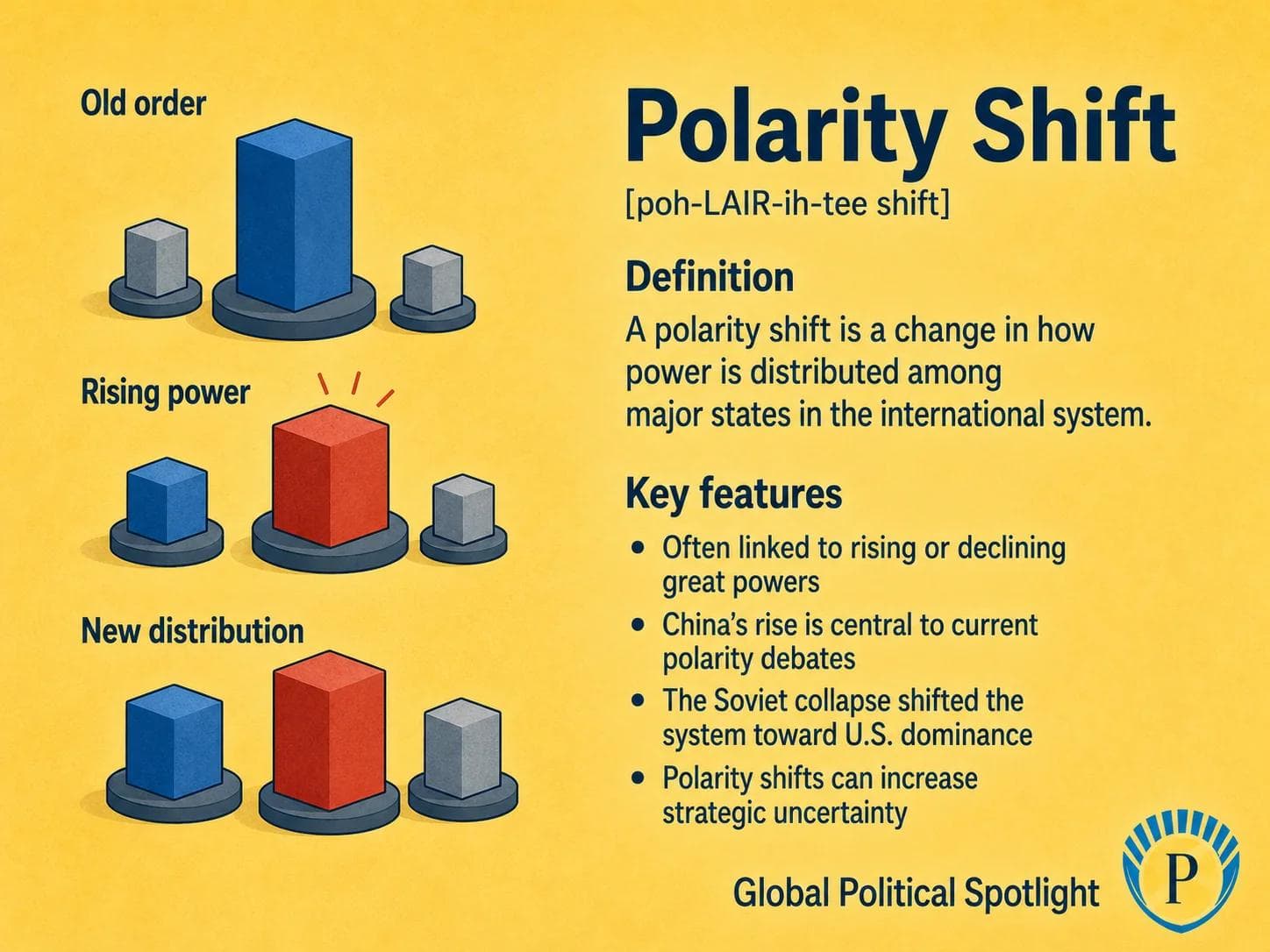
Definition
A polarity shift is a change in the way power is distributed among the major states in the international system. In international relations, polarity refers to the number of major centers of power, such as one dominant power in a unipolar order, two superpowers in a bipolar order, or several major powers in a multipolar order.
Polarity shifts occur when great powers rise, decline, collapse, or become more capable relative to one another. The Soviet Union's collapse helped move the world from Cold War bipolarity toward U.S.-led unipolarity, while China's economic and military rise has contributed to debates about whether the system is moving toward greater multipolarity.
These shifts are rarely instant. They unfold through changes in military capacity, economic weight, technological leadership, alliance networks, industrial strength, demographic trends, and diplomatic influence.
Why It Matters
Polarity shifts matter because they can make global politics less predictable. When states disagree about who has power, who has rights of influence, or which rules should govern the system, the risk of miscalculation can increase.
A changing distribution of power can affect alliance formation, military planning, trade strategy, technology controls, sanctions policy, arms races, and the credibility of security commitments. It can also reshape international institutions when rising powers demand more influence and established powers try to preserve existing rules.
For smaller and middle powers, polarity shifts can create both risks and opportunities. They may face pressure to align with one bloc, hedge between competing powers, or seek greater strategic autonomy.
Polarity shift is a core GPS concept for tracking long-term changes in the international system. It helps connect military modernization, economic growth, alliance behavior, technological competition, institutional reform, and strategic uncertainty into one analytical frame. GPS should watch whether power is concentrating, fragmenting, or becoming more contested across regions and policy domains.
Key Facts
- Type
- International relations concept
- Core idea
- A change in how power is distributed among major states
- Related systems
- Unipolarity, bipolarity, and multipolarity
- Classic transition
- The Soviet collapse helped end Cold War bipolarity and expand U.S. dominance in the 1990s
- Modern example
- China's rise has intensified debate over whether the international system is becoming more multipolar
- Main drivers
- Economic scale, military capability, technology, alliances, industrial capacity, demographics, and institutional influence
- Strategic risk
- Power transitions can increase uncertainty, rivalry, arms competition, and miscalculation
- Policy relevance
- Polarity shifts shape defense strategy, trade policy, alliance commitments, sanctions, and global governance reform
FAQ
What is a polarity shift in geopolitics?
A polarity shift is a change in the distribution of power among major states. It describes movement between different international structures, such as bipolarity, unipolarity, or multipolarity.
What is an example of a polarity shift?
The collapse of the Soviet Union is a major example. It ended the Cold War's bipolar structure between the United States and the Soviet Union and helped create a period of U.S.-led unipolar dominance.
Why do polarity shifts create uncertainty?
They create uncertainty because states may disagree about the new balance of power, the credibility of alliances, and the rules of the international system. Rising powers may seek more influence, while established powers may try to preserve existing arrangements.
Is China's rise a polarity shift?
China's rise is often discussed as part of a broader polarity shift because it has increased China's economic, military, technological, and diplomatic weight relative to other major powers. Whether this produces true multipolarity remains debated.
What is the difference between polarity and balance of power?
Polarity describes the overall structure of power in the international system, especially the number of major power centers. Balance of power focuses more on how states align, compete, and counterbalance one another within that structure.
Do polarity shifts always lead to war?
No. Polarity shifts can raise the risk of rivalry and miscalculation, but they do not automatically cause war. Outcomes depend on diplomacy, institutions, economic interdependence, domestic politics, alliances, military strategy, and crisis management.
Recent Developments
U.S. national security strategy emphasized major-power competition
The 2022 U.S. National Security Strategy described the post-Cold War era as over and framed the international environment around competition with major powers, especially China and Russia.
The White HouseNATO continued to frame China and Russia as long-term strategic challenges
NATO's 2024 Washington Summit Declaration identified Russia as the most significant and direct threat to Allied security and described China as a decisive enabler of Russia's war effort, reflecting a more contested power environment.
NATOSources6 references
- Encyclopaedia Britannica
Reference background on international systems, power structures, and international relations theory.
- The White House
Official U.S. strategy document describing the contemporary strategic environment and major-power competition.
- NATO
Official 2024 NATO summit declaration reflecting alliance views on Russia, China, and the evolving security order.
- World Bank
Reference data for comparing economic scale across major economies, one driver of long-term power distribution.
- SIPRI
Institutional source for military expenditure data, useful for tracking material changes in great-power capabilities.
- Office of the Historian, U.S. Department of State
Historical background on the Soviet collapse and the end of the Cold War power structure.

GPSNews App
Read GPSNews on iPhone
Daily geopolitical briefings, government updates, and prediction signals in one focused app.
Newsletter
Stay Ahead Of The Next Signal
Get briefings in your inbox when new analysis and reports are published.