
United Nations
The central global organization for peace, security, development, human rights, and international law
The United Nations is the main global intergovernmental organization for peace, security, development, human rights, humanitarian coordination, and international law, built around member-state diplomacy.
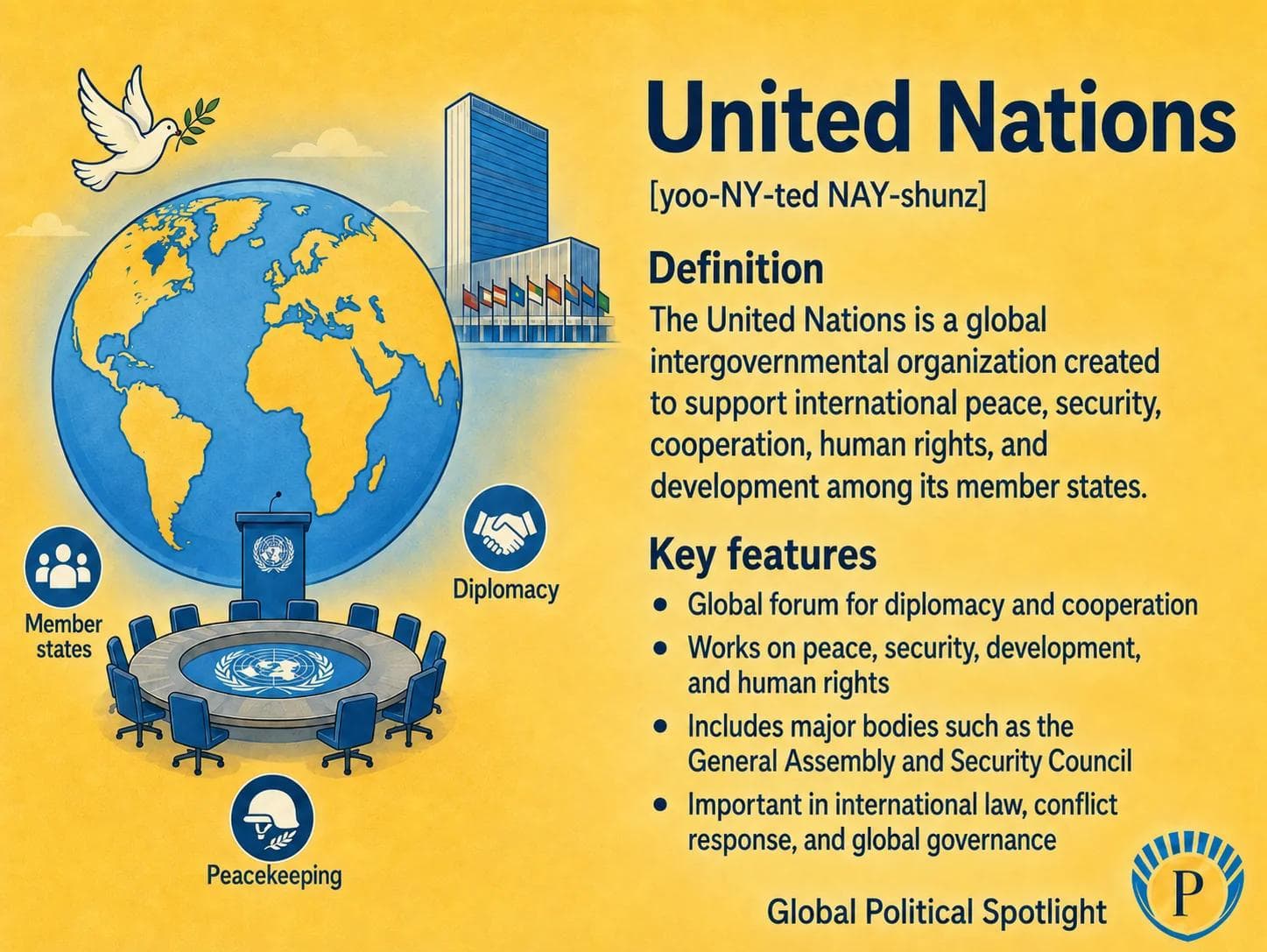
Definition
The United Nations is the world's main intergovernmental organization, founded in 1945 after the Second World War to help maintain international peace and security, promote cooperation among states, support development, protect human rights, coordinate humanitarian work, and provide a framework for international law.
Its core bodies include the General Assembly, where all member states are represented, and the Security Council, which has primary responsibility for international peace and security. The UN system also includes specialized agencies, funds, programmes, courts, peacekeeping missions, and humanitarian coordination bodies.
Why It Matters
The United Nations matters because it provides the most widely recognized global forum for state diplomacy and multilateral legitimacy. UN resolutions, mandates, sanctions, peacekeeping operations, humanitarian appeals, and legal processes can shape how governments justify action, respond to crises, and coordinate across borders.
Its limits are equally important. The UN depends on member states for political consent, funding, enforcement, troops, and implementation. Security Council veto power can block action on major crises, especially when a permanent member or close ally is directly involved.
GPS should track the United Nations as the main institutional arena for multilateral legitimacy, peace and security mandates, sanctions, peacekeeping, humanitarian coordination, development goals, and international legal norms. Key watchpoints include Security Council vetoes, General Assembly votes, peacekeeping mandate renewals, UN agency funding disputes, humanitarian access debates, sanctions committees, recognition issues, and reform proposals affecting representation and institutional credibility.
Key Facts
- Type
- Global intergovernmental organization
- Founded
- 1945, under the Charter of the United Nations
- Headquarters
- New York City, with major UN offices in Geneva, Vienna, and Nairobi
- Core bodies
- General Assembly, Security Council, Economic and Social Council, International Court of Justice, Secretariat, and Trusteeship Council
- Security Council
- Primary UN body for international peace and security, with five permanent members and ten elected members
- Veto power
- The five permanent Security Council members can block substantive Council decisions
- Operational roles
- Peacekeeping, humanitarian coordination, development assistance, human rights monitoring, sanctions implementation, and international legal support
- Strategic relevance
- Multilateral legitimacy, crisis diplomacy, international law, humanitarian response, sanctions, peacekeeping, and global governance
FAQ
What is the United Nations?
The United Nations is a global intergovernmental organization founded in 1945. It provides a forum for states to cooperate on peace and security, development, human rights, humanitarian response, and international law.
What does the UN Security Council do?
The Security Council has primary responsibility for international peace and security. It can authorize peacekeeping operations, impose sanctions, approve mandates, and adopt binding resolutions, but its action can be blocked by vetoes from permanent members.
What is the UN General Assembly?
The General Assembly is the main deliberative body of the UN, where all member states are represented. Its resolutions are usually not legally binding, but they can signal international opinion, diplomatic legitimacy, and political pressure.
Who has veto power at the UN?
The five permanent members of the Security Council have veto power: China, France, Russia, the United Kingdom, and the United States. A veto can block substantive Security Council decisions.
What are UN peacekeeping missions?
UN peacekeeping missions are field operations authorized by the Security Council and staffed by personnel contributed by member states. They can monitor ceasefires, protect civilians, support political processes, and help stabilize conflict-affected areas, depending on their mandate.
Why is the United Nations often criticized?
The UN is often criticized because it depends on member-state consent, funding, and enforcement. Great-power rivalry, Security Council vetoes, weak implementation, underfunded agencies, and political divisions can limit its ability to respond to crises.
Recent Developments
UN member states adopted the Pact for the Future
UN member states adopted the Pact for the Future at the Summit of the Future, outlining commitments on peace and security, sustainable development, digital cooperation, youth, human rights, and reform of global governance institutions.
United NationsThe UN reviewed progress on the Sustainable Development Goals
The SDG Summit brought member states together to review progress on the 2030 Agenda, underscoring the UN's continuing role in development coordination, climate priorities, poverty reduction, and global public-goods debates.
United NationsSources6 references
- United Nations
Official UN overview of the organization's purpose, history, structure, and work.
- Charter of the United Nations
Official text of the UN Charter, the founding treaty framework of the United Nations.
- United Nations Security Council
Official Security Council site covering membership, mandates, resolutions, sanctions committees, and peace and security work.
- United Nations General Assembly
Official General Assembly site explaining the UN's main deliberative body and its work.
- United Nations Peacekeeping
Official UN peacekeeping source for mission mandates, operations, troop contributions, and peacekeeping principles.
- United Nations Sustainable Development Goals
Official UN source for the Sustainable Development Goals and development cooperation agenda.
GPSNews App
Read GPSNews on iPhone
Daily geopolitical briefings, government updates, and prediction signals in one focused app.
Newsletter
Stay Ahead Of The Next Signal
Get briefings in your inbox when new analysis and reports are published.