
Multipolarity vs. Unipolarity
How the distribution of power shapes alliances, rivalries, and global crisis behavior
Multipolarity and unipolarity describe how power is distributed in the international system: either among several major powers or concentrated around one dominant superpower.
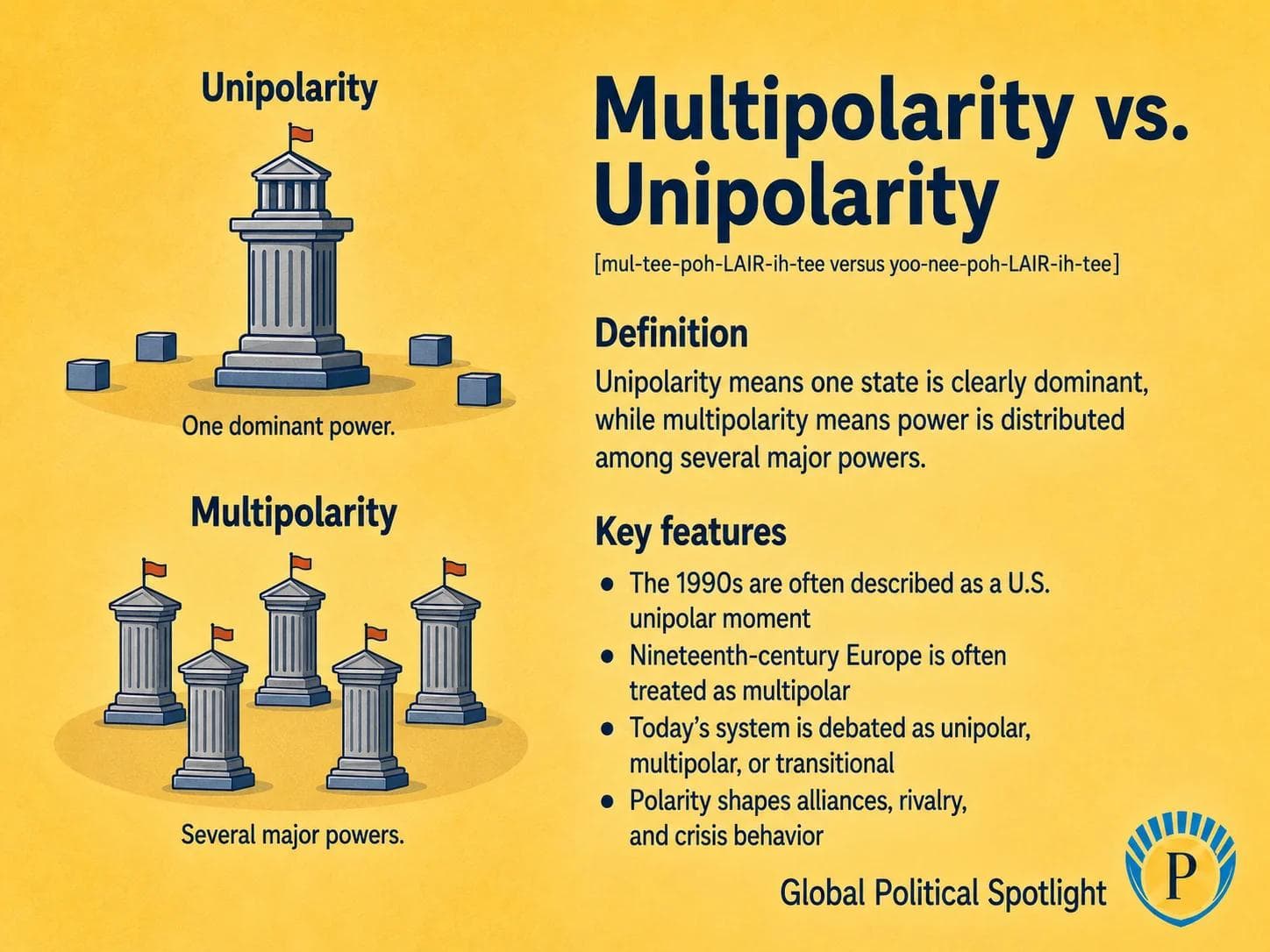
Definition
Unipolarity is an international system in which one state has a clearly dominant position across military, economic, diplomatic, and institutional power. The term is often used to describe the period after the Cold War, when the United States was widely regarded as the central global superpower.
Multipolarity is an international system in which several major powers hold significant influence at the same time. In a multipolar order, power is less centralized, and states often manage overlapping alliances, regional spheres of influence, economic dependencies, and strategic rivalries.
Polarity does not mean that every state is equally powerful. It refers to the structure of the system: whether the most important sources of power are concentrated around one pole, two poles, or several competing centers of influence.
Why It Matters
Polarity shapes how states form alliances, calculate risk, respond to crises, and interpret threats. A unipolar system may give one power greater agenda-setting capacity, while a multipolar system can create more diplomatic flexibility but also more uncertainty about alignments and escalation.
The concept matters for understanding debates about whether the post-Cold War order is giving way to a more contested world shaped by the United States, China, the European Union, Russia, India, and other regional powers.
GPS should track polarity as a structural concept behind alliance formation, great power competition, institutional reform debates, regional balancing, sanctions coordination, defense spending, and crisis behavior. The key question is not only which state is strongest, but whether other major powers can constrain, balance, bypass, or reshape the preferences of the leading power.
Key Facts
- Concept type
- International relations theory
- Unipolarity
- A system with one dominant superpower
- Multipolarity
- A system with several major centers of power
- Cold War comparison
- The Cold War is usually described as bipolar, centered on the United States and the Soviet Union
- Post-Cold War example
- The 1990s and early 2000s are often cited as a period of U.S.-led unipolarity
- Strategic effect
- Polarity influences alliance choices, deterrence calculations, crisis management, and institutional bargaining
- Common debate
- Analysts debate whether the current order is still U.S.-led, increasingly multipolar, or better described as complex interdependence
- Important limit
- Polarity simplifies global power structures and does not capture every form of economic, technological, or regional influence
FAQ
What is unipolarity in geopolitics?
Unipolarity is a global power structure in which one state is clearly more powerful than all others across the main dimensions of power, such as military capability, economic influence, diplomacy, and institutional reach.
What is multipolarity?
Multipolarity is a system where several major powers hold significant influence at the same time. These powers may compete, cooperate, form coalitions, or balance against one another depending on the issue.
Is the world currently multipolar?
There is no single accepted answer. Many analysts argue that U.S. dominance has weakened relative to China and other powers, while others argue that the United States still retains unmatched military, financial, technological, and alliance advantages.
Why does polarity matter for international security?
Polarity affects how states judge threats and opportunities. In a unipolar system, states may adapt to or resist the leading power. In a multipolar system, states may hedge among several powers, making alliances more flexible but crisis behavior harder to predict.
Is multipolarity more peaceful than unipolarity?
Not necessarily. Some argue multipolarity allows broader balancing and regional autonomy, while others argue it can increase uncertainty, miscalculation, and shifting alliance commitments. The effects depend on institutions, norms, capabilities, and specific disputes.
How is bipolarity different from multipolarity?
Bipolarity describes a system dominated by two major powers or blocs, such as the United States and Soviet Union during the Cold War. Multipolarity involves three or more major centers of power.
Recent Developments
U.S. strategy described intensifying major-power competition
The 2022 U.S. National Security Strategy framed the international environment around competition among major powers, especially with China and Russia, reinforcing debate over whether the post-Cold War unipolar moment has faded.
The White HouseBRICS expansion highlighted multipolar-order debates
The BRICS decision to invite additional members renewed discussion about non-Western institutional coordination and the political language of a more multipolar international order.
BRICS 2023 South AfricaSources6 references
- Encyclopaedia Britannica
Reference background on balance of power and international system structure.
- The White House
Official U.S. strategy document discussing the contemporary strategic environment and major-power competition.
- NATO
Institutional reference on alliance strategy in a contested international security environment.
- United Nations
Foundational institutional reference for the sovereign-state system and international order.
- Council on Foreign Relations
Accessible reference overview of world order, institutions, and changing power relationships.
- BRICS 2023 South Africa
Primary summit declaration useful for understanding the political language of multipolarity.

GPSNews App
Read GPSNews on iPhone
Daily geopolitical briefings, government updates, and prediction signals in one focused app.
Newsletter
Stay Ahead Of The Next Signal
Get briefings in your inbox when new analysis and reports are published.