
International Monetary Fund
A global financial institution for macroeconomic surveillance, crisis lending, debt sustainability, and financial stability
The International Monetary Fund is a global financial institution that monitors economies, lends during balance-of-payments crises, assesses debt sustainability, and supports financial stabilization.
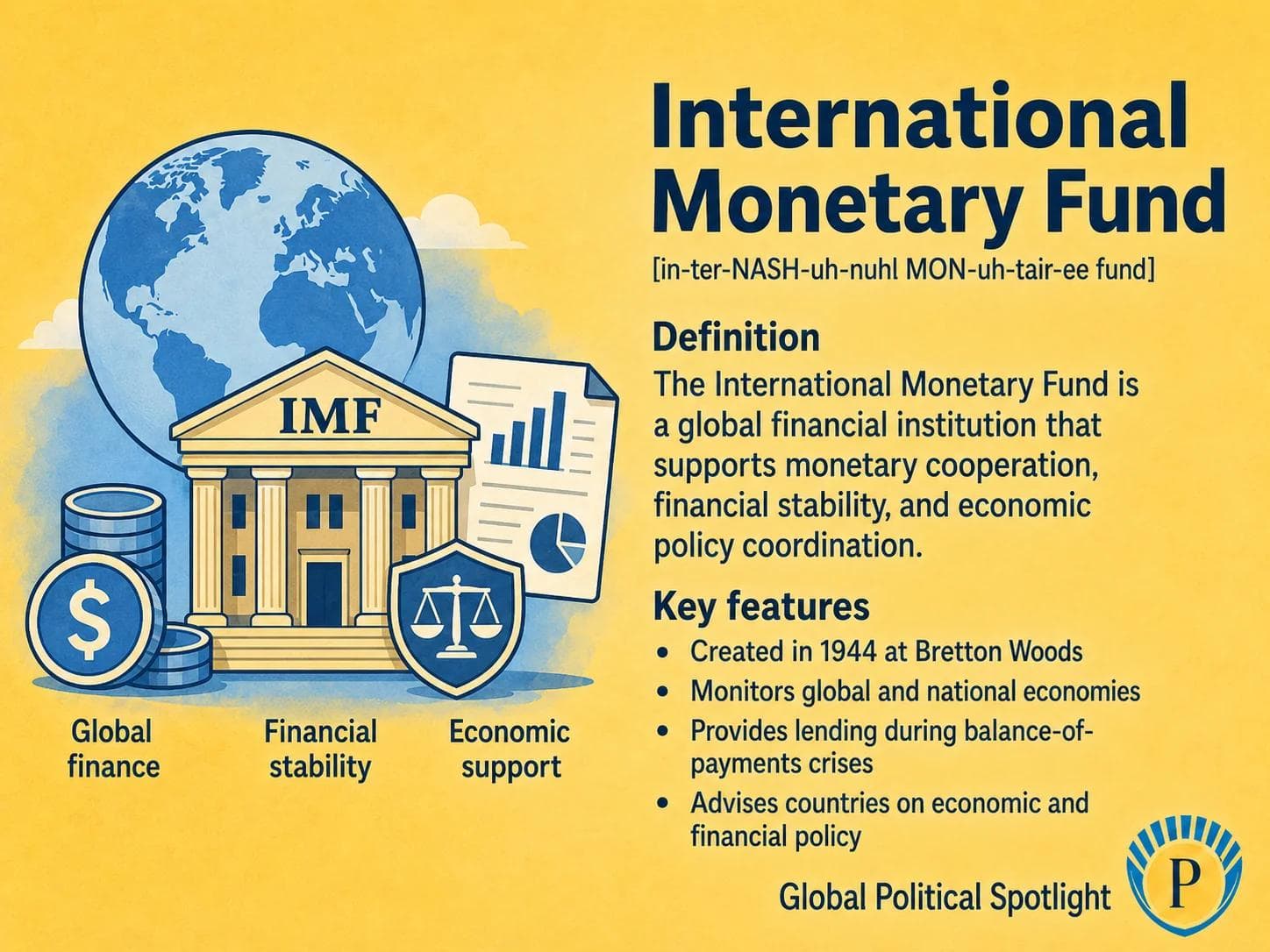
Definition
The International Monetary Fund, or IMF, is a global financial institution created after the Second World War to promote international monetary cooperation, exchange-rate stability, balanced growth, and financial stability. It is headquartered in Washington, D.C. and is owned by its member countries.
The IMF's core work has three main pillars: surveillance, lending, and capacity development. It monitors national and global economic conditions, provides policy advice, lends to countries facing balance-of-payments pressures, and helps governments strengthen institutions such as central banks, finance ministries, and tax systems.
IMF lending is often linked to conditionality: policy commitments designed to restore macroeconomic stability, rebuild reserves, reduce unsustainable fiscal or external imbalances, and improve confidence. These conditions make IMF programs influential but also politically controversial.
Why It Matters
The IMF matters because balance-of-payments crises can destabilize currencies, banking systems, inflation, import access, debt repayment, and government budgets. IMF support can help countries avoid disorderly adjustment, but it usually comes with policy reforms that affect domestic politics and social conditions.
Its debt sustainability assessments are especially important for emerging markets and low-income countries. IMF analysis can influence whether creditors restructure debt, whether other lenders provide support, and whether a country is viewed as solvent, illiquid, or in need of deeper debt relief.
Geopolitically, the IMF is part of the global financial safety net. Its programs, surveillance reports, quota system, Special Drawing Rights, and crisis lending connect economic policy to creditor politics, exchange-rate pressure, debt negotiations, and the balance of influence between advanced economies and emerging powers.
GPS should track the International Monetary Fund as a central institution in global financial stability, emerging-market crises, debt restructuring, currency pressure, and macroeconomic policy coordination. Key watchpoints include IMF program negotiations, debt sustainability analysis, conditionality debates, Special Drawing Rights allocations and rechanneling, quota reform, lender-of-last-resort politics, and how IMF decisions interact with China, private creditors, the G20 Common Framework, and regional financial arrangements.
Key Facts
- Type
- Global financial institution and international monetary organization
- Founded
- Established in 1944 at Bretton Woods; began operations in 1945
- Headquarters
- Washington, D.C., United States
- Core functions
- Macroeconomic surveillance, balance-of-payments lending, capacity development, and financial-stability analysis
- Crisis role
- Provides financing to countries facing external financing gaps, reserve shortages, debt stress, or exchange-rate pressure
- Conditionality
- Many IMF programs require policy commitments on fiscal, monetary, exchange-rate, financial-sector, or structural reforms
- Special Drawing Rights
- SDRs are international reserve assets created by the IMF and allocated to members to supplement official reserves
- Strategic limit
- The IMF cannot solve crises alone and depends on member-country cooperation, creditor participation, domestic implementation, and political legitimacy
FAQ
What is the International Monetary Fund?
The International Monetary Fund is a global financial institution that monitors economic conditions, provides policy advice, lends to countries facing balance-of-payments problems, assesses debt sustainability, and supports financial stability.
What does the IMF do during a financial crisis?
During a crisis, the IMF can provide financing to help a country cover external payment needs, rebuild reserves, stabilize confidence, and implement policy reforms. Its programs often involve fiscal, monetary, exchange-rate, financial-sector, or structural conditions.
What is IMF conditionality?
IMF conditionality means the policy commitments attached to IMF lending. These conditions are designed to address the causes of a crisis and restore stability, but they can be controversial when they involve spending cuts, tax changes, subsidy reform, interest-rate increases, or restructuring.
What are Special Drawing Rights?
Special Drawing Rights, or SDRs, are international reserve assets created by the IMF. They are not a normal currency used by households, but they can supplement official reserves and be exchanged among member countries for usable currencies.
Why does the IMF matter for emerging markets?
The IMF matters for emerging markets because many are exposed to exchange-rate pressure, dollar funding stress, commodity shocks, capital outflows, and debt refinancing risks. IMF programs can provide liquidity and policy credibility, but they also influence domestic economic choices.
What are the limits of the IMF?
The IMF's limits include political resistance to conditionality, uncertainty over debt restructuring, dependence on creditor cooperation, quota and voting-power disputes, and the fact that lending can stabilize a crisis but cannot by itself guarantee growth, social protection, or institutional reform.
Recent Developments
The IMF implemented a historic SDR allocation
The IMF implemented a general allocation of Special Drawing Rights equivalent to about 650 billion dollars to help supplement global reserves during the COVID-19 economic shock. The allocation remains an important reference point for debates over liquidity support and reserve access for vulnerable economies.
International Monetary FundIMF governors approved a 50 percent quota increase
The IMF Board of Governors approved a 50 percent increase in quotas under the Sixteenth General Review of Quotas. The decision aimed to strengthen the Fund's permanent resources while leaving wider debates over voting power and representation in the institution unresolved.
International Monetary FundSources6 references
- International Monetary Fund
Official IMF overview of the institution, its mandate, and its work.
- International Monetary Fund
Official IMF explanation of surveillance and macroeconomic monitoring.
- International Monetary Fund
Official IMF overview of lending tools and crisis financing.
- International Monetary Fund
Official IMF explanation of conditionality in lending programs.
- International Monetary Fund
Official IMF fact sheet on Special Drawing Rights.
- International Monetary Fund
Official IMF page for debt sustainability analysis resources.

GPSNews App
Read GPSNews on iPhone
Daily geopolitical briefings, government updates, and prediction signals in one focused app.
Newsletter
Stay Ahead Of The Next Signal
Get briefings in your inbox when new analysis and reports are published.