
Realism vs. Liberalism vs. Constructivism
Three major ways of explaining state behavior and international politics
Realism, Liberalism, and Constructivism are major international relations theories that explain global politics through power and security, institutions and cooperation, or ideas and identity.
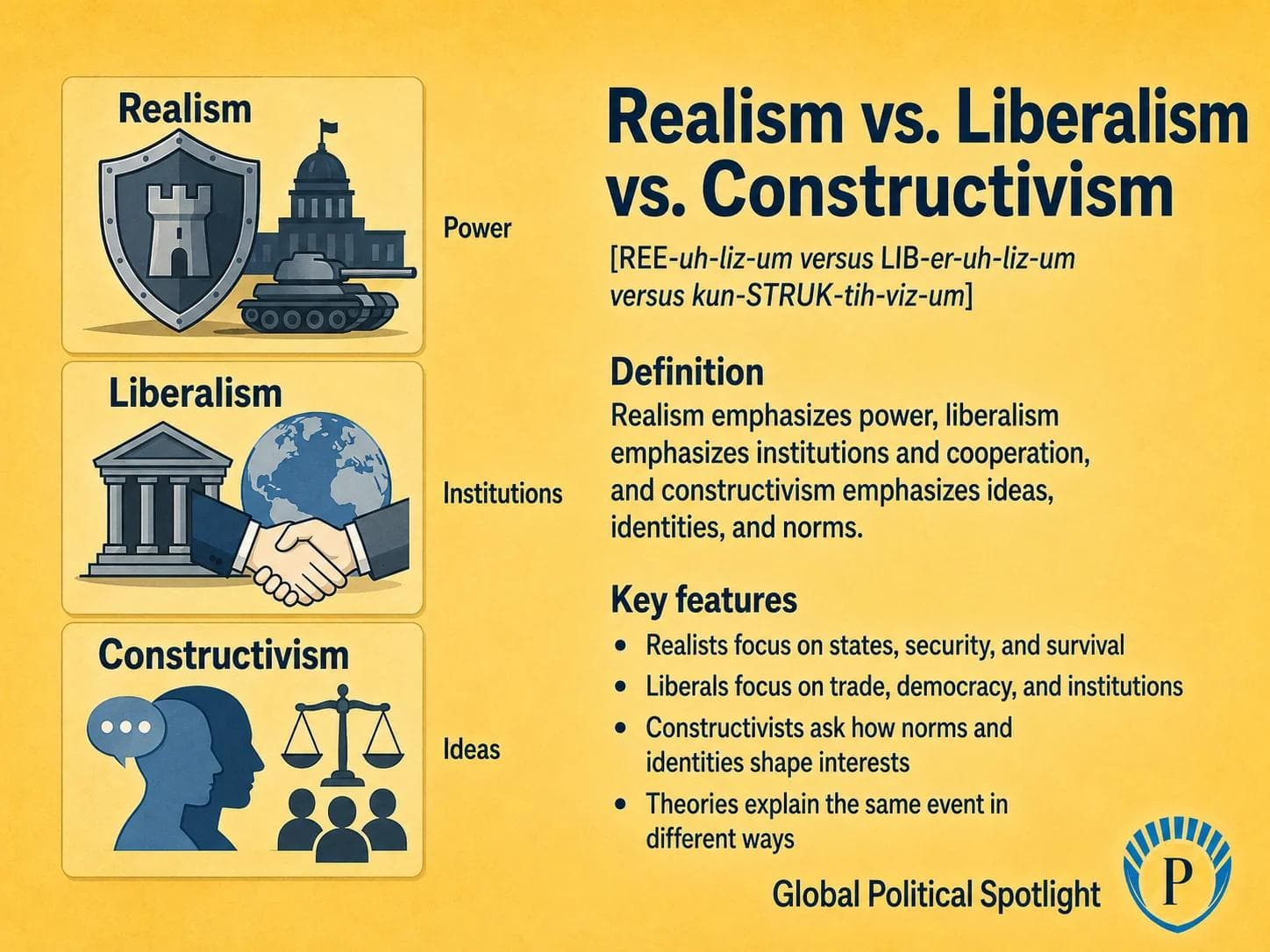
Definition
Realism, Liberalism, and Constructivism are three major theoretical approaches in international relations. They offer different explanations for why states act as they do, why conflict occurs, why cooperation sometimes works, and how international order changes over time.
Realism emphasizes power, security, survival, and competition in an anarchic international system where no central authority can reliably protect states. Liberalism emphasizes institutions, trade, democracy, law, and cooperation as ways to reduce conflict and manage interdependence.
Constructivism emphasizes the role of ideas, identities, norms, beliefs, and social meaning. It argues that state interests are not fixed only by material power, but are shaped by how actors understand themselves, others, and the rules of international life.
Why It Matters
These theories matter because the same global event can look very different depending on the analytical lens. A war may be explained by realists as a security dilemma, by liberals as institutional failure, and by constructivists as a clash of identities, narratives, or norms.
They also shape policy debates. Realist thinking often prioritizes deterrence and balance of power, liberal thinking highlights alliances and international institutions, and constructivist thinking draws attention to legitimacy, norms, recognition, and political identity.
GPS should track these theories as foundational analytical frameworks for interpreting great-power competition, alliance behavior, institutional reform, sanctions, conflict, diplomacy, sovereignty disputes, and norm change. The key analytical value is comparative: each theory highlights different drivers of behavior and can reveal different risks or policy choices.
Key Facts
- Concept type
- International relations theory
- Realism
- Focuses on power, security, survival, national interest, and competition under anarchy
- Liberalism
- Focuses on institutions, cooperation, democracy, trade, interdependence, and international law
- Constructivism
- Focuses on ideas, identities, norms, beliefs, and the social construction of interests
- Core contrast
- Realism emphasizes material power, Liberalism emphasizes rules and cooperation, and Constructivism emphasizes meaning and identity
- Policy relevance
- Theories influence debates over deterrence, alliances, institutions, diplomacy, legitimacy, and intervention
- Analytical use
- Different theories can explain the same event in different but complementary ways
- Important limit
- No single theory explains every case; strong analysis often compares several frameworks
FAQ
What is realism in international relations?
Realism is a theory that emphasizes power, security, survival, and competition among states. It assumes that the international system lacks a central authority, so states must protect themselves and pay close attention to relative power.
What is liberalism in international relations?
Liberalism argues that cooperation is possible through institutions, trade, democracy, law, diplomacy, and interdependence. It focuses on how rules and organizations can reduce uncertainty and manage conflict.
What is constructivism in international relations?
Constructivism argues that international politics is shaped by ideas, identities, norms, and shared meanings. It asks how states define their interests and how those definitions change over time.
How do the three theories explain war differently?
Realists often explain war through power competition and insecurity. Liberals may point to weak institutions, lack of democracy, or failed cooperation. Constructivists may emphasize hostile identities, nationalist narratives, norms, or perceptions of legitimacy.
Which international relations theory is correct?
No single theory is universally correct. Each highlights different mechanisms. Realism is strong for power politics, Liberalism for institutions and cooperation, and Constructivism for identity, norms, and changing interests.
Why do these theories matter for geopolitics?
They matter because they shape how analysts and policymakers interpret threats, alliances, institutions, diplomacy, sanctions, wars, and global order. Different theoretical assumptions can lead to different policy recommendations.
Recent Developments
U.S. strategy reflected several international relations lenses
The 2022 U.S. National Security Strategy combined realist concerns about major-power competition with liberal emphasis on alliances, institutions, democracy, and rule-based cooperation.
The White HouseNATO strategy linked deterrence, institutions, and shared values
NATO’s 2022 Strategic Concept illustrated how real-world strategy often mixes theoretical logics, including deterrence, collective defense, institutional cooperation, democratic values, and alliance identity.
NATOSources6 references
- Encyclopaedia Britannica
Reference overview of realism as a political and international relations theory.
- Encyclopaedia Britannica
Reference background on liberalism, including political ideas relevant to international cooperation and institutions.
- Oxford Research Encyclopedia of International Studies
Scholarly reference on constructivism in international relations.
- United Nations
Foundational institutional reference for liberal-institutional ideas about sovereign equality, cooperation, international law, and collective security.
- NATO
Institutional source useful for analyzing deterrence, alliance cooperation, collective defense, and shared political identity.
- The White House
Official strategy document showing how power competition, alliances, institutions, democracy, and norms appear together in contemporary policy.

GPSNews App
Read GPSNews on iPhone
Daily geopolitical briefings, government updates, and prediction signals in one focused app.
Newsletter
Stay Ahead Of The Next Signal
Get briefings in your inbox when new analysis and reports are published.