
NATO
A transatlantic military alliance built around collective defense under Article 5
NATO is a transatlantic military alliance of North American and European states based on collective defense under Article 5, deterrence, interoperability, and shared security planning.
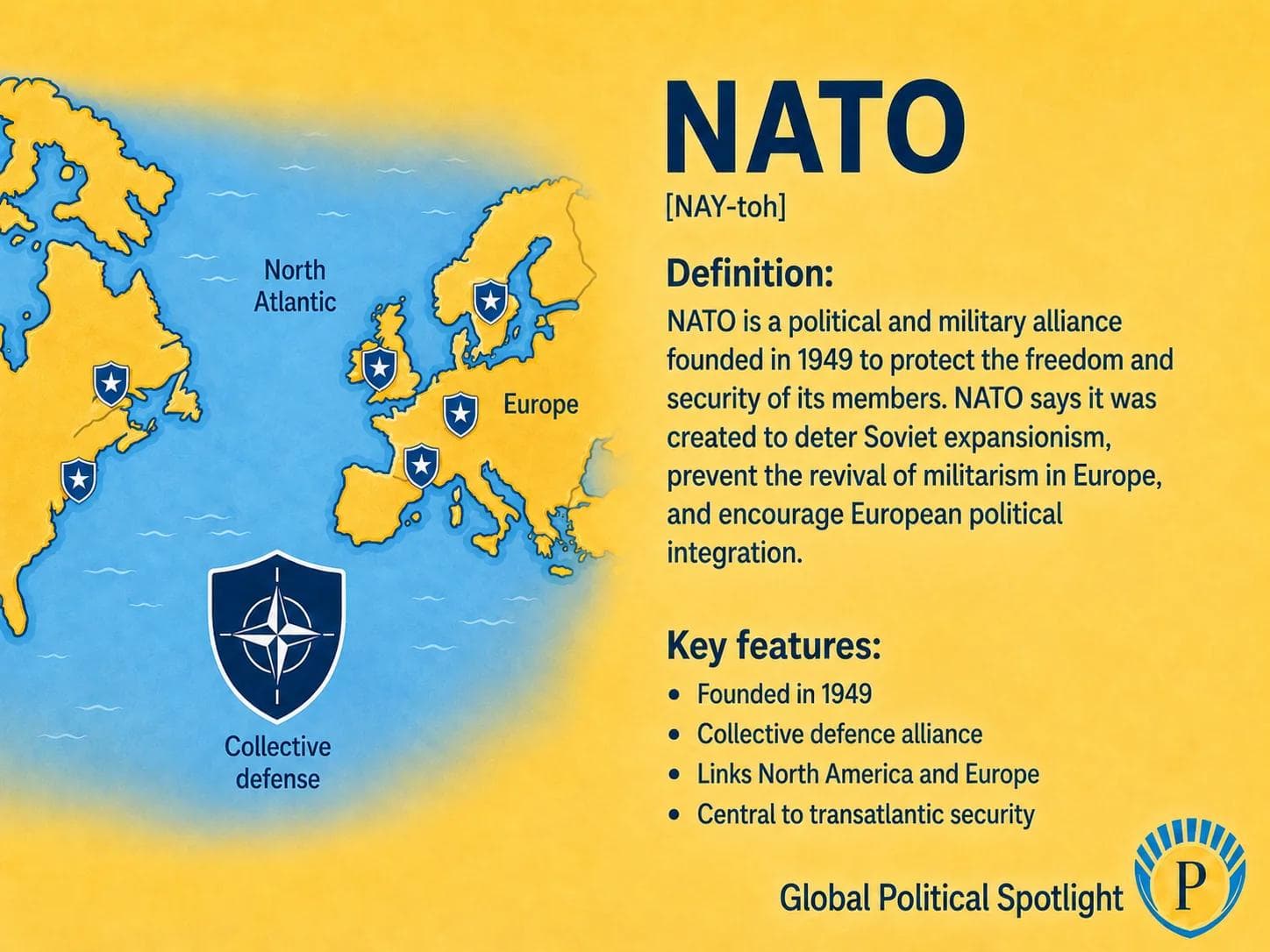
Definition
NATO, the North Atlantic Treaty Organization, is a transatlantic military alliance founded in 1949 by the North Atlantic Treaty. Its members are sovereign states in North America and Europe that cooperate on collective defense, deterrence, crisis management, military planning, interoperability, and security consultation.
The alliance's central commitment is Article 5, which says an armed attack against one or more members in Europe or North America shall be considered an attack against them all. NATO decisions are made by consensus, and each member decides how it contributes to collective defense.
Why It Matters
NATO matters because it is the core security alliance linking the United States, Canada, and Europe. Its deterrence posture shapes European security, defense spending, military planning, arms procurement, intelligence cooperation, and crisis response across the North Atlantic area.
NATO has become especially central to Russia-related security concerns after Russia's actions in Ukraine and broader tensions with the West. The alliance's eastern flank, enlargement decisions, forward deployments, air policing, missile defense, and readiness plans are key indicators of European military risk.
GPS should track NATO as the central transatlantic security alliance where Article 5 collective defense, U.S. military leadership, European defense capacity, deterrence, enlargement, eastern flank deployments, interoperability, and Russia-related security concerns intersect. Key watchpoints include summit declarations, defense spending commitments, force posture changes, air and missile defense plans, Ukraine support frameworks, enlargement debates, U.S. policy shifts, and member-state disagreements over burden sharing or escalation risk.
Key Facts
- Type
- Transatlantic military alliance
- Founded
- 1949, under the North Atlantic Treaty
- Headquarters
- Brussels, Belgium
- Collective defense clause
- Article 5 treats an armed attack against one or more allies as an attack against all
- Membership
- 32 member states after Finland joined in 2023 and Sweden joined in 2024
- Dominant military actor
- The United States provides a large share of NATO's military capabilities, nuclear deterrence, strategic lift, intelligence, and command capacity
- Core functions
- Deterrence and defense, crisis prevention and management, cooperative security, interoperability, and political consultation
- Strategic focus
- European security, the eastern flank, Russia-related threats, resilience, cyber defense, and long-term military readiness
FAQ
What is NATO?
NATO is the North Atlantic Treaty Organization, a military alliance of North American and European states founded in 1949. It is built around collective defense, deterrence, military interoperability, and political consultation.
What is Article 5 of NATO?
Article 5 is NATO's collective-defense clause. It says that an armed attack against one or more NATO members in Europe or North America shall be considered an attack against them all, though each ally decides what actions it takes in response.
How many countries are in NATO?
NATO has 32 member states after Finland joined in 2023 and Sweden joined in 2024. Members include the United States, Canada, and many European countries.
Why is the United States important to NATO?
The United States is NATO's largest military power and provides major capabilities in nuclear deterrence, intelligence, strategic transport, command systems, air power, and reinforcement capacity. U.S. policy is therefore central to alliance credibility.
What is NATO's eastern flank?
NATO's eastern flank refers to allied territory closest to Russia, Belarus, and the Black Sea region, including states such as Poland, the Baltic countries, Romania, Bulgaria, Slovakia, Hungary, and Finland. It is a major focus of deterrence and forward defense planning.
Is NATO only a military organization?
NATO is primarily a military alliance, but it is also a political organization. Members consult on security issues, set strategic concepts, coordinate defense planning, support resilience, and work on areas such as cyber defense, hybrid threats, and partnerships.
Recent Developments
Sweden became NATO's 32nd member
Sweden formally joined NATO in March 2024, completing a major enlargement step after Finland's accession in 2023 and reshaping alliance geography in Northern Europe and the Baltic Sea region.
NATONATO leaders adopted the Washington Summit Declaration
At the 2024 Washington Summit, NATO leaders emphasized deterrence and defense, support for Ukraine, defense spending, industrial capacity, resilience, and the alliance's long-term approach to Russia-related security concerns.
NATOSources6 references
- NATO
Official NATO overview of the alliance, its purpose, membership, and core tasks.
- North Atlantic Treaty
Official text of the 1949 North Atlantic Treaty, including Article 5.
- NATO Article 5
Official NATO explanation of collective defense and Article 5.
- NATO Member Countries
Official NATO page listing member countries and accession history.
- NATO Washington Summit Declaration
Official 2024 summit declaration outlining NATO's contemporary security priorities.
- NATO Strategic Concept
Official NATO Strategic Concept describing the alliance's security environment, core tasks, and threat assessment.

GPSNews App
Read GPSNews on iPhone
Daily geopolitical briefings, government updates, and prediction signals in one focused app.
Newsletter
Stay Ahead Of The Next Signal
Get briefings in your inbox when new analysis and reports are published.