
Soft Power vs. Hard Power
Two ways states influence others: attraction and legitimacy, or coercion and pressure
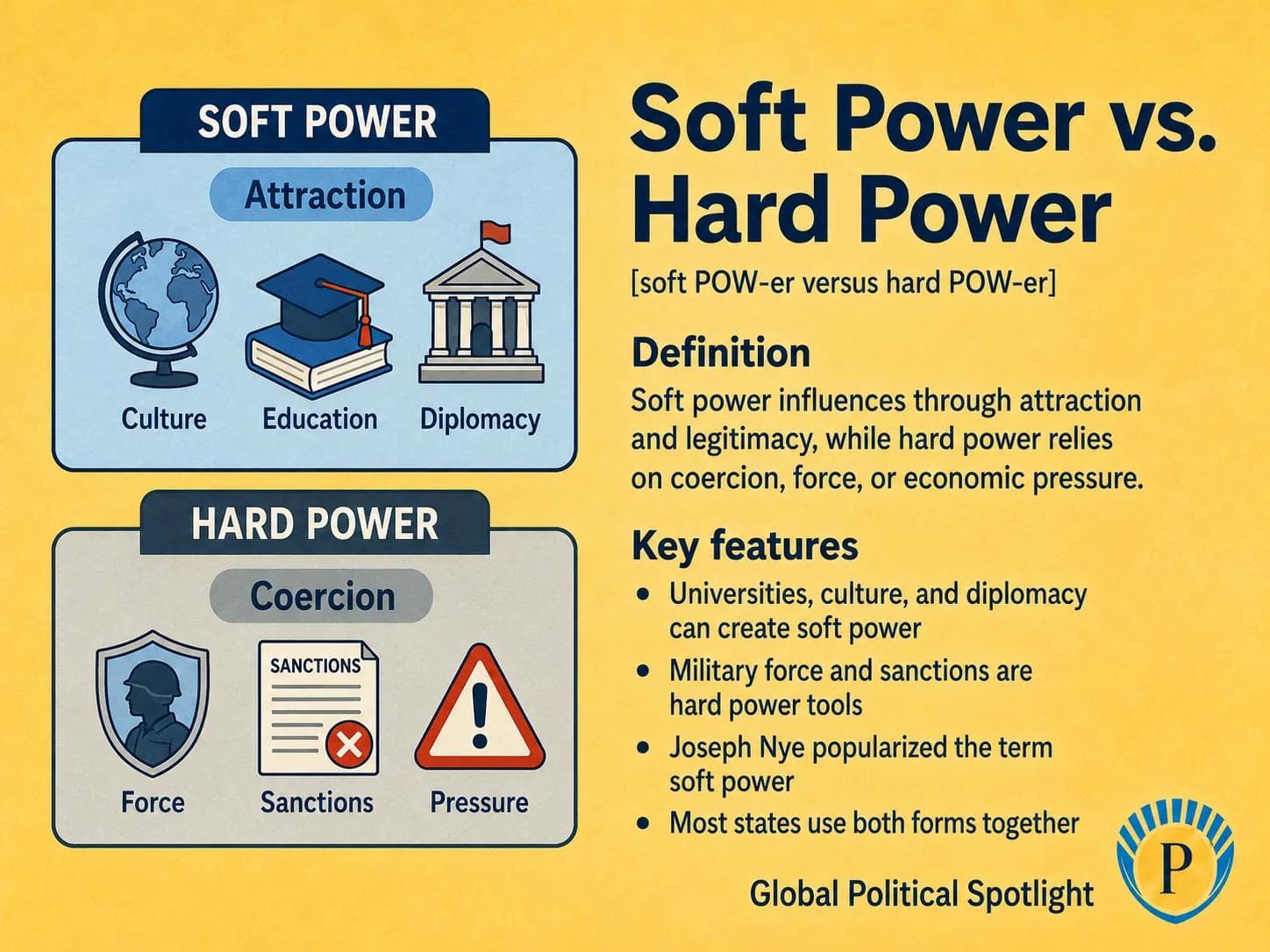
Soft power is influence through attraction, legitimacy, culture, values, and diplomacy, while hard power relies on coercion through military force, sanctions, or economic pressure.
Definition
Soft power is the ability of a state or political actor to influence others through attraction, legitimacy, culture, values, education, diplomacy, institutions, and reputation. The term is closely associated with political scientist Joseph Nye, who used it to describe a form of power based on getting others to want outcomes that align with one’s preferences.
Hard power is influence based on coercion, pressure, or material inducements. It includes military force, military threats, sanctions, economic pressure, security guarantees, aid conditionality, and other tools that change behavior by raising costs or offering direct incentives.
In practice, states rarely use only one form of power. Foreign policy often combines soft and hard power through alliances, public diplomacy, trade policy, development aid, defense partnerships, sanctions, cultural outreach, and institutional leadership.
Why It Matters
The distinction matters because influence is not only about military strength or economic size. States can gain support when others see them as legitimate, attractive, competent, or normatively persuasive, but they may also rely on coercive tools when persuasion fails or when security interests are urgent.
Soft and hard power shape alliances, sanctions, public diplomacy, development finance, military intervention, technology competition, cultural influence, and international reputation. A state’s effectiveness often depends on whether its coercive tools and attractive qualities reinforce or undermine each other.
GPS should track soft and hard power as complementary tools of influence in foreign policy. The key analytical issue is whether a state is gaining compliance through coercion, attraction, legitimacy, economic leverage, institutional leadership, or a combination of these mechanisms, and whether its methods strengthen or weaken long-term influence.
Key Facts
- Concept type
- Foreign policy and international relations theory
- Soft power
- Influence through attraction, legitimacy, culture, values, education, diplomacy, and reputation
- Hard power
- Influence through coercion, force, sanctions, threats, economic pressure, or material incentives
- Key thinker
- Joseph Nye popularized the term soft power in international relations
- Soft power tools
- Public diplomacy, cultural exchange, universities, media, foreign aid, institutions, values, and international reputation
- Hard power tools
- Military force, defense guarantees, sanctions, tariffs, coercive diplomacy, and economic leverage
- Combined strategy
- Most states use a mixture of soft and hard power depending on context, capabilities, and political objectives
- Important limit
- Soft power is difficult to control directly, while hard power can achieve compliance but may damage legitimacy or trust
FAQ
What is soft power?
Soft power is the ability to influence others through attraction and legitimacy rather than coercion. It can come from culture, values, education, diplomacy, reputation, institutions, and political credibility.
What is hard power?
Hard power is influence based on coercion, pressure, or material incentives. It includes military force, threats, sanctions, economic pressure, tariffs, security guarantees, and aid conditionality.
Who coined the term soft power?
The term soft power is closely associated with Joseph Nye, who popularized it in international relations to describe the ability to shape others’ preferences through attraction rather than coercion.
What is the difference between soft power and hard power?
Soft power works through attraction, legitimacy, and persuasion, while hard power works through coercion, pressure, or direct material incentives. Soft power makes others want to cooperate; hard power changes the costs of not cooperating.
Can a country use both soft power and hard power?
Yes. Most countries use both. A state may use cultural diplomacy, education exchanges, and international institutions while also maintaining military alliances, sanctions tools, defense capabilities, and economic leverage.
Why does soft power matter in geopolitics?
Soft power matters because states often need legitimacy, trust, and voluntary cooperation to sustain influence. Military and economic pressure may produce short-term compliance, but attraction and credibility can shape long-term partnerships.
Recent Developments
U.S. strategy combined hard-power competition with alliance and values-based influence
The 2022 U.S. National Security Strategy emphasized military strength, economic tools, alliances, democracy, technology, and institutional cooperation, illustrating how foreign policy often combines hard and soft power.
The White HouseGlobal soft power rankings continued to track reputation as a source of influence
Recent soft power indices continued to assess national influence through reputation, culture, governance, education, business, media, and international engagement, reflecting the continuing policy interest in attraction-based power.
Brand FinanceSources6 references
- Joseph S. Nye Jr.
Foundational article associated with the concept of soft power in international relations.
- Encyclopaedia Britannica
Reference overview of soft power and its role in international relations.
- The White House
Official U.S. strategy document showing the use of military, economic, alliance, institutional, and values-based influence.
- United Nations
Foundational institutional reference for diplomacy, cooperation, sovereignty, and peaceful relations among states.
- U.S. Department of State
Official reference on public diplomacy, a major soft-power tool.
- Council on Foreign Relations
Reference overview of economic sanctions as a coercive foreign policy instrument often associated with hard power.

GPSNews App
Read GPSNews on iPhone
Daily geopolitical briefings, government updates, and prediction signals in one focused app.
Newsletter
Stay Ahead Of The Next Signal
Get briefings in your inbox when new analysis and reports are published.