
Coercive Diplomacy
Using threats, pressure, or limited force to persuade an actor to change behavior
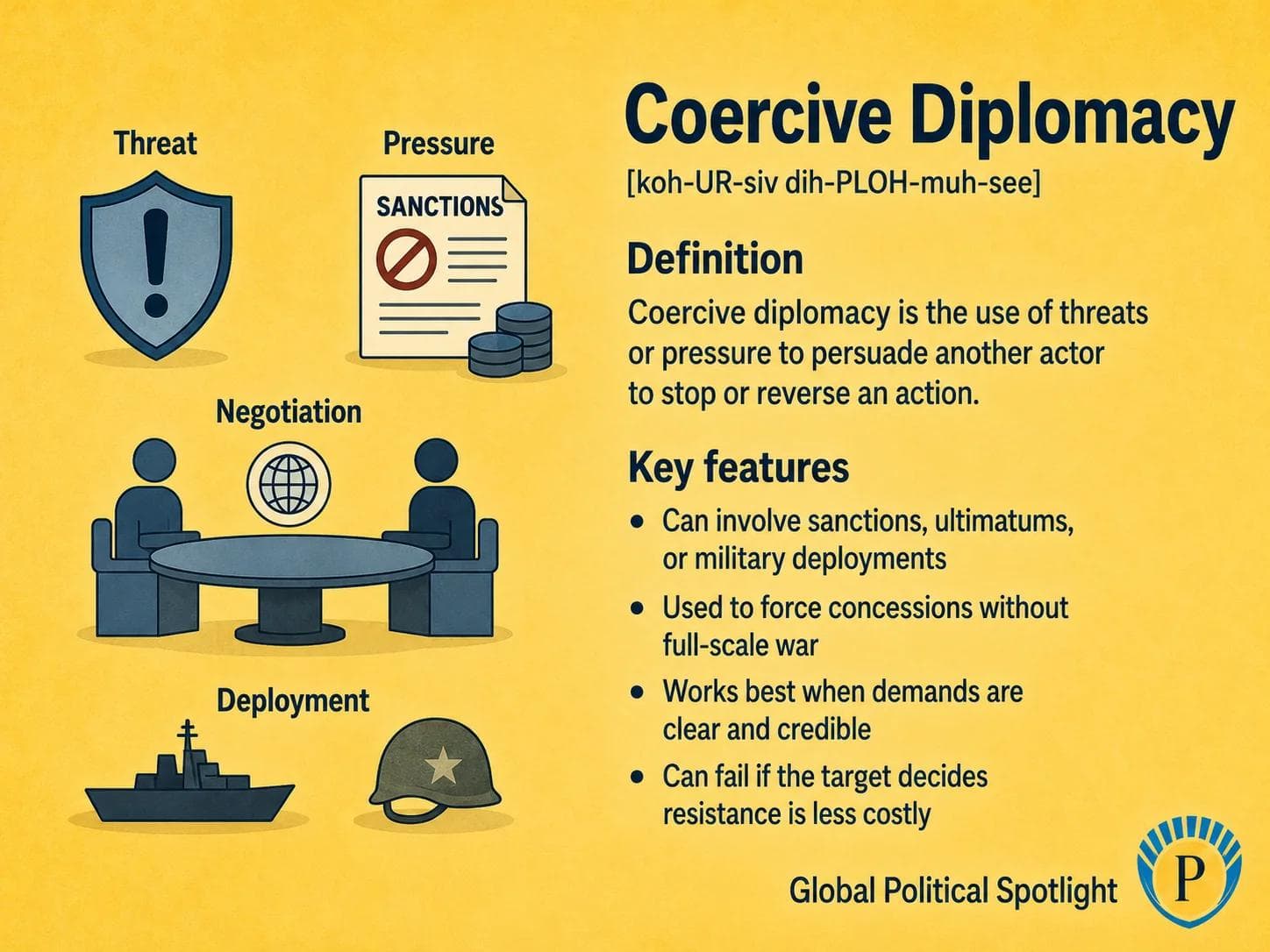
Coercive diplomacy is the use of threats, pressure, or limited force to persuade another actor to stop, reverse, or alter an action without resorting to full-scale war.
Definition
Coercive diplomacy is a strategy that uses threats, pressure, or limited force to persuade another actor to stop, reverse, or modify an action. It is different from pure persuasion because it relies on the possibility of punishment if the target refuses to comply.
The tools of coercive diplomacy can include sanctions, ultimatums, military deployments, naval blockades, air patrols, cyber warnings, diplomatic isolation, or threats of limited military action. The goal is usually to force concessions while avoiding the costs and risks of full-scale war.
Successful coercive diplomacy depends on clear demands, credible threats, proportional pressure, and a target that believes compliance is less costly than resistance. It can fail when threats are not credible, demands are unclear, or the target values resistance more than avoiding punishment.
Why It Matters
Coercive diplomacy matters because it sits between negotiation and war. States often use it when they want to change another actor's behavior but do not want to begin a large-scale military conflict.
It is central to sanctions policy, crisis bargaining, deterrence, arms-control disputes, maritime confrontations, and regional security crises. The same pressure that can create leverage can also increase escalation risk if the target responds defiantly.
For international order, coercive diplomacy raises recurring questions about legitimacy, proportionality, sovereignty, alliance coordination, and the line between lawful pressure and unlawful threats or use of force.
Coercive diplomacy is a key GPS concept for analyzing how states try to alter behavior through pressure short of full-scale war. GPS should track the clarity of demands, credibility of threats, available off-ramps, alliance coordination, target resolve, domestic political constraints, and whether coercive tools are producing compliance, resistance, or escalation.
Key Facts
- Type
- Conflict management and bargaining strategy
- Core idea
- Using threats or pressure to persuade another actor to change behavior
- Main goal
- To force concessions without immediately resorting to full-scale war
- Common tools
- Sanctions, ultimatums, military deployments, diplomatic isolation, limited force, and economic pressure
- Key requirement
- The target must believe that non-compliance will be more costly than compliance
- Success factors
- Clear demands, credible threats, proportional pressure, timing, communication, and a plausible exit path
- Main risk
- Pressure can provoke resistance, nationalism, counter-escalation, or military confrontation
- Related concepts
- Deterrence, compellence, sanctions, brinkmanship, coercion, and crisis bargaining
FAQ
What is coercive diplomacy?
Coercive diplomacy is the use of threats, pressure, or limited force to persuade another actor to stop, reverse, or change an action without immediately resorting to full-scale war.
How is coercive diplomacy different from deterrence?
Deterrence usually tries to prevent an actor from taking an action in the first place. Coercive diplomacy often tries to make an actor stop or reverse something it has already done, though the two concepts can overlap.
What tools are used in coercive diplomacy?
Common tools include sanctions, ultimatums, military deployments, naval patrols, limited strikes, diplomatic isolation, cyber pressure, aid conditionality, and threats of future punishment.
When does coercive diplomacy succeed?
It is more likely to succeed when demands are clear, threats are credible, pressure is proportional, the target has a face-saving exit, and the cost of resistance appears higher than the cost of compliance.
Why does coercive diplomacy fail?
It can fail when threats lack credibility, demands are too broad, the target doubts the coercer's resolve, domestic politics reward resistance, or the target believes surrender would be more dangerous than punishment.
Is coercive diplomacy legal under international law?
It depends on the tools used. Diplomatic pressure and many sanctions can be lawful, while threats or uses of force are constrained by the UN Charter and other rules of international law. Legality often depends on authorization, self-defense claims, proportionality, and the specific facts of the case.
Recent Developments
Western states expanded sanctions after Russia's full-scale invasion of Ukraine
The United States, European Union, United Kingdom, and partners imposed broad sanctions and export controls on Russia after its full-scale invasion of Ukraine, illustrating how economic coercion can become a central tool of crisis response.
European CouncilU.S. military deployments sought to deter wider regional escalation
After the October 2023 Hamas attacks on Israel and the subsequent Gaza war, the United States deployed additional military assets to the region, describing part of the posture as intended to deter broader escalation by regional actors.
U.S. Department of DefenseSources6 references
- United Nations Charter
Primary source for international legal principles on sovereignty, peaceful settlement of disputes, and limits on threats or use of force.
- European Council
Institutional overview of EU sanctions as a foreign policy tool.
- U.S. Department of the Treasury
Official U.S. source for sanctions programs and economic pressure instruments.
- NATO
Institutional background on deterrence and defense, relevant to military signaling and coercive pressure.
- RAND Corporation
Research background on deterrence, coercion, and strategic bargaining.
- Encyclopaedia Britannica
Reference background on diplomacy as a tool of statecraft and international relations.

GPSNews App
Read GPSNews on iPhone
Daily geopolitical briefings, government updates, and prediction signals in one focused app.
Newsletter
Stay Ahead Of The Next Signal
Get briefings in your inbox when new analysis and reports are published.