
Non-Alignment / Strategic Autonomy
Foreign policy independence in a world of competing blocs and great powers
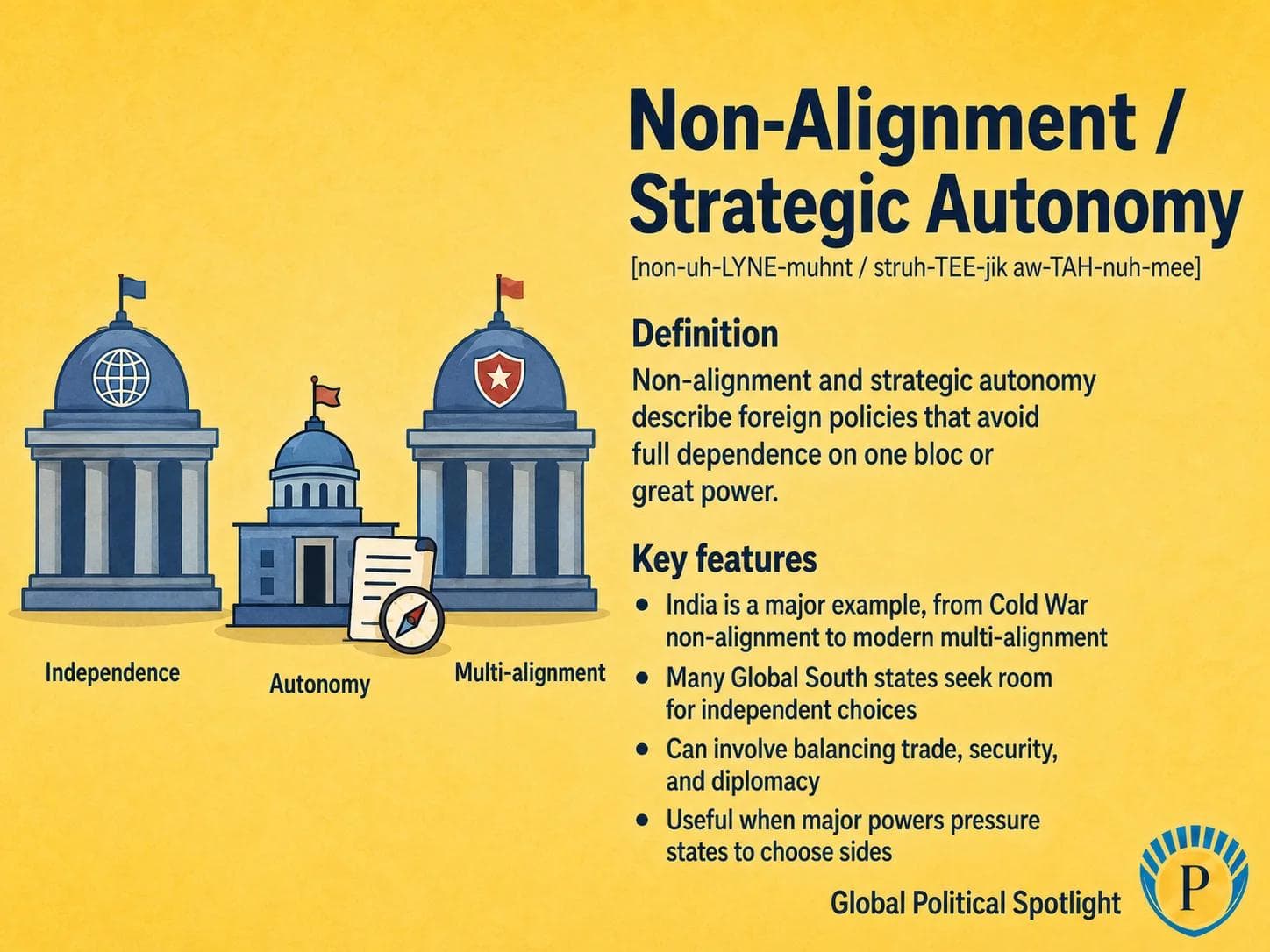
Non-alignment and strategic autonomy describe foreign policies that avoid full dependence on any single bloc or great power while preserving room for independent choices.
Definition
Non-alignment is a foreign policy approach that avoids formal alignment with competing great-power blocs. It became especially important during the Cold War, when many newly independent states sought to avoid automatic dependence on either the U.S.-led or Soviet-led bloc.
Strategic autonomy is the capacity of a state to make major foreign, security, economic, and technological choices without being fully constrained by another power. It does not always mean neutrality; states may cooperate closely with several partners while trying to preserve independent decision-making.
India is often cited as both a historical example of non-alignment and a modern example of strategic autonomy. Many Global South states also use similar approaches to balance trade, security, development finance, energy needs, and diplomatic flexibility.
Why It Matters
Non-alignment and strategic autonomy matter because they shape how states respond when major powers pressure them to choose sides. States may seek security cooperation with one partner, energy or trade ties with another, and diplomatic independence in international institutions.
The concepts are especially relevant in a more contested international order, where sanctions, technology controls, defense partnerships, development finance, supply chains, and voting behavior at the United Nations can all become tests of alignment.
GPS should track non-alignment and strategic autonomy as frameworks for understanding how middle powers and Global South states navigate U.S.-China competition, Russia relations, energy security, sanctions pressure, defense procurement, technology dependencies, and multilateral voting. The key analytical issue is whether a state can diversify partnerships without losing credibility, security access, or economic leverage.
Key Facts
- Concept type
- Foreign policy strategy
- Non-alignment
- Avoiding formal dependence on one major power bloc
- Strategic autonomy
- Preserving independent decision-making in security, diplomacy, trade, technology, and development policy
- Cold War context
- Non-alignment became prominent among states that did not want to join either the U.S.-led or Soviet-led bloc
- Common example
- India is often cited as a leading historical and contemporary example
- Global South relevance
- Many states use flexible partnerships to balance development needs, security ties, energy supplies, and diplomatic independence
- Policy tradeoff
- Autonomy can increase flexibility but may also create pressure from partners demanding clearer alignment
- Important limit
- Strategic autonomy is constrained by geography, economic dependence, military capability, debt exposure, technology access, and alliance commitments
FAQ
What is non-alignment in international relations?
Non-alignment is a foreign policy approach that avoids formal alignment with a major power bloc. It became prominent during the Cold War among states that did not want to be fully tied to either the United States or the Soviet Union.
What is strategic autonomy?
Strategic autonomy is the ability of a state to make important foreign, security, economic, and technological decisions independently, without being fully dependent on another power or alliance.
Is strategic autonomy the same as neutrality?
No. A strategically autonomous state may cooperate with alliances, buy weapons from one partner, trade heavily with another, or support some international initiatives. The key point is preserving room for independent choice rather than staying neutral in every dispute.
Why is India often linked to non-alignment and strategic autonomy?
India was a leading figure in the Non-Aligned Movement during the Cold War and continues to pursue diversified partnerships today, including security cooperation with Western states, historical defense ties with Russia, and independent positions in multilateral forums.
Why do many Global South states value strategic autonomy?
Many Global South states value strategic autonomy because it lets them seek development finance, energy access, trade opportunities, security partnerships, and diplomatic flexibility without being locked into one bloc’s priorities.
What are the limits of non-alignment?
Non-alignment can be constrained by military dependence, debt, trade exposure, geographic threats, sanctions risk, technology access, and domestic politics. In major crises, powerful states may still pressure non-aligned countries to take clearer positions.
Recent Developments
G20 New Delhi declaration reflected Global South diplomatic balancing
The G20 New Delhi Leaders’ Declaration highlighted development, debt, climate, food security, and multilateral reform priorities, illustrating how major emerging states seek agenda-setting influence without simple bloc alignment.
G20 IndiaNon-Aligned Movement summit emphasized sovereignty and independent development choices
The Kampala summit of the Non-Aligned Movement continued to frame sovereignty, development, multilateralism, and resistance to domination as central themes for states seeking policy independence.
Non-Aligned Movement Uganda 2024Sources6 references
- Non-Aligned Movement
Official host site for the 19th Summit of the Non-Aligned Movement in Uganda, useful for contemporary NAM themes and declarations.
- United Nations
Foundational institutional reference for sovereignty, sovereign equality, and peaceful cooperation among states.
- India Ministry of External Affairs
Official source for India’s foreign policy statements, diplomatic engagements, and multilateral positioning.
- European Union External Action Service
Official EU reference relevant to debates over strategic autonomy, security cooperation, and external action.
- G20 India
Primary summit declaration showing development, multilateral reform, and Global South priorities in a major diplomatic forum.
- Encyclopaedia Britannica
Reference overview of the Non-Aligned Movement and its Cold War origins.

GPSNews App
Read GPSNews on iPhone
Daily geopolitical briefings, government updates, and prediction signals in one focused app.
Newsletter
Stay Ahead Of The Next Signal
Get briefings in your inbox when new analysis and reports are published.