
Deterrence
Discouraging an opponent by making aggression look too costly or risky
Deterrence is the use of credible threats, defensive capabilities, or promised retaliation to discourage an opponent from taking an unwanted action.
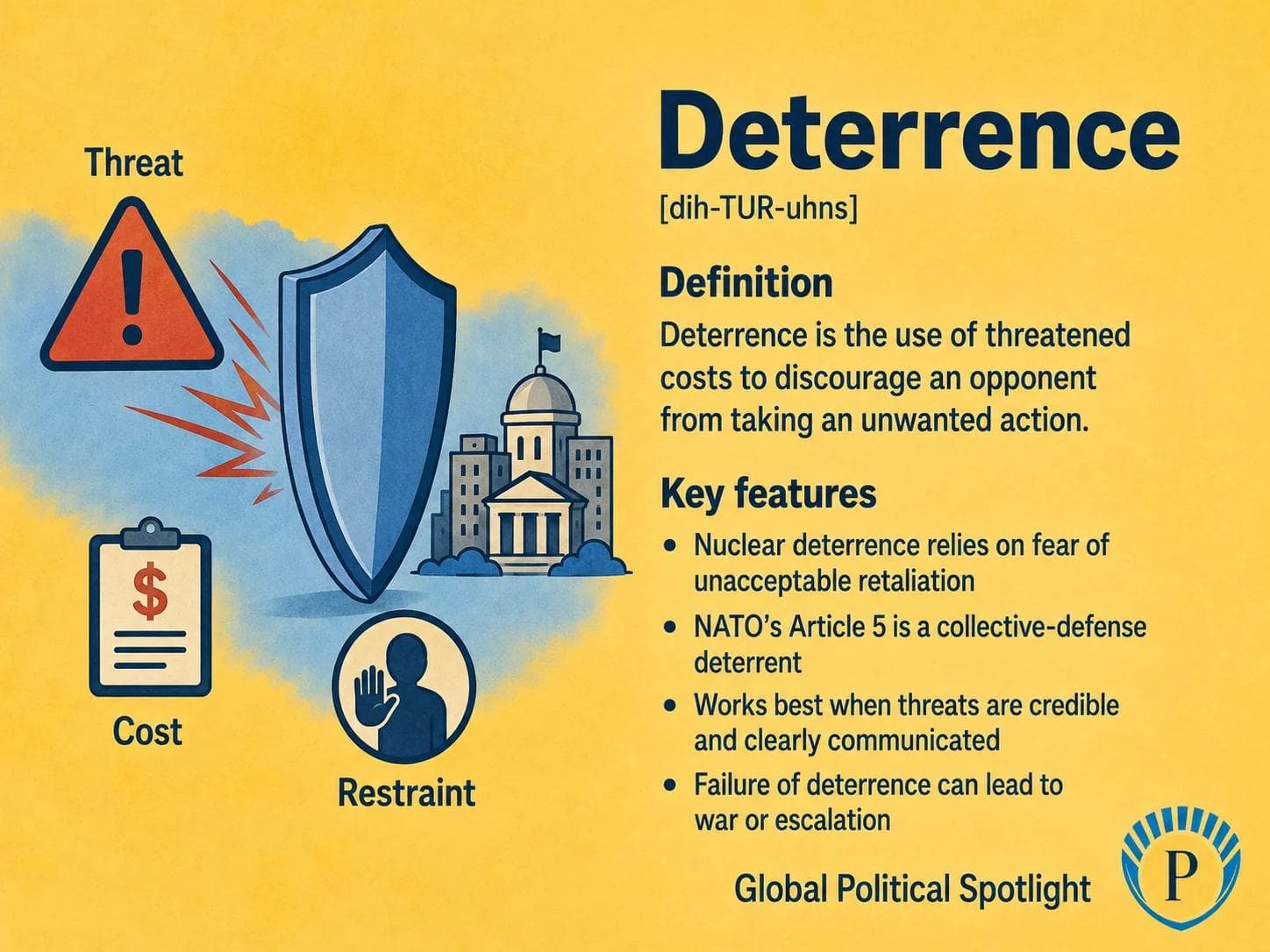
Definition
Deterrence is a strategy for preventing an unwanted action by making the expected costs, risks, or consequences of that action appear too high. In international security, it often means convincing a potential aggressor that attack, coercion, or escalation would trigger punishment, military resistance, or wider political costs.
Deterrence can rely on punishment, such as the threat of retaliation, or denial, such as making an attack unlikely to succeed. Nuclear deterrence relies heavily on fear of catastrophic retaliation, while conventional deterrence often depends on forward deployments, alliance commitments, air defense, naval presence, and rapid reinforcement.
For deterrence to work, the threat must usually be credible, clearly communicated, and backed by capability. Deterrence can fail if an opponent doubts resolve, misreads signals, underestimates costs, or believes it can achieve objectives quickly before outside actors respond.
Why It Matters
Deterrence is central to alliance politics, military planning, nuclear strategy, and crisis management. It helps explain why states position forces, issue warnings, maintain reserve capabilities, conduct exercises, and make collective-defense commitments even when they are trying to avoid war.
The concept matters because deterrence is both stabilizing and risky. It can prevent aggression by raising expected costs, but failed deterrence can lead to war, and overly aggressive signaling can increase escalation risks during crises.
GPS should track deterrence as a core mechanism behind alliance commitments, nuclear posture, forward military deployments, arms control debates, air and missile defense, cyber strategy, and crisis signaling. The key analytical questions are whether threats are credible, whether communication is clear, whether capabilities match commitments, and whether adversaries interpret the signal as intended.
Key Facts
- Concept type
- Security strategy and military doctrine
- Core mechanism
- Discouraging action by threatening costs, retaliation, or denial of success
- Main forms
- Deterrence by punishment and deterrence by denial
- Nuclear role
- Nuclear deterrence relies on fear of catastrophic retaliation
- Alliance example
- NATO Article 5 is a collective-defense commitment intended to deter attacks on member states
- Credibility requirement
- A deterrent threat must be believable and supported by capability, resolve, and communication
- Failure risk
- Deterrence can fail when opponents miscalculate, doubt resolve, or believe they can act before costs are imposed
- Important limit
- Deterrence cannot remove conflict incentives; it only changes how actors assess costs, risks, and likely responses
FAQ
What is deterrence in geopolitics?
Deterrence is a strategy that tries to prevent an opponent from taking an unwanted action by making the expected costs, risks, or consequences appear too high.
What is deterrence by punishment?
Deterrence by punishment means discouraging aggression by threatening retaliation after the action occurs. Nuclear deterrence is the clearest example because it relies on the fear of devastating retaliatory consequences.
What is deterrence by denial?
Deterrence by denial means discouraging aggression by making it unlikely to succeed. Examples include air defense systems, fortified positions, forward-deployed forces, cyber resilience, and rapid reinforcement plans.
How does NATO Article 5 support deterrence?
NATO Article 5 states that an armed attack against one or more members shall be considered an attack against them all. This collective-defense commitment is intended to deter aggression by raising the risk that an attack on one member could trigger a wider alliance response.
Why does deterrence fail?
Deterrence can fail if the opponent doubts the threat, misreads signals, believes the defender lacks resolve, expects a quick victory, or accepts the risk of punishment because the objective is highly valuable.
Is deterrence the same as defense?
No. Defense is the ability to resist or defeat an attack. Deterrence is the effort to prevent the attack from happening in the first place. Strong defense can support deterrence, but the two concepts are not identical.
Recent Developments
NATO reaffirmed deterrence and defense as core alliance tasks
NATO’s 2022 Strategic Concept emphasized deterrence and defense as central responsibilities in a more contested security environment, including collective defense, forward presence, resilience, and nuclear deterrence.
NATOU.S. nuclear posture emphasized deterrence and extended deterrence
The 2022 U.S. Nuclear Posture Review described nuclear weapons as intended to deter strategic attacks and support extended deterrence commitments to allies.
U.S. Department of DefenseSources6 references
- NATO
Institutional reference on NATO deterrence, defense, collective security, and the alliance’s strategic posture.
- NATO
Official NATO explainer on deterrence and defence, including conventional, nuclear, and missile-defense elements.
- U.S. Department of Defense
Official U.S. defense strategy document including the Nuclear Posture Review and Missile Defense Review.
- U.S. Department of State
Official reference on nuclear risk reduction and strategic stability, relevant to deterrence and escalation management.
- Encyclopaedia Britannica
Reference overview of deterrence as a political and military strategy.
- RAND Corporation
Research overview on deterrence theory, military strategy, and security policy.

GPSNews App
Read GPSNews on iPhone
Daily geopolitical briefings, government updates, and prediction signals in one focused app.
Newsletter
Stay Ahead Of The Next Signal
Get briefings in your inbox when new analysis and reports are published.