
Weaponized Interdependence
How control over global networks can become geopolitical leverage
Weaponized interdependence is the strategic use of control over global networks, finance, supply chains, data, or infrastructure to gain political or economic leverage.
Definition
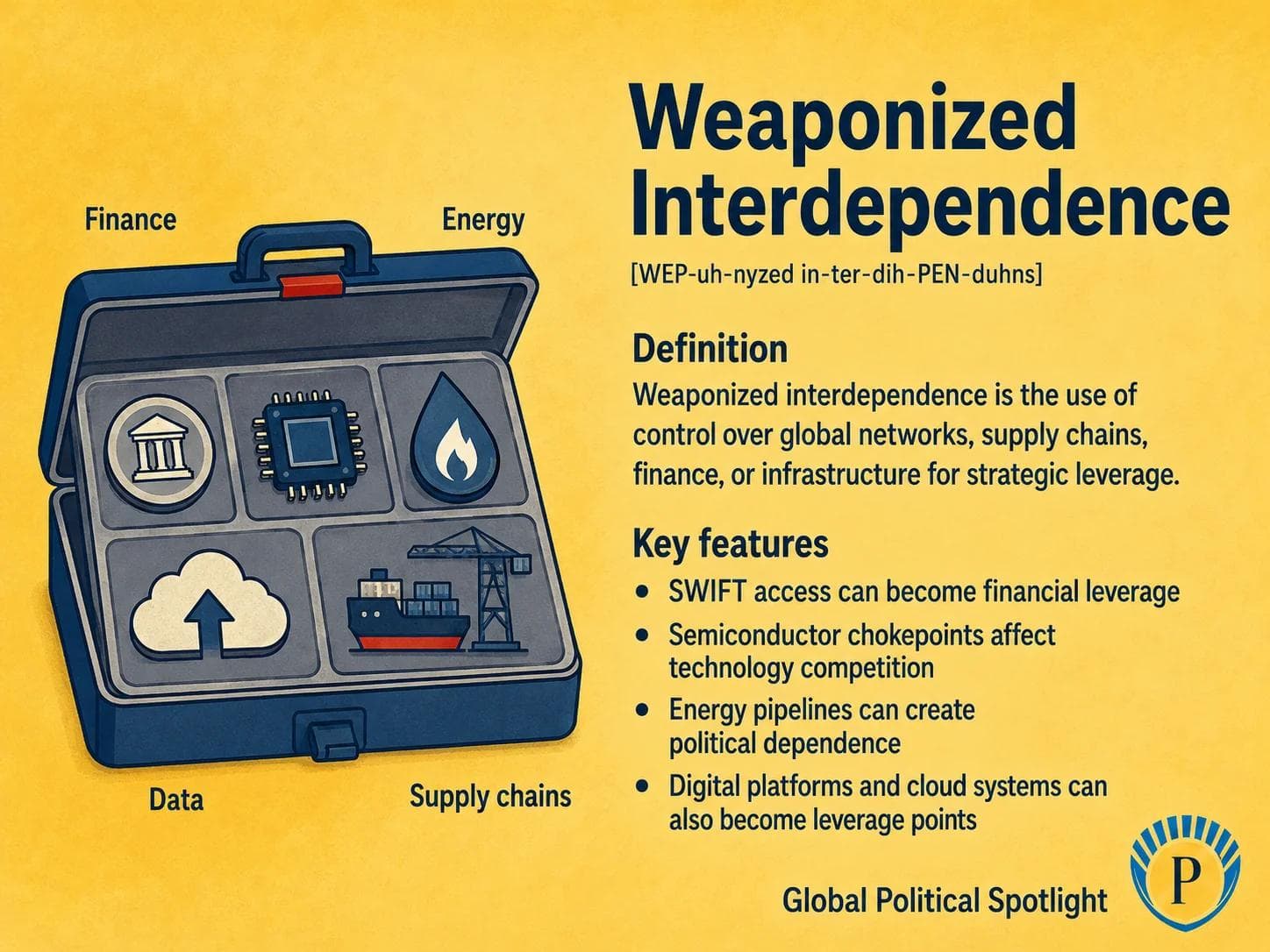
Weaponized interdependence is the use of control over global economic, financial, technological, or infrastructure networks to gain leverage over other states or firms. It turns the benefits of connectivity into instruments of pressure, surveillance, exclusion, or strategic advantage.
The concept is often applied to networks where a small number of actors occupy central positions. These can include financial messaging systems, payment infrastructure, semiconductor supply chains, cloud platforms, undersea cables, ports, energy pipelines, shipping routes, and critical minerals processing.
Weaponized interdependence does not mean all trade or connectivity is coercive. It refers to situations where asymmetric dependence and network centrality allow powerful actors to restrict access, monitor flows, impose sanctions, or create strategic costs for others.
Why It Matters
The concept matters because modern power is not only military. States that control key nodes in finance, technology, logistics, data, or energy can influence the choices of others without using force. This makes supply chains and infrastructure part of geopolitical strategy.
Weaponized interdependence also explains why states pursue resilience, reshoring, friend-shoring, export controls, sanctions evasion, digital sovereignty, energy diversification, and alternative payment systems. Reducing vulnerability can become as important as gaining efficiency.
GPS should track weaponized interdependence as a framework for analyzing sanctions, export controls, semiconductor chokepoints, energy dependencies, payment networks, data infrastructure, cloud platforms, undersea cables, shipping lanes, and supply-chain resilience. The key analytical issue is which actors control critical nodes and whether dependence can be converted into coercive leverage.
Key Facts
- Concept type
- Economic statecraft and network power
- Core mechanism
- Using control over global networks or chokepoints to create political, economic, or security leverage
- Key domains
- Finance, energy, data, technology, logistics, ports, supply chains, and critical infrastructure
- Financial example
- Access to payment systems, correspondent banking, dollar clearing, and SWIFT messaging can become sanctions leverage
- Technology example
- Semiconductor design tools, advanced chips, manufacturing equipment, and foundry capacity can create strategic chokepoints
- Energy example
- Pipeline routes, gas supplies, oil chokepoints, electricity grids, and LNG infrastructure can create asymmetric dependence
- Policy response
- States often respond through diversification, export controls, sanctions planning, stockpiles, friend-shoring, and resilience strategies
- Important limit
- Weaponizing networks can create backlash, encourage alternatives, raise costs for allies, and reduce long-term trust in the system
FAQ
What is weaponized interdependence?
Weaponized interdependence is the use of control over global networks, infrastructure, finance, supply chains, data, or technology to gain leverage over other states, firms, or institutions.
Why does interdependence create geopolitical power?
Interdependence creates power when one actor controls a critical node that others need. If a country, firm, or alliance can restrict access to that node, it can impose costs without using direct military force.
What are examples of weaponized interdependence?
Examples include financial sanctions linked to SWIFT or dollar clearing, semiconductor export controls, energy pipeline leverage, restrictions on digital platforms, port access, critical minerals processing, and control over key supply-chain inputs.
Is weaponized interdependence the same as sanctions?
No. Sanctions are one possible tool. Weaponized interdependence is broader because it also includes technology controls, data access, infrastructure dependency, supply-chain chokepoints, platform governance, and energy leverage.
Why do states try to reduce dependence on global networks?
States try to reduce dependence when they fear that access to critical systems could be restricted during a crisis. This can lead to energy diversification, alternative payment systems, domestic industrial policy, stockpiling, and supply-chain resilience planning.
What are the limits of weaponized interdependence?
Using network power can create costs for allies and firms, encourage rivals to build alternatives, reduce trust in shared systems, and fragment global markets. Leverage is strongest when alternatives are limited and coordination among powerful actors is high.
Recent Developments
SWIFT restrictions highlighted financial network leverage
Following Russia’s invasion of Ukraine, selected Russian banks were disconnected from SWIFT-related services, illustrating how access to financial messaging and cross-border payment infrastructure can become geopolitical leverage.
Council of the European UnionU.S. semiconductor export controls showed technology chokepoint power
U.S. export controls on advanced computing and semiconductor manufacturing items demonstrated how control over critical technology supply chains can be used to restrict strategic capabilities.
U.S. Bureau of Industry and SecuritySources6 references
- International Security
Foundational scholarly article by Henry Farrell and Abraham Newman introducing the concept of weaponized interdependence.
- SWIFT
Institutional reference on SWIFT as a global financial messaging network.
- Council of the European Union
Official EU reference on sanctions against Russia, including financial and economic restrictive measures.
- U.S. Bureau of Industry and Security
Official U.S. reference on advanced computing and semiconductor manufacturing export controls.
- International Energy Agency
Institutional reference on energy security, supply vulnerability, and resilience in energy systems.
- OECD
Institutional reference on global value chains and trade interdependence.

GPSNews App
Read GPSNews on iPhone
Daily geopolitical briefings, government updates, and prediction signals in one focused app.
Newsletter
Stay Ahead Of The Next Signal
Get briefings in your inbox when new analysis and reports are published.