
Sphere of Influence
A region where a powerful state exerts strong political, military, or economic influence
A sphere of influence is a region where a powerful state has significant political, military, economic, or cultural influence over other states, often without formal sovereignty or direct rule.
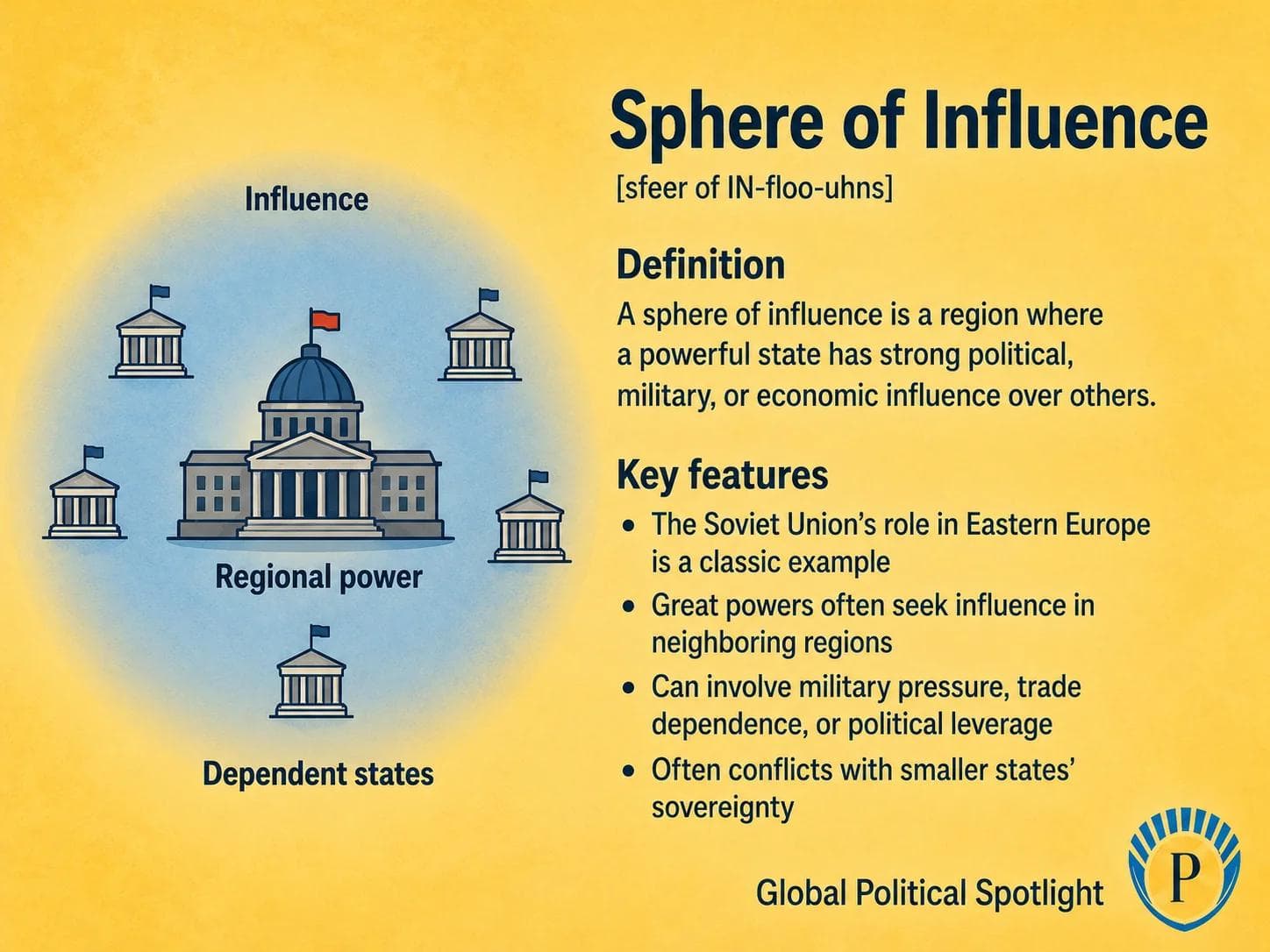
Definition
A sphere of influence is an area in which a powerful state exercises strong influence over the political, military, economic, or diplomatic choices of other states. The influenced states may remain legally independent, but their foreign policy options can be constrained by the power, proximity, or leverage of a dominant actor.
Spheres of influence can be informal or formalized through alliances, military presence, economic dependence, client relationships, or ideological alignment. They are often associated with great-power politics, regional security orders, and competition over buffer zones.
A classic historical example is the Soviet Union's dominance over much of Eastern Europe during the Cold War, where formally sovereign states were heavily shaped by Moscow's security interests, political ideology, and military power.
Why It Matters
Spheres of influence matter because they reveal how power can operate below the level of direct conquest. A state may not formally annex territory, but it can still shape another state's choices through pressure, dependency, security guarantees, or the threat of punishment.
The concept is closely tied to sovereignty, alliance politics, military basing, sanctions, trade dependence, and great-power competition. It helps explain why neighboring regions often become central arenas of rivalry between major powers.
For smaller states, being inside a great power's sphere can create strategic benefits, such as security or market access, but it can also reduce autonomy and make domestic politics more vulnerable to external pressure.
Sphere of influence is a core concept for tracking how major powers seek regional depth, strategic buffers, economic dependency, and diplomatic alignment. GPS should watch how states use military presence, energy links, trade networks, political parties, media ecosystems, and security guarantees to shape the behavior of formally independent countries.
Key Facts
- Type
- Geopolitical power concept
- Core idea
- A dominant state shapes the choices of other states in a surrounding or dependent region
- Legal status
- Influence does not equal formal sovereignty or legal ownership
- Common tools
- Military pressure, alliances, trade dependence, aid, energy leverage, political influence, and security guarantees
- Classic example
- Soviet influence over Eastern Europe during the Cold War
- Main tension
- Great-power security interests can conflict with the sovereignty and self-determination of smaller states
- Strategic role
- Spheres of influence can create buffer zones, regional blocs, and zones of reduced outside access
- Modern relevance
- The concept remains central to debates about NATO enlargement, regional security orders, economic dependency, and great-power competition
FAQ
What is a sphere of influence?
A sphere of influence is a region where a powerful state has strong influence over the political, military, economic, or diplomatic choices of other states, even though those states may remain formally independent.
How is a sphere of influence different from an empire?
An empire usually involves formal rule or direct control over territory. A sphere of influence is often more indirect: the dominant state shapes another state's behavior through pressure, dependence, alliances, or political leverage without necessarily governing it directly.
Why do great powers want spheres of influence?
Great powers often seek spheres of influence to create strategic buffers, secure trade routes, limit rival powers, protect military access, and shape the political orientation of neighboring states.
Can a country be independent but still inside a sphere of influence?
Yes. A state can be legally sovereign while still facing strong external pressure that limits its practical freedom of action. This is one reason the concept is important in debates about sovereignty and self-determination.
What is a historical example of a sphere of influence?
The Soviet Union's dominance over Eastern Europe during the Cold War is a classic example. Countries such as Poland, Hungary, East Germany, and Czechoslovakia remained formally separate states, but their political systems and security choices were heavily shaped by Moscow.
Are spheres of influence legal under international law?
International law recognizes state sovereignty and the principle of non-intervention, but spheres of influence are political realities rather than formal legal categories. They can become legally problematic when influence involves coercion, intervention, occupation, or violations of another state's sovereign rights.
Sources5 references
- Encyclopaedia Britannica
Reference definition and historical context for the concept of sphere of influence.
- United Nations Charter
Primary source for principles of sovereign equality, non-use of force, and international order.
- Office of the Historian, U.S. Department of State
Historical background on Cold War containment and the geopolitical struggle over influence in Europe and beyond.
- NATO
Institutional background on NATO enlargement and debates over alliance choice, sovereignty, and regional security.
- Council on Foreign Relations
Background context on Ukraine, Russia, NATO, and competing understandings of regional influence.

GPSNews App
Read GPSNews on iPhone
Daily geopolitical briefings, government updates, and prediction signals in one focused app.
Newsletter
Stay Ahead Of The Next Signal
Get briefings in your inbox when new analysis and reports are published.