
Gray Zone Conflict
Coercive activity below the threshold of open war
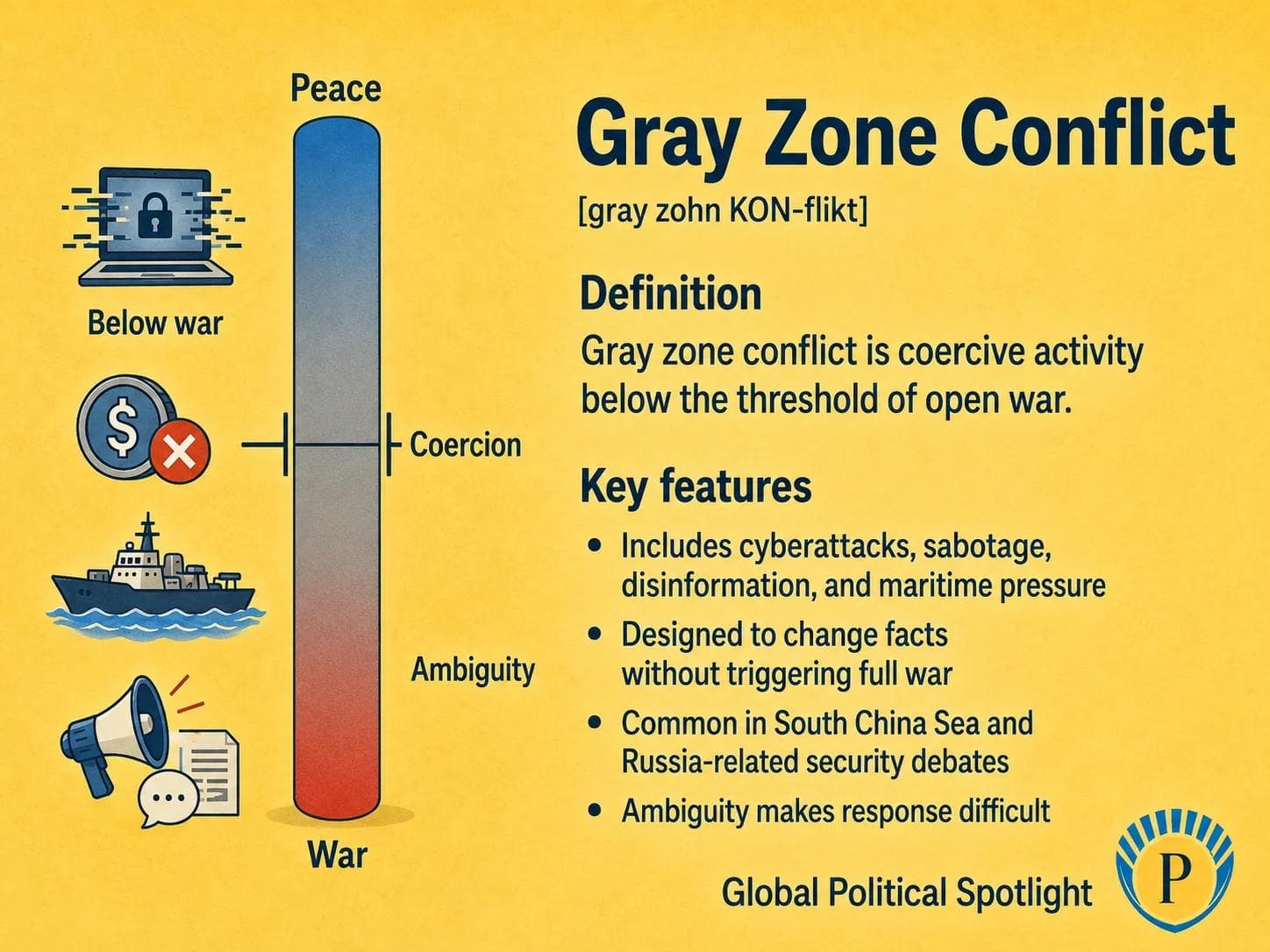
Gray zone conflict refers to coercive state or non-state activity that stays below the threshold of open war while using ambiguity, pressure, disruption, or deniability to gain strategic advantage.
Definition
Gray zone conflict refers to coercive activity that sits between normal state competition and open armed conflict. It involves actions that are hostile, disruptive, or strategically aggressive, but are designed to remain below the threshold that would clearly justify a conventional military response.
Common gray zone tools include cyberattacks, sabotage, disinformation, election interference, maritime pressure, coercive law enforcement, militia activity, economic pressure, political subversion, and the use of proxies or deniable forces. The defining feature is often ambiguity: uncertainty over attribution, intent, legality, or the proper response.
The concept is frequently used in discussions of maritime coercion in the South China Sea, Russia-related security challenges in Europe, cyber operations, and hybrid tactics that exploit the space between peace and war.
Why It Matters
Gray zone conflict matters because it lets actors change facts on the ground without triggering the political and military costs of open war. Small actions can accumulate over time, gradually shifting control, influence, or public perception.
It is difficult to respond to because the target may face uncertainty about who is responsible, whether the action crosses a legal threshold, and whether escalation would be disproportionate. This makes gray zone activity especially useful against alliances and institutions that require consensus.
For policymakers, the challenge is to build resilience, attribution capacity, proportional response options, public communication, and alliance coordination without overreacting or allowing coercive behavior to become normalized.
Gray zone conflict is a key GPS concept for tracking coercive behavior below open war. GPS should monitor cyber incidents, sabotage claims, maritime militia activity, disinformation networks, border pressure, proxy forces, economic coercion, deniable operations, and whether repeated low-level actions are cumulatively changing regional balances of power.
Key Facts
- Type
- Sub-threshold conflict and security concept
- Core idea
- Coercive activity below the threshold of open war
- Common tools
- Cyberattacks, sabotage, disinformation, maritime pressure, proxy activity, economic coercion, and political interference
- Main feature
- Ambiguity over attribution, intent, legality, escalation, or the appropriate response
- Strategic purpose
- To gain advantage, test resolve, weaken institutions, or change facts gradually without triggering open war
- Common regions
- The South China Sea, Eastern Europe, cyberspace, and contested border or maritime zones are frequent areas of discussion
- Related concepts
- Hybrid warfare, coercive diplomacy, proxy war, information warfare, cyber conflict, and escalation management
- Main risk
- Repeated low-level coercion can accumulate into strategic change while increasing the risk of miscalculation
FAQ
What is gray zone conflict?
Gray zone conflict is coercive activity that occurs between normal competition and open war. It uses pressure, ambiguity, disruption, or deniability to gain advantage without clearly crossing the threshold into conventional armed conflict.
What are examples of gray zone tactics?
Examples include cyberattacks, sabotage, disinformation, maritime harassment, election interference, proxy activity, economic coercion, border pressure, and the use of militias or deniable forces.
Why is gray zone conflict hard to respond to?
It is hard to respond to because responsibility may be unclear, the action may fall below legal or military thresholds, and a strong response may look escalatory. This creates uncertainty for governments and alliances.
How is gray zone conflict different from hybrid warfare?
The terms overlap. Gray zone conflict emphasizes the space below open war, while hybrid warfare often refers to the combined use of military and non-military tools. Many hybrid tactics can be used in the gray zone.
Why is the South China Sea associated with gray zone conflict?
The South China Sea is often associated with gray zone conflict because states can use coast guard vessels, maritime militias, artificial islands, legal claims, patrols, and harassment tactics to assert control without launching conventional naval warfare.
Can gray zone conflict lead to war?
Yes. Gray zone activity is designed to stay below the threshold of war, but repeated incidents, miscalculation, unclear red lines, or accidental clashes can increase escalation risk.
Recent Developments
NATO emphasized hybrid threats and hostile state activity
NATO's 2024 Washington Summit Declaration highlighted hybrid, cyber, space, and other hostile activities as part of the alliance's contested security environment, reflecting the continuing importance of gray zone challenges.
NATOPhilippines and China tensions highlighted maritime gray zone risks
Public reporting and official statements on South China Sea incidents continued to show how coast guard vessels, maritime militia activity, water cannons, blocking maneuvers, and legal claims can create coercive pressure below the level of conventional naval warfare.
Permanent Court of ArbitrationSources6 references
- NATO
Institutional background on hybrid threats, resilience, and security challenges below conventional war.
- NATO
Official 2024 Washington Summit Declaration covering hybrid threats, cyber activity, deterrence, and alliance security.
- U.S. Department of Defense
Official defense strategy source relevant to deterrence, integrated campaigning, cyber threats, and strategic competition.
- Permanent Court of Arbitration
Reference source for the South China Sea arbitration case, relevant to maritime claims and legal disputes.
- RAND Corporation
Research background on hybrid warfare, gray zone activity, and sub-threshold security challenges.
- Cybersecurity and Infrastructure Security Agency
Official U.S. source on cyber threats and advisories, relevant to gray zone cyber activity and resilience.

GPSNews App
Read GPSNews on iPhone
Daily geopolitical briefings, government updates, and prediction signals in one focused app.
Newsletter
Stay Ahead Of The Next Signal
Get briefings in your inbox when new analysis and reports are published.