What Moved the Market
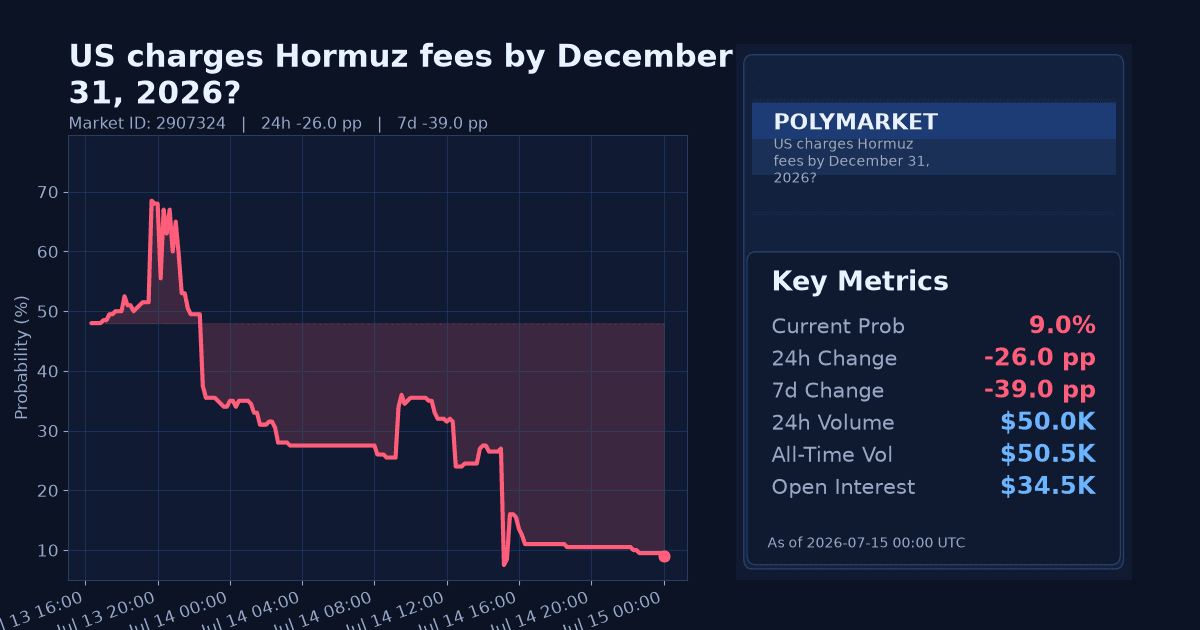
Polymarket traders sharply marked down the probability that the United States will collect any fee or reimbursement for transit or protection in the Strait of Hormuz by 11:59 PM ET on December 31, 2026. The contract fell 26 percentage points over 24 hours to 9%.
The move comes early in the market’s life (listed July 13, 2026) and follows elevated trading activity. The price action suggests a rapid reassessment of the likelihood that an actual payment will be received within the contract window.
Why It Likely Moved
- The repricing appears driven by US policy signals emphasizing military operations rather than fee-based protection. US Central Command reported completing another wave of strikes against Iran on July 13, citing “dozens of targets” hit with precision munitions, according to the US government’s announcement by U.S. Central Command published July 13 (war.gov).
- Markets also reacted to reporting that the US will reinstate a blockade over the Strait of Hormuz starting Tuesday, framing actions as interdiction rather than a paid escort/compensation scheme (NPR, July 14).
- Legislative signals may have weighed: Senate Democrats blocked a roughly $1 trillion defense bill on July 14 in protest over Iran-war concerns, highlighting intraparty opposition that could slow or complicate new mechanisms tied to Hormuz operations (AP News, July 14).
- Allied statements underscore the security crisis without pointing to fee collection. The E3 (UK, France, Germany) condemned Iranian attacks on July 12, reflecting a focus on deterrence and accountability rather than compensation frameworks (UK government, July 12).
- Despite tighter energy conditions—Brent crude at $85.3/bbl and up about 15% over 7 days—the selloff suggests traders distinguish broader risk from the specific requirement that the US actually receive at least one qualifying payment by end-2026.
How Strong the Move Is
The 24-hour decline of 26 percentage points is classified as extreme by the market’s own z-score (z=102.0), indicating an outsized, event-driven repricing relative to recent trading.
Over seven days the contract is down 39 percentage points, but the 7d z-score is assessed as normal. Together, this looks like a sharp single-session reset rather than a well-established multi-week trend.
Cross-Market Confirmation
- “US charges Hormuz fees by July 31, 2026?” fell 10.8pp over 24h to 3.0%, aligning with lower odds across nearby maturities (confirming signal; 24h delta -10.8).
- “US charges Hormuz fees by August 31, 2026?” dropped 14.75pp over 24h to 5.9%, reinforcing the broad repricing lower (confirming signal; 24h delta -14.75).
- “Strait of Hormuz traffic returns to normal by July 31?” eased 1.05pp over 24h and 2.75pp over 7d to 1.8%, indicating persistent disruption (a contextual but indirect signal; it does not contradict reduced fee-collection odds).
News & Real-World Context
The US government reported new offensive strikes against Iran on July 13, with U.S. Central Command describing “another wave” of precision attacks on multiple targets (U.S. Central Command via war.gov, July 13). The E3 (UK, France, Germany) issued a statement on July 12 condemning Iranian attacks in the Strait of Hormuz and the region, signaling coordinated allied messaging focused on security and deterrence (UK government, July 12).
On July 14, NPR reported that the United States will reinstate a blockade over the Strait of Hormuz, heightening tensions around a critical maritime chokepoint (NPR, July 14). The same day, Senate Democrats blocked a roughly $1 trillion defense bill in protest over Iran-war concerns, pausing legislative progress and highlighting domestic policy divisions over the scope of action (AP News, July 14). Additional reporting detailed US use of explosive surface drones in strikes on July 12 (Ars Technica, July 14).
Bottom Line
Traders sharply reduced the likelihood that the US will actually collect a Hormuz transit/protection fee by December 31, 2026, repricing toward a posture centered on blockade and strikes rather than fee-based protection. Legislative headwinds add to uncertainty about operational and legal pathways to a qualifying payment.
This looks like an event-driven reset rather than a confirmed longer-term trend, with probability now anchored in single digits but sensitive to future policy and operational signals.
Market Conditions at Time of Writing
- Current Probability: 9.0%
- 24h Change: -26.0 pp
- 7d Change: -39.0 pp
- Volume (24h, $): 49,968.59
- Open Interest ($): 34,451.6
- Spread (pp): 1.0
- Z-score (24h): 102.0