What Moved the Market
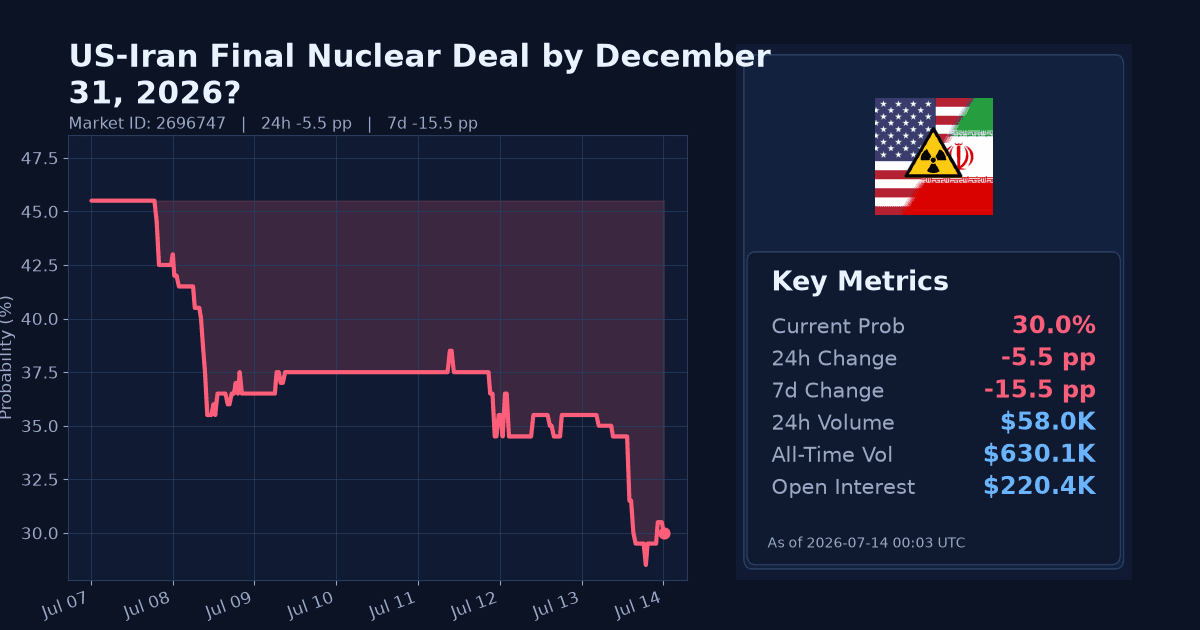
The Polymarket contract “US-Iran Final Nuclear Deal by December 31, 2026?” fell to 30%, down 5.5 percentage points over 24 hours and 15.5 points over seven days. The market, launched on June 26, 2026, covers whether a mutually signed or formally adopted “final deal” is concluded by 11:59 PM ET on December 31, 2026.
The decline represents an extreme downward move relative to recent trading, with high activity: $58k traded in the last 24 hours and open interest around $220k. The quoted spread is 1.0 percentage point.
Why It Likely Moved
- The repricing follows a July 13 announcement that U.S. Central Command completed “another wave of strikes against Iran,” hitting dozens of targets with precision munitions, according to the U.S. government’s CENTCOM release (July 13, 2026).
- Markets reacted to firm allied language on Iranian actions: the E3 (UK, France, Germany) issued a joint statement (July 12, 2026) on Iranian attacks in the Strait of Hormuz and the region, signaling a coordinated stance.
- UK officials at the UN Security Council called for “de-escalation and a return to diplomacy,” a tone that underscores elevated tensions even as it urges talks, per the UK government statement (July 10, 2026).
- Broader risk signals may have reinforced the shift: WTI crude rose 15.5% over the past week to $79.18/bbl, while the VIX is up 10.2% over the same period, both consistent with higher regional risk premia (sources: WTI, VIX).
- Additional context points to deteriorating conditions for near-term diplomacy: NPR reported U.S.–Iran exchanges of fire over the weekend in/around the Strait of Hormuz, complicating a ceasefire path (NPR, July 13, 2026).
How Strong the Move Is
The 24-hour decline of 5.5 percentage points registers as an extreme move versus the market’s recent history (24h z-score: 20.0). The 7-day slide of 15.5 points is also extreme (7d z-score: 60.0), indicating more than a routine fluctuation.
Together, these readings point to a sharp, downside repricing rather than routine noise. The week-long deterioration suggests a developing trend rather than a single-session blip.
Cross-Market Confirmation
- “US-Iran Final Nuclear Deal by August 31, 2026?” fell to 8% (−3 pp 24h, −16 pp 7d), aligning with weaker year-end odds.
- “US-Iran Final Nuclear Deal by August 18, 2026?” dropped to 5% (−2 pp 24h, −13 pp 7d), confirming near-term skepticism.
- “Will the U.S. invade Iran before 2027?” rose to 19% (+2 pp 24h, +8 pp 7d), a divergence that nonetheless conceptually aligns with declining diplomacy odds by reflecting heightened conflict risk.
News & Real-World Context
- The U.S. government reported new offensive strikes on July 13 targeting Iran, citing “dozens of targets” hit with precision munitions, per CENTCOM.
- The E3 (UK, France, Germany) issued a statement (July 12) addressing Iranian attacks in the Strait of Hormuz and the wider region.
- The UK mission to the UN on July 10 urged de-escalation and a return to diplomacy in a Security Council statement.
- NPR’s July 13 coverage highlighted exchanges of fire between the U.S. and Iran over the weekend and described a ceasefire as growing more distant (NPR). AP News reported UK claims that an Iran-backed group was behind attacks on the Jewish community and that the UK announced a ban on Iran’s Revolutionary Guard Corps (AP, July 13).
- The European Parliament recorded a written question on enforcing EU sanctions against Iranian-linked financial networks on July 13, underscoring regulatory scrutiny (European Parliament).
Bottom Line
Markets are marking down the probability of a signed or formally adopted “final deal” by year-end 2026 amid reported U.S. strikes and coordinated European statements on Iranian activity. Given the extreme z-scores and corroborating moves in related contracts, the shift appears acute and trend-like rather than transient.
While the June 14 memorandum set a 60-day extendable negotiation window, current signals point to a tougher near-term path to a qualifying final instrument.
Market Conditions at Time of Writing
- Current Probability: 30.0%
- 24h Change: -5.5 pp
- 7d Change: -15.5 pp
- Volume (24h, $): 58,046.42
- Open Interest ($): 220,384.16
- Spread (pp): 1.0
- Z-score (24h): 20.0