What Moved the Market
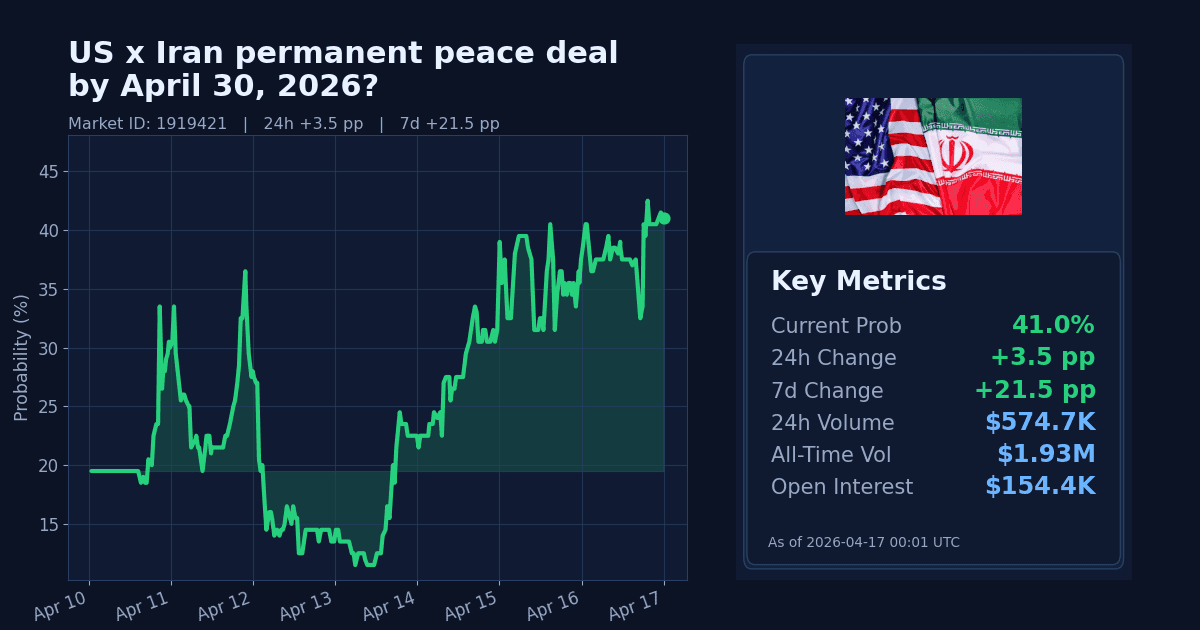
The Polymarket contract on whether the United States and Iran will agree to a permanent peace deal by 11:59 PM ET on April 30, 2026 rose to 41%. Over the past 24 hours, the price increased by 3.5 percentage points; over the past week, it is up 21.5 percentage points.
The market, which opened on April 8, 2026 and closes on April 30, 2026, has seen elevated activity, with a tight 1.0pp spread and substantial 24-hour volume.
Why It Likely Moved
- Repricing appears driven by reporting that mediators are pushing to extend a U.S.–Iran ceasefire and that Pakistan expects to host a second round of U.S.–Iran talks, signaling ongoing diplomacy toward a longer halt to hostilities (NPR, Apr 16, 2026).
- Markets reacted to regional de-escalation headlines, including an announced 10-day Israel–Lebanon ceasefire on Apr 16, which may suggest parallel containment efforts around fronts linked to Iran’s network (Axios, Apr 16, 2026).
- The move also coincides with fresh U.S. sanctions on Iran’s oil sector and a stated end to waivers for Iranian and Russian oil imports, which may be interpreted as pressure designed to shape talks (Ground News aggregation, Apr 16, 2026).
- European and UK government statements highlighting maritime security risks in the Gulf suggest rising institutional focus on curbing escalation, adding diplomatic weight to de-escalation efforts (European Parliament and UK government, Apr 16, 2026).
- U.S. domestic developments—specifically the House’s failure to constrain presidential Iran war powers—preserve executive flexibility, a factor markets may see as relevant to negotiation dynamics (Axios, Apr 16, 2026).
How Strong the Move Is
Both the 24-hour and 7-day z-scores register as extreme, indicating the latest jump is a sharp repricing rather than routine noise. The contract has climbed materially in a short window nearing the April 30, 2026 deadline.
Given the extreme readings over both horizons, the current action looks like a sustained bullish trend with an additional sharp leg higher in the last 24 hours.
Cross-Market Confirmation
- US × Iran permanent peace by Apr 22, 2026: 25% (delta_24h: +5.0pp; delta_7d: +12.0pp). Directional alignment supports the broader upswing, with the shorter-dated contract lagging on timing risk.
- Military action against Iran ends by Apr 17, 2026: 99.9% (delta_7d: +2.6pp). Confirms a de-escalation baseline consistent with higher odds of a durable accord.
- Israel × Hezbollah ceasefire by Apr 18, 2026: 99.7% (delta_24h: N/A; delta_7d: N/A). The high level, despite unavailable deltas, is directionally consistent with regional de-escalation cues.
News & Real-World Context
- On Apr 16, NPR reported mediators are working to extend a U.S.–Iran ceasefire and that Pakistan expects to host a second round of U.S.–Iran negotiations, underscoring active channels for de-escalation (NPR, Apr 16, 2026).
- The same day, Axios reported the House failed to pass a measure curbing presidential Iran war powers, leaving the executive wider latitude on Iran policy (Axios, Apr 16, 2026).
- Also on Apr 16, Axios covered an announcement of a 10-day Israel–Lebanon ceasefire; implementation details were not fully specified (Axios, Apr 16, 2026). An OCHA update meanwhile noted earlier escalation in Lebanon as of Apr 13, highlighting the fragile context (OCHA, Apr 16, 2026).
- A report aggregated by Ground News noted new U.S. sanctions on Iran’s oil sector and an end to waivers for imports of Iranian and Russian oil, signaling increased economic pressure on Tehran (Ground News, Apr 16, 2026).
- Government signals: The UK government, via a statement to the UN General Assembly on Apr 16, said attacks on international shipping in the Gulf have been “deeply damaging,” underscoring official concern over maritime security (UK government, Apr 16, 2026). The European Parliament registered a written question on Iran’s actions in the Strait of Hormuz, framing them as a potential violation of international law and a driver of energy risks (European Parliament, Apr 16, 2026).
- Macro backdrop: WTI crude stood at $90.19/bbl and fell 7.8% over 7 days as of Apr 16, while the VIX declined 8.0% over the week. These moves are consistent with a lower immediate conflict-risk premium in energy and broader market volatility.
Bottom Line
Pricing for a permanent U.S.–Iran peace deal by Apr 30, 2026 has surged, seemingly on intensified mediation signals and parallel regional de-escalation headlines. Mixed policy cues—new U.S. sanctions and maritime security concerns—temper conviction, but the net market reaction is decisively higher.
With extreme z-scores on both 24h and 7d horizons, this looks like a strong, late-window repricing rather than incremental drift.
Market Conditions at Time of Writing
- Current Probability: 41%
- 24h Change: +3.5pp
- 7d Change: +21.5pp
- Volume (24h): $574,657.79
- Open Interest: $154,448.32
- Spread: 1.0pp
- Z-score (24h): 4.2426