What Moved the Market
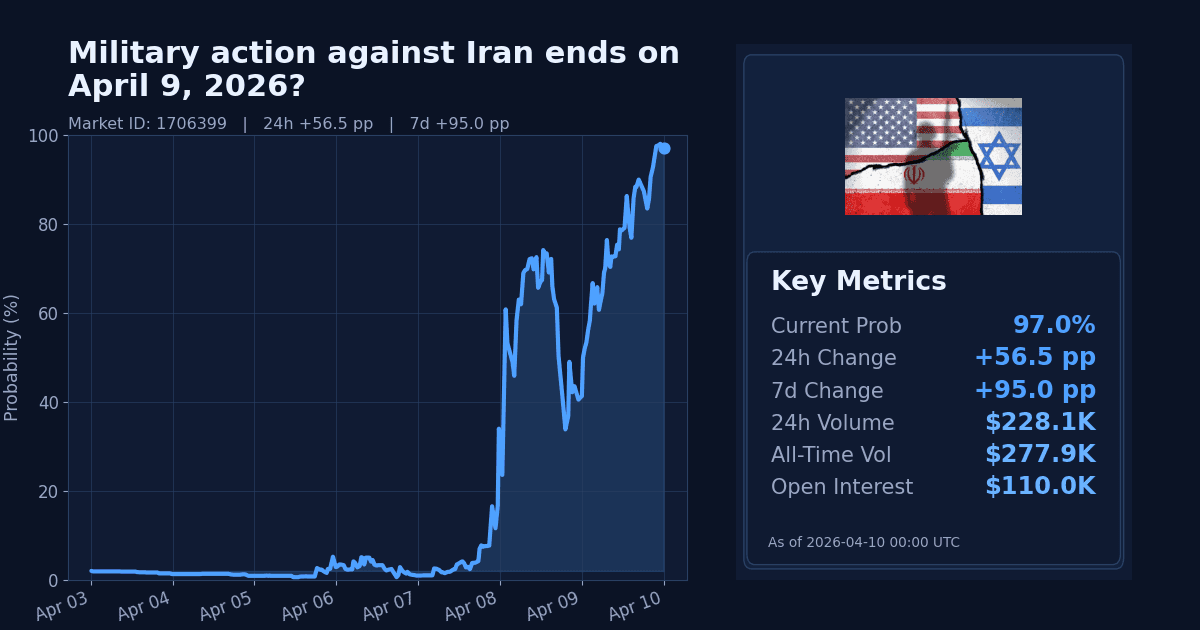
The Polymarket market "Military action against Iran ends on April 9, 2026?" sharply repriced higher, with the implied probability rising 56.5 percentage points over 24 hours to 97.0% as of April 10. The move suggests participants expect April 9 (Iran Standard Time) to mark the first date with no qualifying US or Israeli drone, missile, or air strike on Iranian soil or at an official Iranian diplomatic site.
This contract resolves on the next date (IST) without a qualifying strike; for the April 9 question, if no strike is confirmed by a consensus of credible reporting by the end of the third calendar day after that date, it resolves "Yes."
Why It Likely Moved
- Repricing appears driven by formal ceasefire signals: on April 8, the European Commission published a joint leaders’ statement welcoming a two-week ceasefire between the United States and Iran (European Commission, 2026-04-08).
- The UK government likewise issued an April 8 statement from the Foreign Secretary on the ceasefire between the US, Israel and Iran, reinforcing expectations of a pause in strikes (UK government, 2026-04-08).
- Markets reacted to same-day media corroboration that the United States and Iran reached an 11th‑hour truce, reported on April 9 (NPR, 2026-04-09).
- Broader risk metrics have eased over the past week — Brent crude is $96.63/bbl (−11.37% 7d) and the VIX is 19.49 (−18.35% 7d) — which aligns with de‑escalation pricing in this contract.
How Strong the Move Is
The 24-hour jump of 56.5 percentage points and a 7-day gain of 95.05 percentage points register as extreme on both time horizons. The market’s 24h z-score is 236.4 and 7d z-score is 380.4, both flagged as "extreme" relative to recent trading history.
Given those readings, this looks like an event-driven spike rather than ordinary volatility. The timing aligns with public ceasefire announcements preceding the April 9 (IST) contract date.
Cross-Market Confirmation
- The adjacent "April 10, 2026" end-date market fell 14.4pp over 24h to 6.6%, a move that supports the earlier-April 9 endpoint being priced in (delta_24h: −14.4; delta_7d: +1.4).
- "Trump announces end of military operations against Iran by April 30th?" is little changed at 40.0% (delta_24h: −1.0), offering limited confirmation for near‑term timing.
- "Trump announces end by April 15th?" is 11.0% (delta_24h: +1.0; delta_7d: −2.0), a marginal move that neither confirms nor contradicts the April 9 date-specific repricing.
News & Real-World Context
Government statements provide the clearest policy signal. On April 8, the European Commission published a joint statement by European leaders welcoming a two‑week ceasefire between the United States and Iran, framing it as an opportunity to reduce regional risks (European Commission, 2026-04-08). The same day, the UK government released a Foreign Secretary statement acknowledging a ceasefire between the US, Israel and Iran (UK government, 2026-04-08).
Media coverage on April 9 reported that the United States and Iran reached an 11th‑hour truce ahead of a stated deadline, highlighting a pause and the open questions that follow for maritime security and regional dynamics (NPR, 2026-04-09). Separately, European leaders urged negotiations amid reports that Iran closed the Strait of Hormuz, underscoring the backdrop of elevated regional risk even as ceasefire language emerged (AP News, 2026-04-09).
Bottom Line
The surge in the April 9 contract appears tied to formal ceasefire announcements on April 8 and corroborating media reporting on April 9, which together point to an expected pause in qualifying strikes on that date. Given extreme z-scores and cross‑market alignment, this looks like an event‑driven, date‑specific repricing rather than a broad structural shift.
Market Conditions at Time of Writing
- Current Probability: 97.0%
- 24h Change: +56.5pp
- 7d Change: +95.05pp
- Volume (24h): $228,134.25
- Open Interest: $109,950.71
- Spread: 0.1pp
- Z-score (24h): 236.4