What Moved the Market
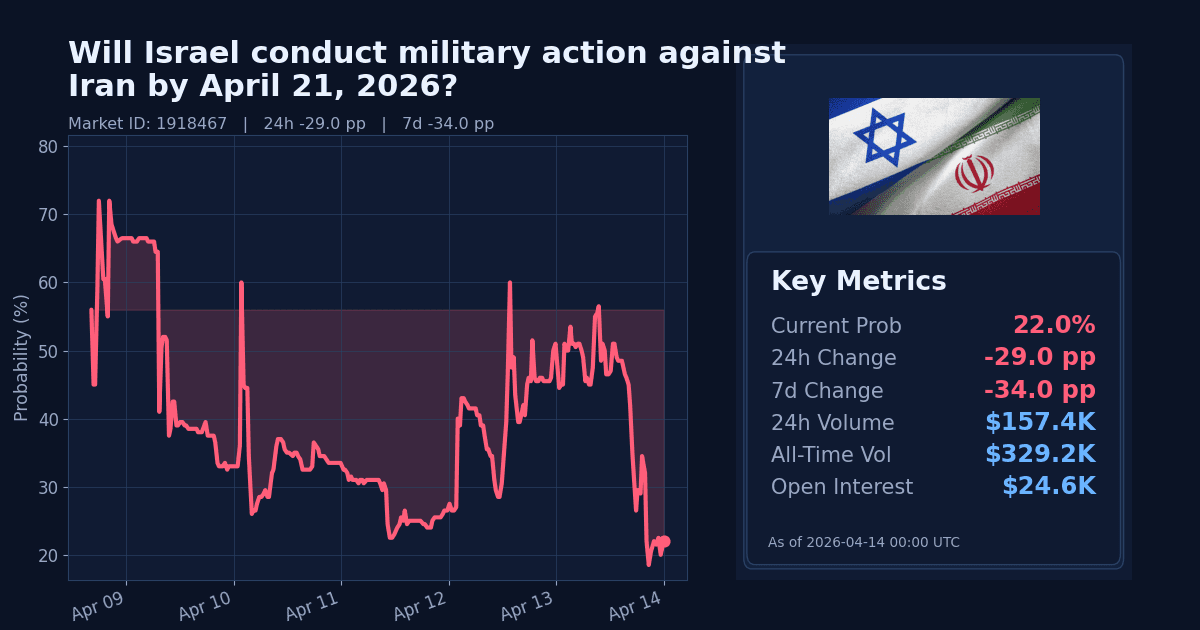
Polymarket traders sharply lowered the probability that Israel will conduct military action on Iranian soil before the contract window closes on April 21, 2026. The market fell 29 percentage points over 24 hours to 22% as of April 14.
Over the past week, the contract is down 34 percentage points. The move resets expectations for an Israeli-initiated drone, missile, or air strike on Iranian territory within the remaining days of the window.
Why It Likely Moved
- Repricing appears driven by an official U.S. operational update on April 13: U.S. Central Command forces started a mine‑clearance mission in the Strait of Hormuz, with two Navy destroyers conducting operations, signaling a focus on maritime security rather than new cross‑border strikes on Iranian soil (U.S. government, 2026‑04‑13).
- Markets reacted to diplomatic signaling: Turkey’s foreign minister said on April 13 that both Iran and the United States appeared “sincere” about pursuing a ceasefire, a tone consistent with reduced near‑term escalation risk (Ground News, 2026‑04‑13).
- The European Commission’s President underscored on April 13 the EU’s focus on the economic impact of the Middle East crisis, framing the issue in terms of managing fallout rather than endorsing additional kinetic action, which may contribute to a de‑risking bias (European Commission, 2026‑04‑13).
- Macro backdrop supports a lower escalation premium: Brent crude stood at $96.91/bbl, down 11.7% over 7 days as of April 13, and the VIX fell 20.9% over the same period, both consistent with an easing risk premium (Yahoo Finance data).
How Strong the Move Is
The 24‑hour decline is extreme by this market’s standards: a 29pp drop accompanied by a 24h z‑score of 116.0. That indicates an outlier, single‑session repricing rather than a gradual drift.
On a 7‑day basis, the market is down 34pp, but the weekly z‑score is flagged as normal relative to recent volatility. Taken together, this looks like a sharp one‑day reset within an already volatile week.
Cross-Market Confirmation
- Will Israel conduct military action against Iran by April 14, 2026? fell to 1.1% (24h −24.95pp), aligning with reduced near‑term strike expectations.
- Military action against Iran ends by April 17, 2026? is priced at 99.9% (7d +71.45pp), consistent with positioning for a near‑term wind‑down rather than fresh Israeli strikes on Iranian soil within this market’s window.
- Trump announces end of military operations against Iran by April 15? at 3.3% (7d −10.25pp) offers limited direct signal but does not contradict the broader de‑escalation repricing.
News & Real-World Context
- On April 13, U.S. Central Command announced the start of a mine‑clearance mission in the Strait of Hormuz, with two Navy destroyers operating in the area, highlighting a maritime security posture (U.S. government, 2026‑04‑13).
- Also on April 13, the President of the European Commission briefed on the economic impact of the Middle East crisis on the EU, emphasizing policy focus on managing consequences after “44 days” of war (European Commission, 2026‑04‑13). The European Parliament, on the same day, published written questions scrutinizing Israel’s recent actions in Lebanon and broader EU policy consistency, signaling sustained political oversight (EP Q&A 1; EP Q&A 2).
- Turkey’s foreign minister said on April 13 that Iran and the U.S. seemed sincere about pursuing a ceasefire, while cautioning about military intervention complexities in the Strait of Hormuz (Ground News, 2026‑04‑13).
- Media coverage explored potential U.S. blockade mechanics and broader economic effects, reflecting heightened attention to maritime dynamics rather than direct Israeli strikes inside Iran (AP News, 2026‑04‑13). Separate reporting noted oil moving above $100 on blockade concerns, underscoring energy‑market sensitivity to these signals (Ground News, 2026‑04‑13).
Bottom Line
This is an extreme single‑day de‑risking move concentrated on the final‑week window through April 21. Official maritime security actions and ceasefire‑related statements reduced the perceived likelihood of an Israeli strike on Iranian soil within the contract horizon. Absent contrary official signals, the shift looks tactical and tied to near‑term expectations.
Market Conditions at Time of Writing
- Current Probability: 22.0%
- 24h Change: −29.0pp
- 7d Change: −34.0pp
- Volume (24h, $): 157,445.17
- Open Interest ($): 24,613.95
- Spread (pp): 1.0
- Z-score (24h): 116.0