
European Union
A political and economic union built around shared institutions, single-market rules, and regulatory power
The European Union is a political and economic union of European states with shared institutions, single-market rules, trade power, regulatory influence, and limits on foreign-policy coordination.
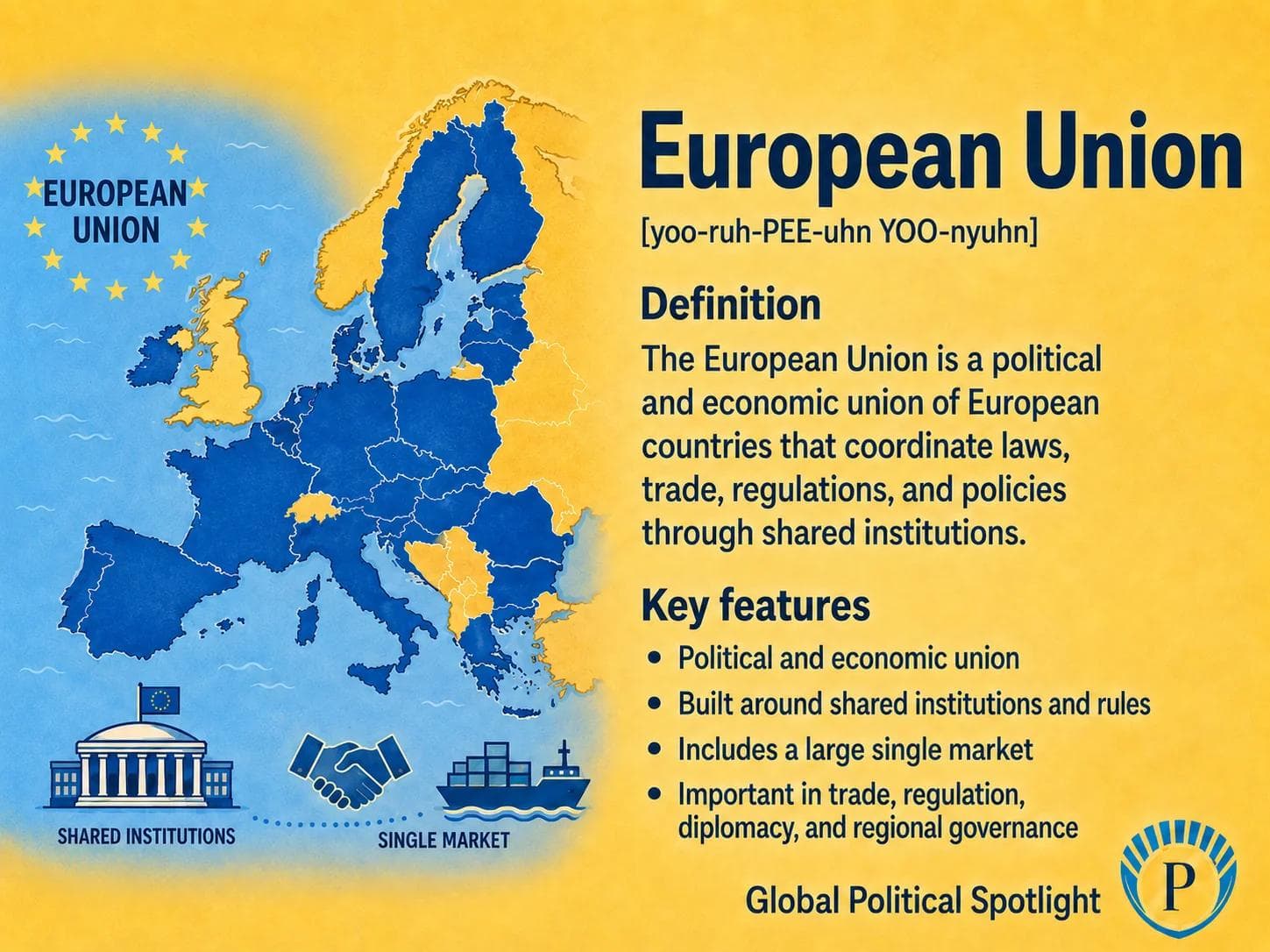
Definition
The European Union is a political and economic union of European states with shared institutions, common laws in many policy areas, a single market, and coordinated external trade policy. It is not a federal state, but its members have pooled sovereignty in areas such as competition policy, trade, agriculture, border rules, environmental regulation, and parts of economic governance.
The EU's main institutions include the European Commission, which proposes and enforces many EU laws; the European Council, where national leaders set broad direction; the Council of the European Union, where member governments negotiate legislation; and the European Parliament, which is directly elected and co-legislates in many areas.
Why It Matters
The European Union matters because it is one of the world's largest economic and regulatory actors. Its single market, trade agreements, competition rules, digital regulation, climate policy, sanctions packages, and product standards can shape corporate behavior, supply chains, and policy choices far beyond Europe.
Its limits also matter. Foreign and security policy often depends on unanimity among member states, making the EU powerful in trade and regulation but slower or divided on military crises, enlargement, migration, sanctions design, and rule-of-law disputes.
GPS should track the European Union as a major regulatory, economic, sanctions, trade, enlargement, and diplomatic actor whose influence depends on the balance between supranational institutions and member-state politics. Key watchpoints include Commission priorities, European Council decisions, Parliament elections, sanctions packages, migration rules, rule-of-law conditionality, eurozone stability, enlargement negotiations, industrial policy, digital regulation, and foreign-policy unanimity constraints.
Key Facts
- Type
- Political and economic union
- Legal basis
- Built on EU treaties, including the Treaty on European Union and the Treaty on the Functioning of the European Union
- Main institutions
- European Commission, European Council, Council of the European Union, European Parliament, Court of Justice of the EU, and European Central Bank
- Single market
- The EU single market is based on the free movement of goods, services, capital, and people
- Eurozone distinction
- Not all EU members use the euro; the eurozone is the group of EU states that share the common currency
- Trade power
- The EU negotiates trade policy collectively, giving it major leverage in global trade and regulatory diplomacy
- Foreign-policy constraint
- Many foreign and security policy decisions require unanimity, limiting speed and coherence when member states disagree
- Strategic relevance
- Regulatory power, sanctions, enlargement, migration policy, rule-of-law debates, energy security, and European security coordination
FAQ
What is the European Union?
The European Union is a political and economic union of European states with shared institutions, a single market, common rules in many policy areas, and collective trade policy. It is not a single country, but members have pooled sovereignty in selected areas.
What does the European Commission do?
The European Commission proposes EU legislation, manages EU programmes, enforces EU law with the Court of Justice, oversees competition policy, and represents the EU in some external areas such as trade negotiations.
What is the difference between the European Council and the Council of the European Union?
The European Council brings together national leaders and sets broad political direction. The Council of the European Union brings together national ministers and negotiates and adopts legislation, often together with the European Parliament.
Is the eurozone the same as the European Union?
No. The eurozone is the group of EU member states that use the euro as their currency. Some EU members do not use the euro, so the eurozone is smaller than the EU.
Why is the EU powerful in regulation and trade?
The EU is powerful because access to its large single market is economically valuable. Its product standards, competition rules, digital regulations, climate policies, and trade agreements can influence companies and governments outside Europe.
Why can EU foreign policy be slow?
EU foreign and security policy often requires unanimity among member states. This means one government can delay or block decisions on sanctions, statements, military missions, enlargement steps, or diplomatic positions.
Recent Developments
The EU opened accession negotiations with Ukraine and Moldova
The European Union formally opened accession negotiations with Ukraine and Moldova, reinforcing enlargement as a major strategic tool linked to European security, democratic reform, and Russia-related geopolitical competition.
Council of the European UnionThe EU adopted a major asylum and migration reform package
The Council adopted the Pact on Migration and Asylum, a major reform of EU migration rules. The package highlighted migration as a persistent policy area where solidarity, border management, national sovereignty, and EU-level governance intersect.
Council of the European UnionSources6 references
- European Union
Official EU overview of principles, member countries, history, and institutional basics.
- European Commission
Official source explaining the European Commission's role, structure, and responsibilities.
- European Council and Council of the European Union
Official Council source for European Council and Council of the EU decisions, meetings, and policy files.
- European Parliament
Official source explaining the European Parliament's democratic, legislative, and budgetary role.
- European Central Bank
Official ECB source explaining the euro and eurozone monetary framework.
- EUR-Lex
Official EU legal portal providing the treaties currently in force.

GPSNews App
Read GPSNews on iPhone
Daily geopolitical briefings, government updates, and prediction signals in one focused app.
Newsletter
Stay Ahead Of The Next Signal
Get briefings in your inbox when new analysis and reports are published.