What Moved the Market
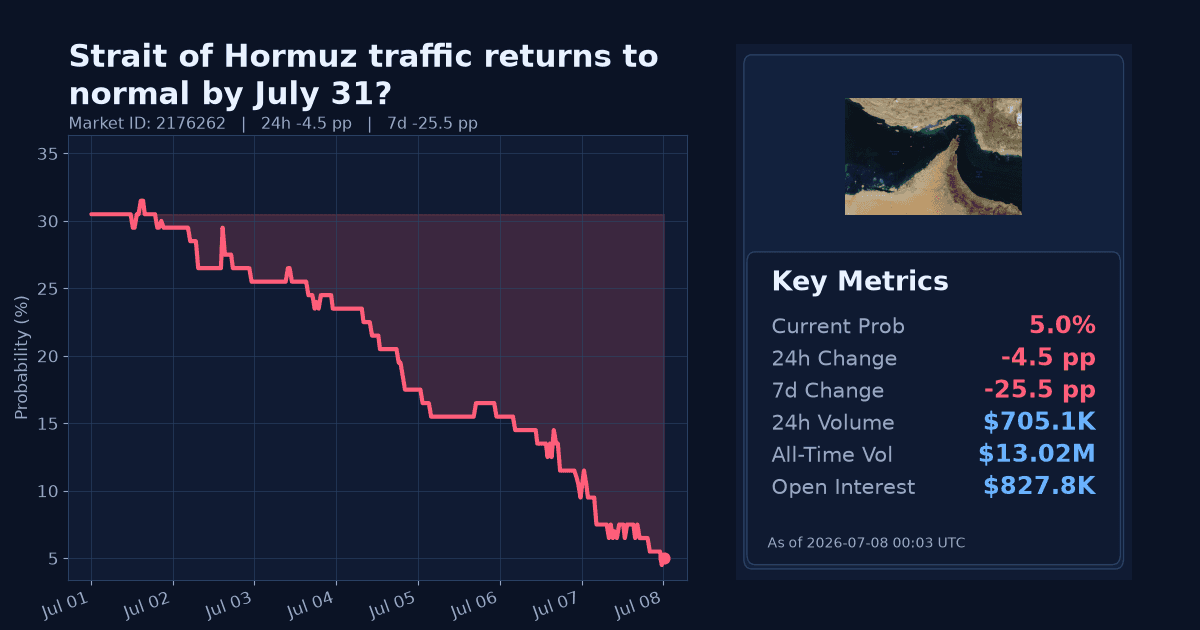
The Polymarket contract “Strait of Hormuz traffic returns to normal by July 31?” fell sharply. Implied probability declined 4.5 percentage points over 24 hours to 5.0%, and is down 25.5 percentage points over the past week as of July 8, 2026.
The market resolves Yes if IMF Portwatch’s 7-day moving average of “Arrivals of Ships” for the Strait of Hormuz reaches at least 60 on any date between market creation (May 11, 2026) and July 31, 2026. With the end date approaching, pricing now reflects low odds of that threshold being met in time.
Why It Likely Moved
- The repricing appears driven by reports on July 7 that a commercial tanker in the Strait of Hormuz was struck by a projectile and set ablaze, raising immediate security concerns for maritime traffic, according to AP News and NPR.
- Markets reacted to concurrent diplomatic friction signals involving Iran: on July 7 the UK government (FCDO) summoned Iran’s Chargé d’Affaires in London, underscoring tense bilateral dynamics.
- The repricing follows broader regional diplomacy activity: on July 7, the French Ministry for Europe and Foreign Affairs published a readout of an engagement with the Saudi foreign minister, highlighting active external engagement on regional issues.
- Cross-asset context is consistent with a modest energy-risk premium: Brent crude stands at $76.13/bbl and is up 4.4% over 7 days (as of July 7), even as it remains down 18.2% over 30 days, per Yahoo Finance.
How Strong the Move Is
The 24-hour shift is classified as extreme by recent trading history (z-score 16.0), indicating an outsized, event-driven adjustment rather than routine volatility. The 7-day change is also extreme (z-score 13.79), reinforcing that this is a sharp repricing.
Given the market’s time-bound structure (resolving by July 31, 2026) and the requirement for a 7-day moving average ≥60, the current 5% pricing reflects a significant downgrade in the likelihood of meeting the threshold before expiry.
Cross-Market Confirmation
- Divergence: “Will 30 ships transit the Strait of Hormuz on any day by July 31, 2026?” trades at 95.6% (+1.35pp 24h), suggesting confidence in at least single-day throughput even as the 7-day-average normalization market sells off.
- Partial confirmation: “Iran charges Hormuz fees by July 15?” is 5.4% (+3.9pp 24h, -2.25pp 7d), a small 24h uptick consistent with elevated perceived risk, though still low-probability overall.
- Unrelated détente remains unlikely: “US–Iran Final Nuclear Deal by July 31, 2026?” is 1.5% (+0.3pp 24h, -1.05pp 7d), offering no supportive signal for a de-escalatory path within the window.
- Macro backdrop: Brent crude’s 7-day gain (+4.4%) aligns directionally with heightened near-term energy-security concerns; however, its 30-day decline (-18.2%) tempers the signal.
News & Real-World Context
- On July 7, a tanker in the Strait of Hormuz was struck by a projectile and set ablaze, according to AP News. NPR reported Iranian state TV said the vessel ignored warnings; no explicit claim of responsibility was cited.
- The UK government (FCDO) summoned Iran’s Chargé d’Affaires on July 7, signaling strained UK–Iran relations.
- The French Ministry for Europe and Foreign Affairs published a July 7 note on an engagement with the Saudi foreign minister, indicating ongoing regional diplomacy.
Bottom Line
This is an extreme, event-driven repricing tied to fresh security incident reports in the Strait and concurrent diplomatic signals involving Iran. With the contract requiring a 7-day average ≥60 by July 31, time remains limited and pricing now reflects low odds of normalization within the window.
Market Conditions at Time of Writing
- Current Probability (%): 5.0
- 24h Change (pp): -4.5
- 7d Change (pp): -25.5
- Volume (24h, $): 705,119.46
- Open Interest ($): 827,843.05
- Spread (pp): 1.0
- Z-score (24h): 16.0