What Moved the Market
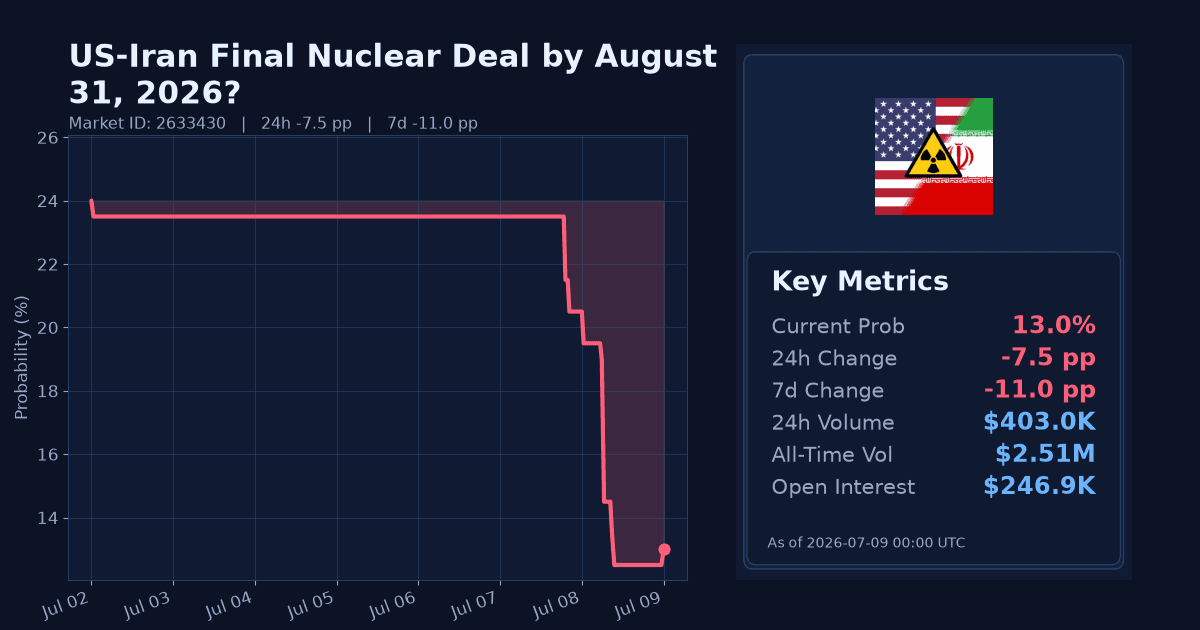
Polymarket traders cut the probability that the United States and Iran will mutually sign or formally adopt a qualifying “final deal” by August 31, 2026 to 13%. The contract, which opened on June 21 and references the June 14 announcement of a written framework to negotiate a final nuclear agreement, fell 7.5 percentage points over the last 24 hours and 11 points over the past week.
The move comes amid heavy trading activity and a tight market spread. As of the latest print, 24-hour volume reached $403k with $247k open interest and a 1.0pp bid-ask spread.
Why It Likely Moved
- Repricing appears driven by reports of new attacks tied to the Iran-related conflict that “raise questions about what comes next” and complicate diplomatic calculus, according to AP coverage published July 8 AP News.
- Sentiment toward the talks likely weakened after AP’s July 8 timeline analysis asked whether an Iran deal is effectively “over” and whether the prospect of war has returned, underscoring deteriorating expectations for near-term diplomacy AP News.
- The UK government signaled friction with Tehran by summoning Iran’s Chargé d’Affaires on July 7 over an attack on a journalist, an official step that points to heightened tensions with a key Western government during the negotiation window UK government.
- Cross-market repricing follows: the earlier-deadline version of the same market also fell over 24h and 7d, while Iran-risk proxies (e.g., potential US blockade, control of Kharg Island) rose.
- Macro signals are consistent with higher geopolitical risk premia: WTI crude is $74.47/bbl and up 8.6% over 7 days, even as 30-day performance remains lower, according to Yahoo Finance data WTI crude.
How Strong the Move Is
By historical standards for this market, the 24-hour selloff is extreme. The 24h z-score registers 32.0, indicating an outsized downside adjustment relative to recent trading behavior. The 7-day move is also extreme with a z-score of 3.8362, suggesting this is not typical day-to-day noise.
Given the magnitude and the alignment with conflict-leaning headlines and related markets, this resembles a sharp, event-driven repricing rather than a gradual trend continuation.
Cross-Market Confirmation
- US–Iran “final deal” by August 18, 2026: probability down 7.0pp (24h) and 10.0pp (7d), confirming broader pessimism around a timely final agreement.
- US blockade on Iran by July 31: probability up 0.5pp (24h) and 8.0pp (7d), a hawkish tilt that diverges from de-escalation and aligns with reduced deal odds.
- Kharg Island no longer under Iranian control by August 31: probability up 2.75pp (24h) and 2.3pp (7d), pointing to elevated conflict risk consistent with the main move.
News & Real-World Context
Two AP articles on July 8 highlighted fresh attacks and questioned whether a deal is “over,” both emphasizing that recent incidents complicate the diplomatic pathway and raise the risk of escalation, which is a headwind for a near-term final instrument that meets this market’s strict criteria AP News, Jul 8, AP News, Jul 8.
Official signals also point to friction. The UK’s Foreign, Commonwealth and Development Office summoned Iran’s Chargé d’Affaires on July 7 regarding an attack on a journalist, an explicit diplomatic protest that underscores strained ties with Western capitals during the negotiation window UK government, Jul 7. Separately, a July 8 blog from the Dutch central bank noted easing energy-price pressures and suggested the US and Iran “seem able to get along again,” reflecting a more benign macro framing; however, market pricing and recent headlines appear less supportive of that view at present De Nederlandsche Bank, Jul 8.
On the military-technical front, reporting on July 8 that the US seeks cheaper expendable drones after significant losses over Iran highlights an operational shift compatible with a contested environment rather than imminent de-escalation Ars Technica, Jul 8. In macro, WTI crude at $74.47/bbl is up 8.6% over 7 days (while down 18.4% over 30 days), which can reflect shifting near-term risk premia linked to Middle East tensions WTI crude.
Bottom Line
Markets sharply discounted the probability of a US–Iran final nuclear deal by August 31, 2026, as escalation-focused headlines and official diplomatic friction overshadow the June 14 framework’s 60-day negotiation phase. The move looks event-driven and significant, with cross-market signals reinforcing a risk-off stance toward a timely, text-qualified agreement.
Market Conditions at Time of Writing
- Current Probability (%): 13.0
- 24h Change (pp): -7.5
- 7d Change (pp): -11.0
- Volume (24h, $): 403,041.29
- Open Interest ($): 246,906.39
- Spread (pp): 1.0
- Z-score (24h): 32.0