What Moved the Market
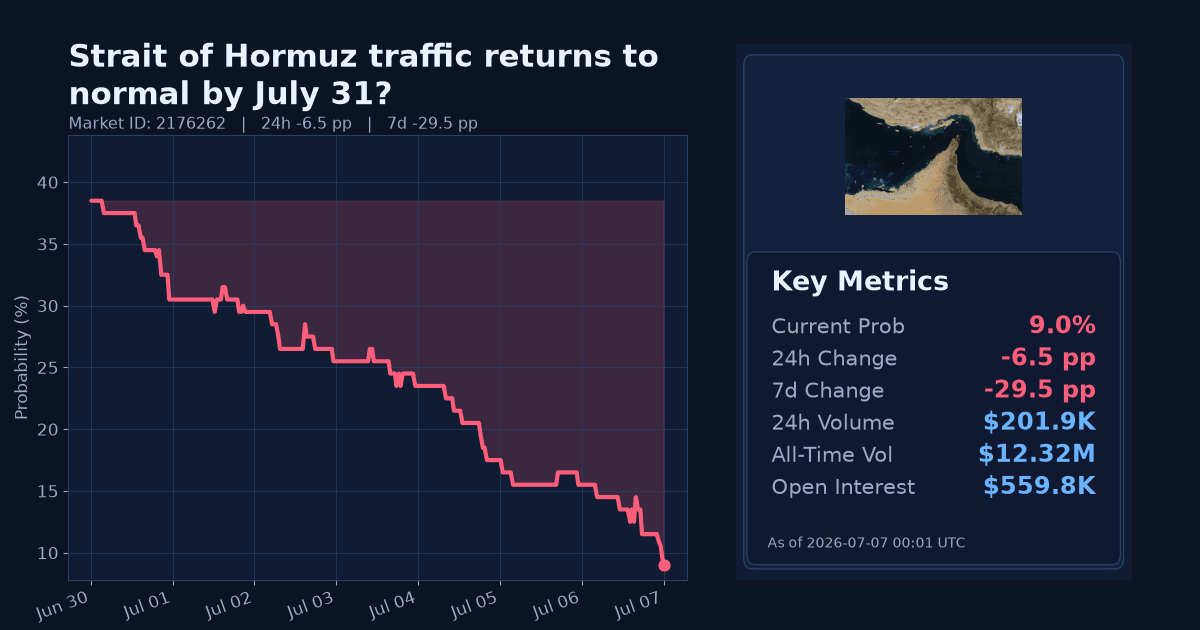
The Polymarket contract on whether Strait of Hormuz traffic returns to “normal” by July 31, 2026 fell to 9%. Pricing is down 6.5 percentage points over 24 hours and 29.5 points over the past week.
The contract resolves Yes if the IMF Portwatch 7‑day moving average of transit calls (Arrivals of Ships) for the Strait of Hormuz reaches at least 60 on any date between market creation (May 11, 2026) and July 31, 2026. No qualifying data point has been cited by traders so far, and the window is closing.
Why It Likely Moved
- Repricing appears driven by deadline proximity: with the contract window ending July 31, 2026, the probability is falling as time to achieve a ≥60 7‑day average narrows.
- The move follows broader cross‑tenor adjustments in related markets, suggesting a reassessment of the likelihood that IMF Portwatch will post a qualifying ≥60 print in time.
- Macro signals do not indicate an urgent, supply‑shock‑driven rebound in tanker flows; Brent crude stands at $72.19/bbl (−1.3% w/w, −22.5% m/m), reinforcing caution around a near‑term “normalization” print.
- There have been no official government announcements in the period directly addressing Strait of Hormuz maritime traffic. Recent EU communications focused on other security and trade priorities, which markets may interpret as an absence of supportive policy catalysts.
How Strong the Move Is
The 24‑hour decline (−6.5pp) is flagged as extreme by the market’s own z‑score calibration. The 7‑day drawdown (−29.5pp) is also characterized as extreme, indicating outsized repricing rather than routine noise.
Given the magnitude across both time horizons, this reads as a sharp, deadline‑driven de‑risking rather than a minor fluctuation. It resembles a continuation of a bearish reassessment as the July 31 cutoff approaches without a qualifying Portwatch observation.
Cross-Market Confirmation
- Strait of Hormuz traffic returns to normal by July 15: now 1.8% (−2.3pp 24h, −12.75pp 7d). Directionally confirms near‑term pessimism on achieving a ≥60 7‑day average.
- Strait of Hormuz traffic returns to normal by December 31: now 60.0% (−14.0pp 24h, −23.0pp 7d). The broader‑horizon contract also fell, aligning with a general downgrade of expected timing or confidence in Portwatch readings.
News & Real-World Context
- On July 6, 2026, the European Parliament announced a press conference on new EU military mobility rules, emphasizing intra‑EU transport and defense logistics priorities rather than Gulf maritime lanes (European Parliament).
- Also on July 6, 2026, Environment Committee MEPs backed strengthening the EU carbon border adjustment mechanism, a trade‑policy step unrelated to Strait of Hormuz traffic conditions (European Parliament).
- Two written questions published July 6, 2026, addressed EU foreign policy themes (Horizon Europe Russia payments; EU‑Israel Association Agreement), but did not discuss Gulf maritime flows (European Parliament; European Parliament).
- The Dutch government on July 6, 2026 announced a trade mission to China, likewise not touching on the Strait of Hormuz (Government of the Netherlands).
- AP News on July 6, 2026 reported prosecutorial filings in a U.S. Iran‑sanctions case, an item with no stated implications for maritime transit levels through Hormuz (AP News).
No government statements in this period signaled policy changes affecting Strait of Hormuz shipping or data reporting by IMF Portwatch.
Bottom Line
Pricing now reflects a low likelihood that IMF Portwatch will post a ≥60 7‑day average for Hormuz before July 31, given time constraints and the absence of supportive catalysts. The drop is extreme across 24h and 7d horizons and corroborated by related markets.
This looks primarily like a short‑term, deadline‑driven repricing rather than a structural energy‑market shift, consistent with subdued Brent pricing.
Market Conditions at Time of Writing
- Current Probability: 9.0%
- 24h Change: −6.5pp
- 7d Change: −29.5pp
- Volume (24h, $): 201,855.94
- Open Interest ($): 559,752.4
- Spread (pp): 1.0
- Z-score (24h): 24.0