What Moved the Market
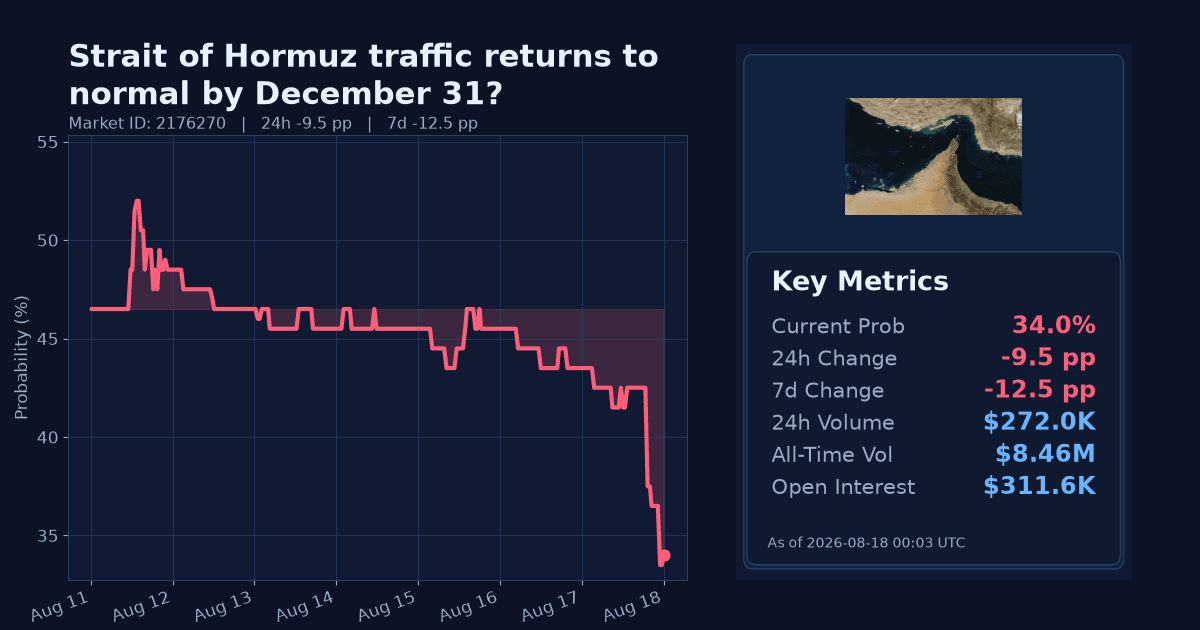
The Polymarket contract on whether Strait of Hormuz traffic “returns to normal” by December 31, 2026 (defined as IMF Portwatch’s 7‑day moving average of transit calls reaching ≥60 on any date between market creation on May 11, 2026 and year‑end) declined 9.5 percentage points over the past 24 hours to 34%.
Over the past week, the contract is down 12.5 percentage points. The move comes with elevated trading activity and a tight spread, indicating an active repricing rather than illiquidity.
Why It Likely Moved
- The repricing appears driven by reporting on August 17 that a 60‑day deadline tied to a proposed Iran peace deal is expiring without a final agreement, leaving core issues unresolved and near‑term uncertainty elevated, according to AP News.
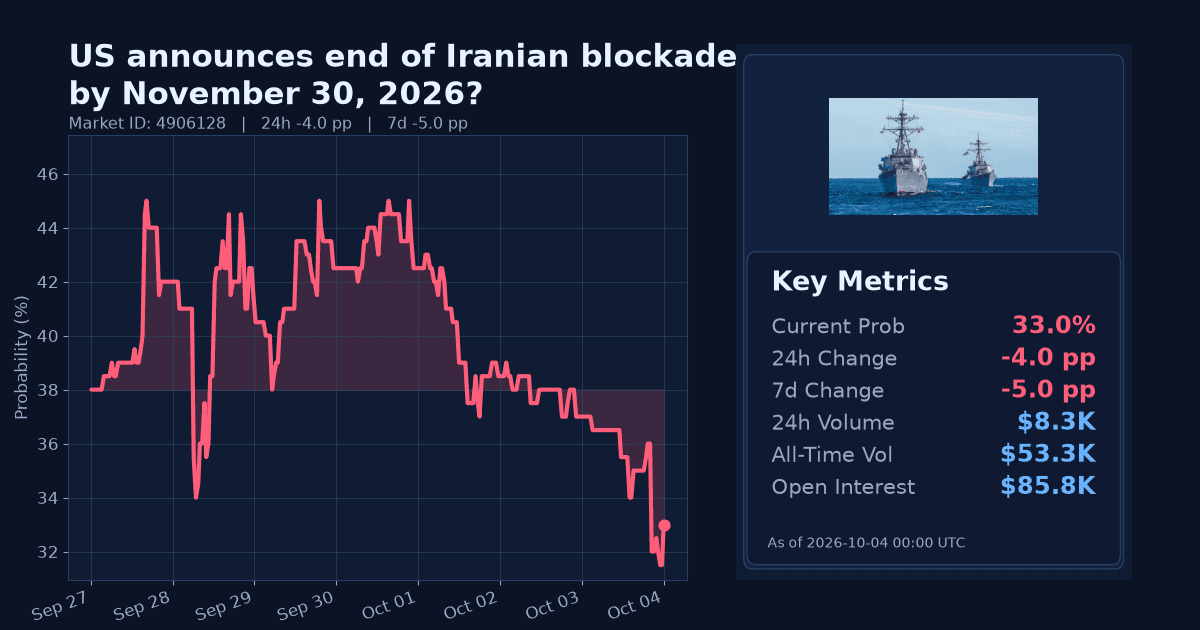
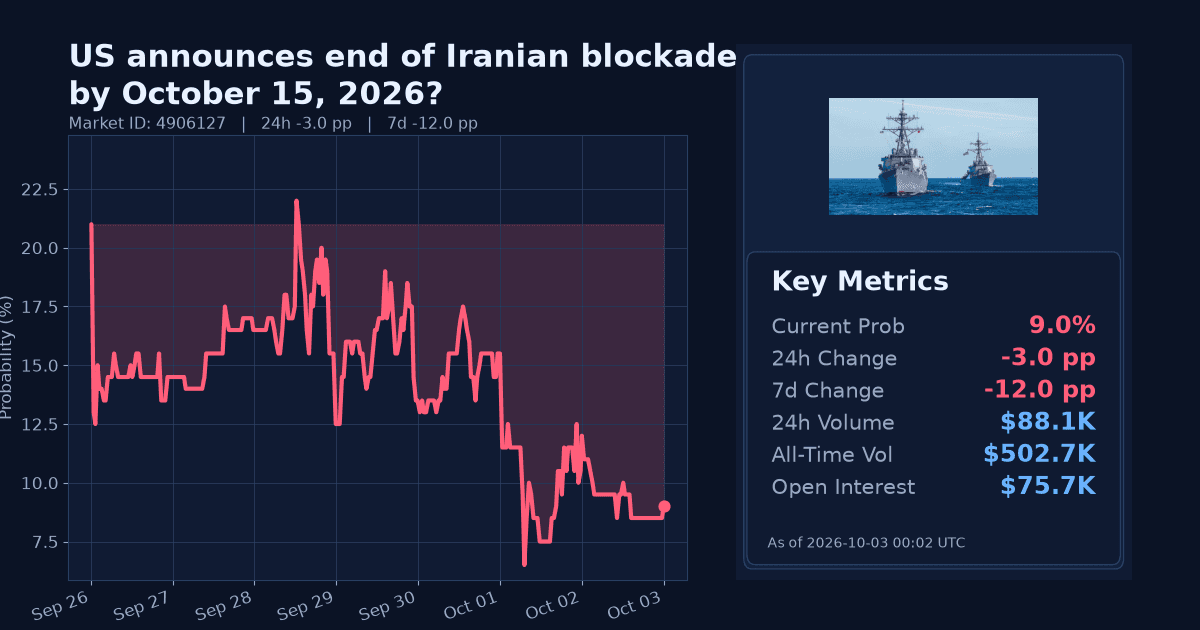
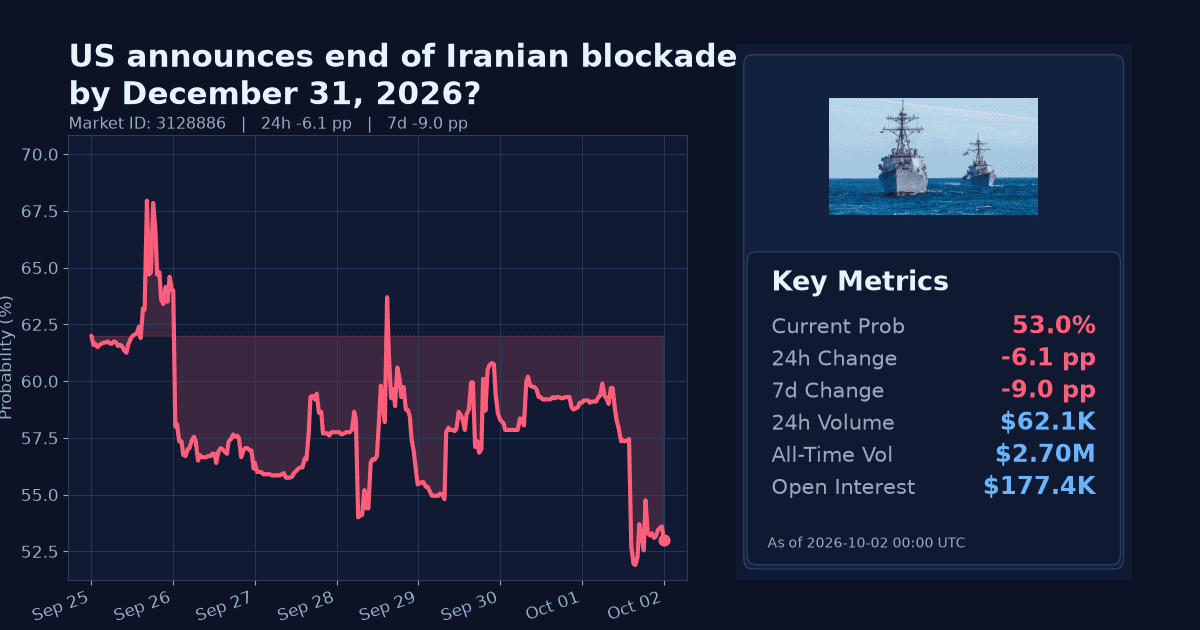
- Markets reacted to a broader softening in related geopolitical risk markets: a contract on a “US announces end of Iranian blockade by September 30, 2026” fell 7pp in 24h and 23.5pp over 7d, reinforcing reduced expectations for rapid de‑escalation.
- The downdraft also aligns with low odds in nearer‑dated Hormuz normalization markets (August 31 at 1.3% and September 30 at 10%), suggesting participants are discounting a swift rebound in IMF Portwatch traffic metrics before year‑end.
- Brent crude at $91.12/bbl is up 3.9% over the past week, providing a risk backdrop consistent with ongoing supply‑route uncertainty rather than immediate normalization (source: Yahoo Finance).
How Strong the Move Is
The 24‑hour decline (‑9.5pp) registers as an extreme move versus this market’s recent trading history (z‑score ~40), indicating a decisive shift in positioning. The 7‑day drop (‑12.5pp) is classified as sharp (z‑score ~2.8), suggesting this is more than routine noise.
Taken together, the pattern looks like a significant bearish repricing rather than a minor fluctuation. Follow‑through will likely depend on new data from IMF Portwatch or clear policy signals affecting passage through the Strait during the contract window.
Cross-Market Confirmation
- “US announces end of Iranian blockade by September 30, 2026?”: 24h −7.0pp; 7d −23.5pp. Direction aligns with weaker odds of near‑term de‑escalation.
- “Strait of Hormuz traffic returns to normal by September 30?”: 7d −4.0pp. Confirms a broader downshift in expectations for 2026Q3 normalization.
- “Strait of Hormuz traffic returns to normal by August 31?”: 24h +0.1pp; 7d −2.2pp. Essentially flat in 24h but lower on the week, in the same overall direction.
News & Real-World Context
- On August 17, AP News reported that a 60‑day deadline linked to an Iran deal is expiring without agreement, with key verification and sanctions issues unsettled. This sustains uncertainty around regional risk conditions through 2026.
- Also on August 17, AP News noted Iran is working to finalize an agreement with Oman related to the Strait of Hormuz. While a bilateral track exists, market pricing suggests this was not sufficient to offset broader uncertainty.
- A same‑day report highlighted rising diplomatic friction as Iran barred two French embassy employees from returning, per Ground News (August 17), adding to a cautious backdrop.
- No Hormuz‑specific official government statements were included in the provided set for the past 24 hours. Recent government releases instead covered unrelated topics, such as an Australian defence announcement on a Solomon Islands border outpost on August 17 by the Australian Department of Defence and EU parliamentary written questions on port safety and rail access on August 17 by the European Parliament.
Bottom Line
Traders cut year‑end normalization odds after news signaled no comprehensive Iran agreement at the deadline and related markets weakened. Absent new policy signals or a clear uptick in IMF Portwatch transit data to ≥60 on a 7‑day average before December 31, skepticism may persist.
Market Conditions at Time of Writing
- Current Probability: 34%
- 24h Change: −9.5pp
- 7d Change: −12.5pp
- Volume (24h, $): 271,955.55
- Open Interest ($): 311,554.96
- Spread (pp): 1.0
- Z-score (24h): 40.0