What Moved the Market
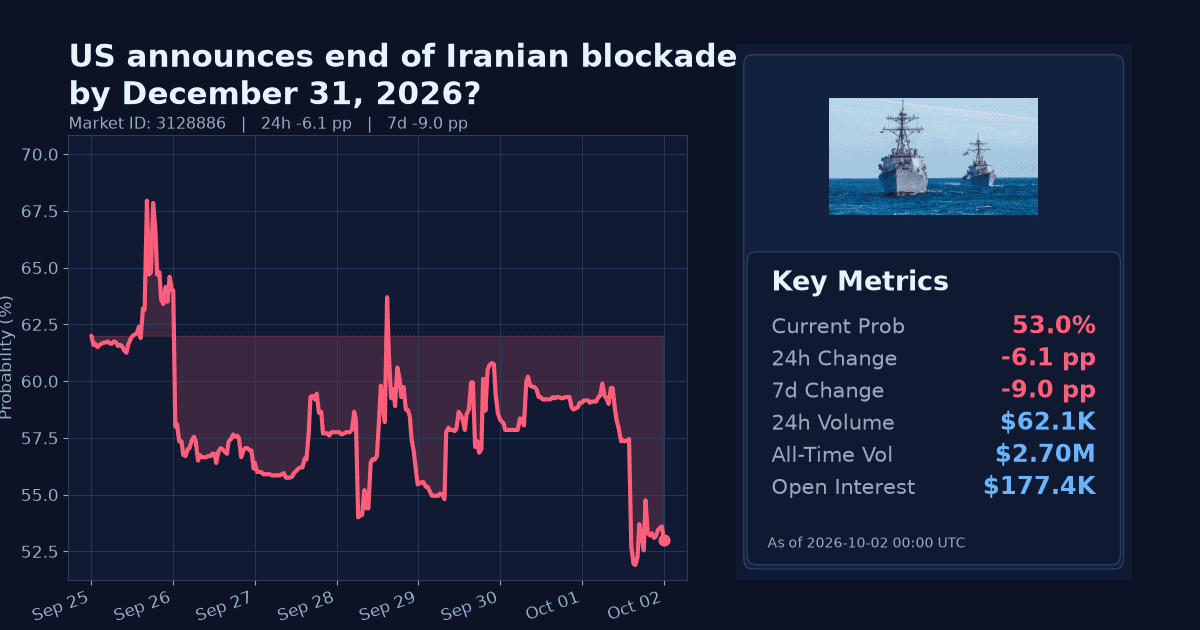
The Polymarket contract "US announces end of Iranian blockade by December 31, 2026?" fell 6.05 percentage points over the past 24 hours to 53%. Over the last seven days, the market is down 9 points. The contract resolves Yes if an authorized US government announcement ends, lifts, or suspends the US naval blockade of Iranian ships and customers before 11:59 PM ET on December 31, 2026.
Context: The blockade policy was announced on July 13, 2026, and the market’s resolution window runs from market creation (July 27, 2026) through the question’s deadline (December 31, 2026).
Why It Likely Moved
- Repricing appears driven by a firm multilateral sanctions signal: on October 1, the UK government told the UN General Assembly that “UN sanctions on Iranian proliferation remain fully in force,” despite vetoes affecting the Panel of Experts’ mandate, underscoring continued international pressure on Iran (UK government, 2026-10-01).
- Markets reacted to domestic enforcement news implicating an Iran-aligned proxy: the FBI arrested a US Energy Department employee on charges of attempting to support the Iran-backed Houthi movement in Yemen, according to AP reporting on October 1, reinforcing a hardline security posture (AP News, 2026-10-01).
- The repricing follows broader US sanctions tightening signals, albeit on a different file: the State Department announced new Cuba sanctions regulations on September 30, highlighting a general escalation in economic pressure tools rather than de-escalation (US State Department, 2026-09-30).
- Macro context likely played a secondary role: Brent crude is at $102.45/bbl (down 3.9% over 7 days, up 8.2% over 30 days), the US Dollar Index is up 0.69% over 7 days, and the VIX is up 4.6% over 7 days — a backdrop suggesting the move is more policy-signal driven than a response to immediate oil price relief.
How Strong the Move Is
By statistical measures, the shift is sharp. The 24-hour move carries an extreme z-score of 21.8, indicating an unusually large decline versus recent trading history. The 7-day move is also extreme (z-score ~3.73), pointing to persistent downward pressure.
Given a 6.05pp drop in 24 hours and 9pp over the week, this is a significant, statistically unusual repricing rather than routine noise.
Cross-Market Confirmation
- Earlier-deadline variant (Oct 31, 2026): down 5pp in 24h and 6pp in 7d to 25%, confirming a synchronized downward reassessment.
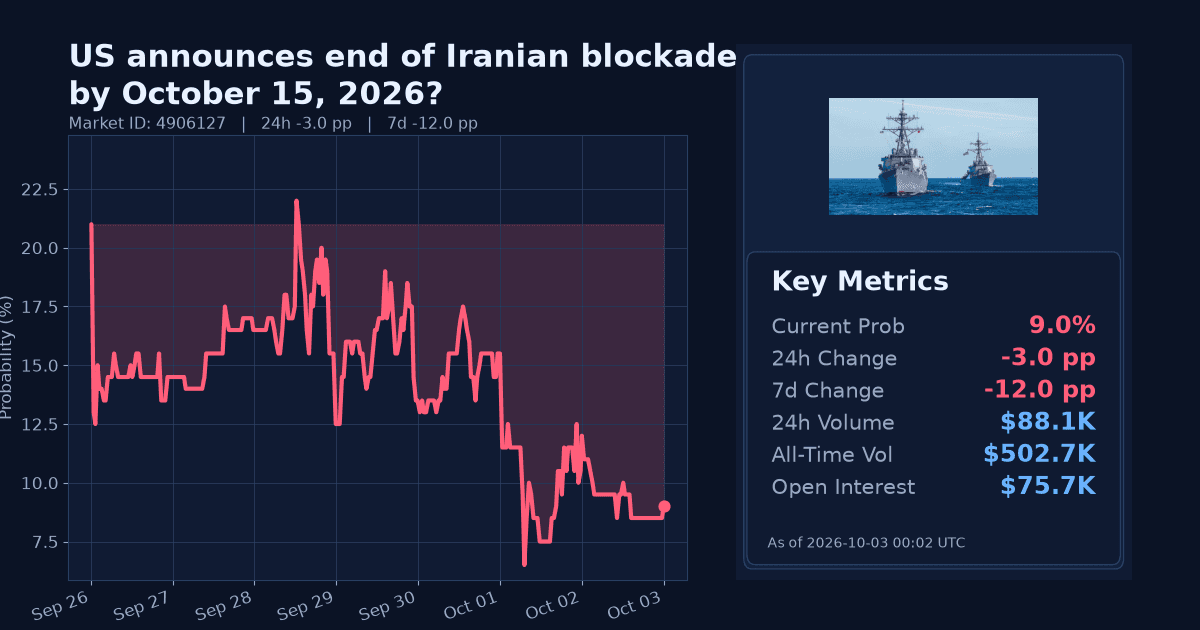
- Near-term variant (Oct 15, 2026): down 5pp in 24h and 8pp in 7d to 12%, also confirming the main move.
- Related geopolitical risk market (US invades Iran before 2027): no notable 24h/7d change (current ~15%), suggesting no simultaneous broad escalation pricing; this is neutral rather than a confirmation.
News & Real-World Context
- On October 1, the UK’s Permanent Representative stated at the UN General Assembly that, despite vetoes impacting the Panel of Experts, UN sanctions on Iranian proliferation “remain fully in force,” signaling continued international compliance expectations and scrutiny (UK government, 2026-10-01).
- On October 1, AP reported the FBI arrested an Energy Department employee on charges of attempting to support the Iran-backed Houthis in Yemen — a case highlighting active enforcement against actors tied to Iran’s regional proxies (AP News, 2026-10-01).
- On September 30, the US State Department announced tightened Cuba sanctions via OFAC regulations implementing Executive Order 14404, reflecting a broader posture of intensifying sanctions and economic pressure tools (US State Department, 2026-09-30).
Bottom Line
Traders marked down the probability that the US will officially announce the end or suspension of the Iran naval blockade by December 31, 2026. The move appears driven by firm sanctions and enforcement signals rather than macro pressures.
Absent offsetting, authoritative US policy communications, the shift looks like a short-term but notable reassessment that could persist.
Market Conditions at Time of Writing
- Current Probability: 53%
- 24h Change: -6.05pp
- 7d Change: -9.0pp
- Volume (24h, $): 62,054.48
- Open Interest ($): 177,368.03
- Spread (pp): 1.0
- Z-score (24h): 21.8