What Moved the Market
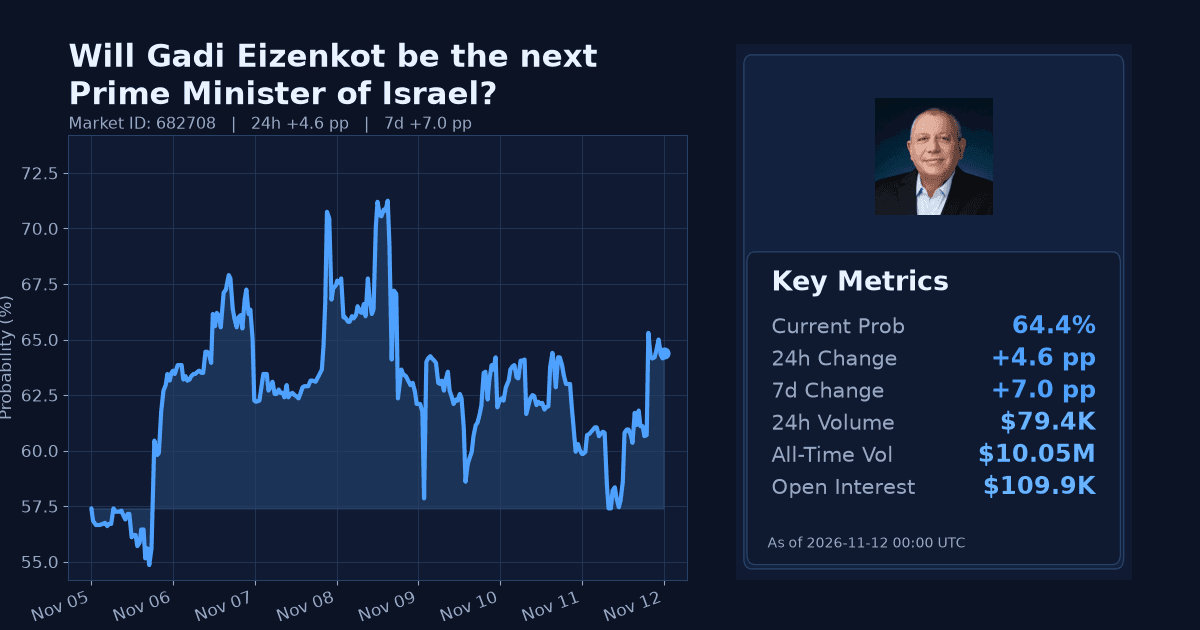
Polymarket’s contract on whether Gadi Eizenkot will be the next Prime Minister of Israel moved higher. The market concerns the individual formally appointed and sworn in as prime minister after Israel’s parliamentary election process; interim or caretaker roles do not count.
The contract data show a market window from November 15, 2025 to October 28, 2026, with resolution tied to official Government of Israel information or a consensus of credible reporting. At the time of writing, Eizenkot is priced as the leading listed outcome.
Why It Likely Moved
- The repricing appears driven primarily by a leadership-substitution trade: the related Benjamin Netanyahu next-prime-minister market moved lower over the same period, indicating traders were reallocating probability away from Netanyahu and toward Eizenkot rather than simply adding broad uncertainty.
- Markets reacted to official diplomatic signals involving Israel. On November 10, the European Parliament published a written question on the timeline for a proposed suspension of trade preferences under the EU-Israel Association Agreement, keeping EU-Israel policy pressure in view.
- The move also follows a broader official foreign-affairs calendar. On November 11, Global Affairs Canada published the G7 foreign ministers’ joint statement from Paris, marking continued high-level diplomatic engagement by major governments.
- The available news set does not contain a direct Eizenkot candidacy or Israeli coalition-development article. That makes the observed move look more like market-led political repricing than a response to a single supplied news headline.
- Broader macro risk conditions do not fully explain the move. The VIX was 17.49 and up 5.30% over seven days, while Brent crude was $92.45 per barrel and down 2.29% over seven days, suggesting the Eizenkot move is more specific than a simple regional-risk or oil-shock trade.
How Strong the Move Is
The market rose 4.55 percentage points over 24 hours and 7.00 percentage points over seven days. Its 24-hour z-score is 15.8, which the supplied market data classify as an extreme upward move relative to this contract’s recent trading history.
The seven-day z-score is 3.471, classified as a sharp upward move. Taken together, the price action is best described as a significant spike that also extends a short weekly trend, not ordinary noise.
Cross-Market Confirmation
- The Netanyahu next-prime-minister market confirms the main move directionally: it fell 1.6 percentage points over 24 hours and 7.6 percentage points over seven days, consistent with a zero-sum leadership repricing.
- The “U.S. invade Iran before 2027” market provides mixed confirmation for regional-risk narratives: it rose 1.0 percentage point over 24 hours but remains down 3.0 percentage points over seven days.
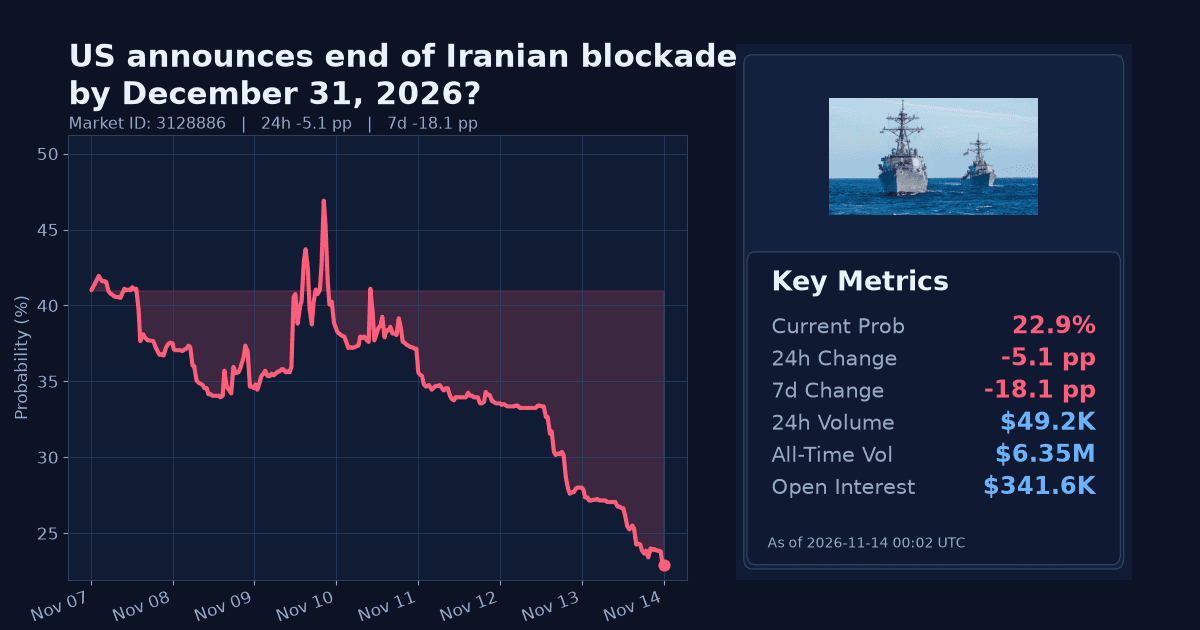
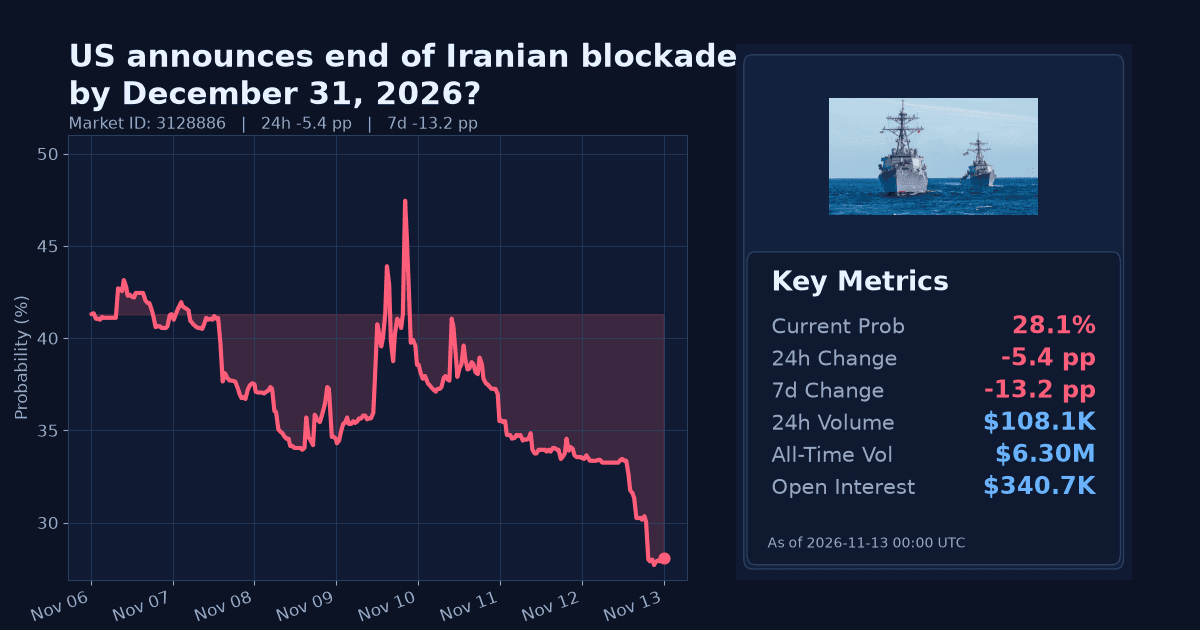
- The “US announces end of Iranian blockade by November 30, 2026” market diverges from a simple de-escalation interpretation, falling 3.0 percentage points over 24 hours and 12.0 percentage points over seven days.
News & Real-World Context
- On November 10, the European Parliament published a written question asking about the timeline for the proposed suspension of trade preferences under the EU-Israel Association Agreement. This is an official EU policy signal and is the most directly Israel-relevant government item in the supplied context.
- On November 11, Global Affairs Canada published the G7 foreign ministers’ joint statement following the Paris meeting held on November 9-10. The statement is relevant as an official diplomatic signal, though the supplied excerpt does not specify Israeli domestic politics.
- Other official items in the correlated set are foreign-affairs related but not directly tied to Israel’s leadership market: the UK government published a COP31 speech on November 11, the UK government published a second COP31 speech the same day, and Denmark’s foreign-affairs notice came via Ritzau on November 10.
- The provided news articles do not supply a direct Israeli election catalyst. The closest election-related item is a November 11 report that Eric Zemmour will stand in France’s 2027 presidential election, according to Ground News; another article concerns a possible FIFA presidency challenge involving Arsène Wenger, also via Ground News. These are not treated as direct drivers of the Eizenkot market.
Bottom Line
The Eizenkot contract’s rise is large by this market’s own recent standards and is most clearly supported by a corresponding decline in Netanyahu’s odds. The move appears short-term-to-uncertain rather than clearly structural, because the supplied evidence contains official Israel-related diplomatic context but no direct news catalyst on Eizenkot or Israel’s post-election government formation.
Market Conditions at Time of Writing
- Current Probability (%): 64.4
- 24h Change (pp): 4.55
- 7d Change (pp): 7.00
- Volume (24h, $): 79,363.86
- Open Interest ($): 109,885.03
- Spread (pp): 1.2
- Z-score (24h): 15.8