What Moved the Market
The Polymarket contract asks whether Pete Hegseth will cease to be U.S. Secretary of Defense at any point between the market start date, April 1, 2026, and the contract end date, January 1, 2027. It also resolves “Yes” immediately if a resignation or removal is announced before the end date.
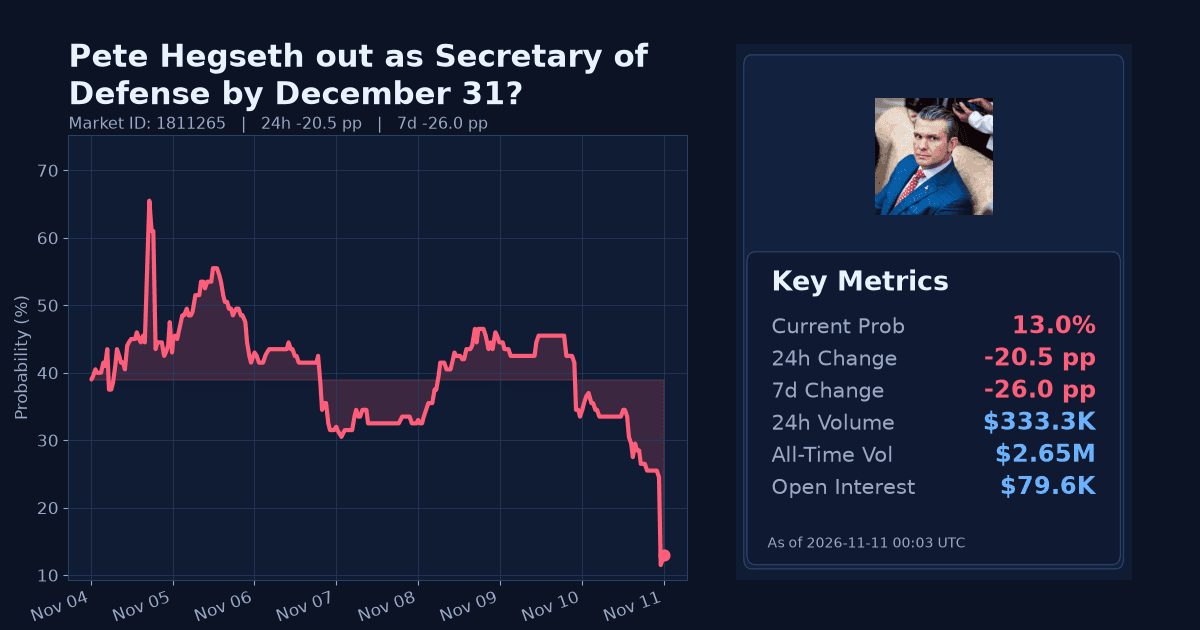
As of November 11, the market moved sharply lower. The “Yes” probability fell to 13.0%, down 20.5 percentage points over 24 hours and down 26.0 points over the past week.
Why It Likely Moved
- The repricing appears driven by traders reassessing the likelihood that impeachment pressure translates into an actual departure before the contract deadline.
- Markets reacted to reporting that the House was set to vote on impeaching Hegseth, but that lawmakers faced significant obstacles to removing him from office.
- Official U.S. government messaging likely reduced perceived near-term exit risk: a November 10 government release described Hegseth publicly defending his record while facing the threat of impeachment.
- A separate November 9 official announcement showing Hegseth issuing military education reforms reinforced that he was still publicly exercising authority rather than exiting the role.
- The broader risk backdrop did not show a fresh volatility shock: the VIX stood at 19.46 and was down 6.58% over seven days, limiting support for a wider crisis-driven personnel premium.
How Strong the Move Is
This is a significant downward repricing, not routine noise. The 24-hour move is classified as extreme to the downside, with a 24-hour z-score of 88.0, meaning it is far outside this market’s recent trading pattern.
The weekly move also confirms follow-through rather than a single isolated tick. The seven-day decline is classified as sharp, with a 7-day z-score of 2.378236. Taken together, the move looks like an extreme short-term spike lower within a broader one-week downward trend.
Cross-Market Confirmation
- The market on whether the U.S. announces an end to the Iranian blockade by December 31, 2026 also moved lower, at 35.6%, down 2.95 points over 24 hours and 2.45 points over seven days. That directionally aligns, but it is not a direct personnel signal.
- The November 15, 2026 Iranian blockade deadline market fell to 3.4%, down 1.35 points over 24 hours and 6.15 points over seven days. This confirms weaker pricing in adjacent U.S. defense-policy markets.
- The November 30, 2026 Iranian blockade deadline market stood at 14.0%, down 2.0 points over 24 hours and 10.0 points over seven days. It broadly aligns with the main move, though the linkage to Hegseth’s tenure is indirect.
News & Real-World Context
The highest-signal official context is the November 10 U.S. government announcement stating that Hegseth, while facing impeachment threats, argued that “impeachment over policy disagreement” would send the wrong signal to adversaries and detailed operations conducted on his watch, according to the U.S. War Department. That is a primary official signal that he was publicly contesting the case against him, not announcing a resignation or removal.
A second official release on November 9 said Hegseth mandated military education reform during a speech at the U.S. Naval War College, according to the U.S. War Department. The most directly relevant news report, published November 10, said the House was set to vote on impeaching Hegseth but emphasized that lawmakers faced significant obstacles to actually removing him from office, according to NPR.
Bottom Line
The market is now pricing Hegseth’s departure by January 1, 2027 as substantially less likely, despite continued impeachment activity. The move appears primarily short-term and headline-driven, but the weeklong decline gives it trend characteristics; whether it becomes structural depends on official resolution-relevant developments.
Market Conditions at Time of Writing
- Current Probability (%): 13.0
- 24h Change (pp): -20.5
- 7d Change (pp): -26.0
- Volume (24h, $): 333,257.01
- Open Interest ($): 79,631.67
- Spread (pp): 1.0
- Z-score (24h): 88.0