What Moved the Market
The market asks whether the U.S. government will publicly and officially announce the end, lifting, termination, or suspension of its naval blockade on Iranian ships and ships of Iranian customers by Dec. 31, 2026. The contract window runs from market creation on July 27, 2026, through 11:59 p.m. ET on Dec. 31, 2026.
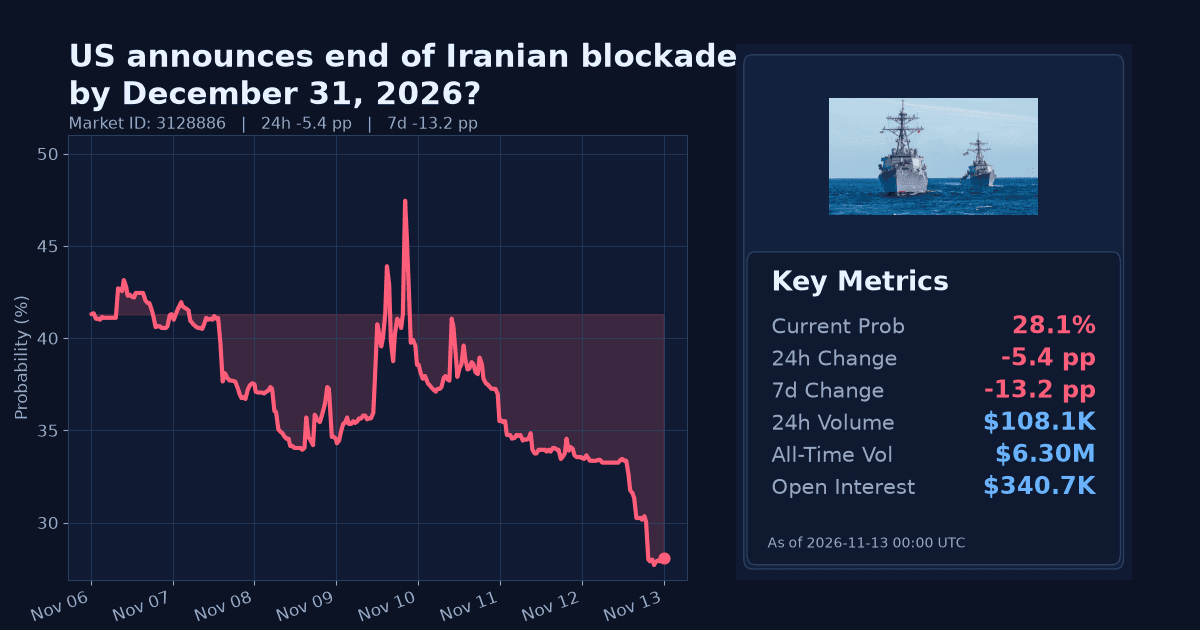
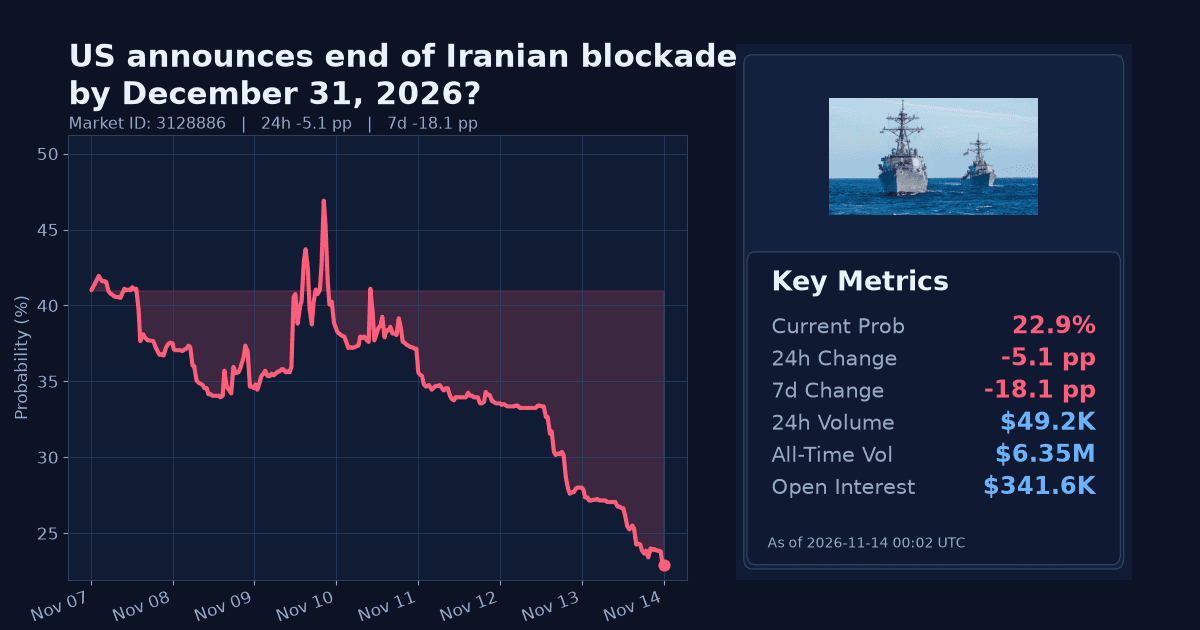
The “Yes” price moved lower over both the daily and weekly horizons. Traders are now assigning materially less probability to a qualifying U.S. announcement before the contract deadline.
Why It Likely Moved
- The repricing appears driven by evidence that U.S. Iran policy is being framed as maintaining the “status quo,” rather than moving toward a public reversal of the blockade.
- Markets reacted to official-policy context that points more toward pressure on Iran than de-escalation: Canada announced the reimposition of sanctions on Iranian entities, while no provided U.S. government item announced a blockade suspension.
- The contract’s resolution standard is narrow: only a clear and official U.S. government announcement ending or suspending the blockade qualifies. Related diplomatic or third-party statements do not resolve the market.
- Macro context does not show an obvious oil-shock pressure point forcing a policy reversal: Brent crude was at $96.08/bbl, down 2.28% over seven days and 9.41% over 30 days as of Nov. 13.
- The move also appears reinforced by related Polymarket contracts with earlier deadlines repricing lower in the same direction.
How Strong the Move Is
This is an extreme downside move rather than routine noise. The contract fell 5.1 percentage points over 24 hours and 18.1 percentage points over seven days. The 24-hour z-score is 20.8, and the seven-day z-score is 15.450946; both supplied interpretations classify the move as extreme to the downside relative to this market’s recent trading history.
Given the size and persistence across the observed week, the action looks like a sharp continuation of a bearish repricing rather than a one-off fluctuation. The move is significant because it occurred while the contract remains inside the active resolution window and still more than six weeks from the Dec. 31 deadline.
Cross-Market Confirmation
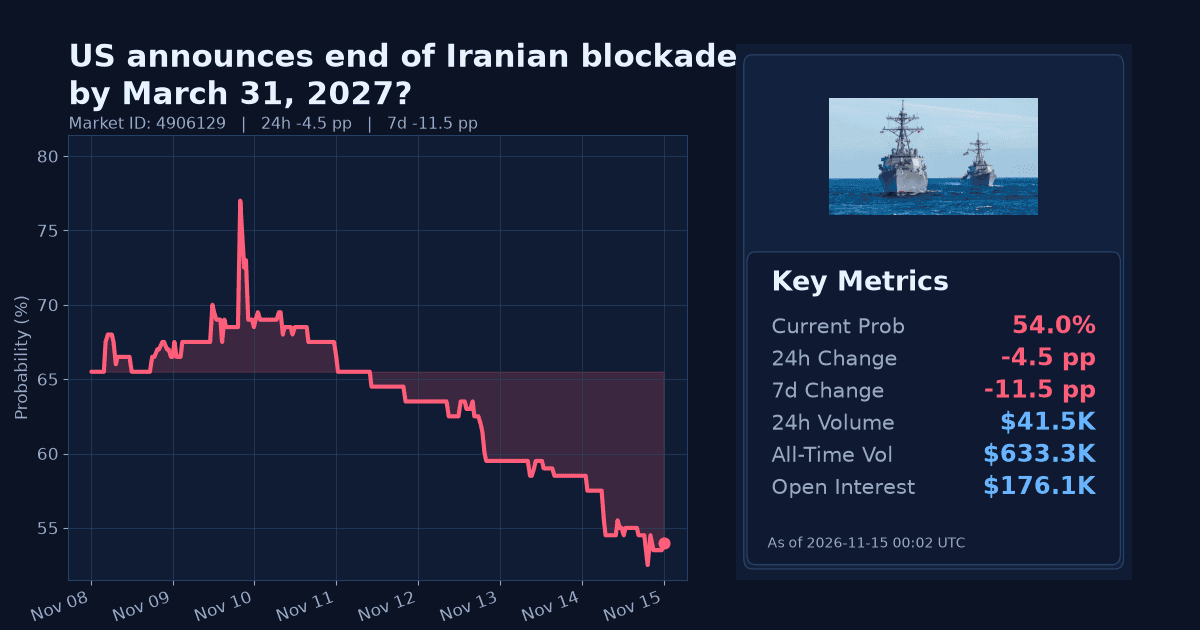
- The Nov. 30 version of the same blockade-ending question confirms the main move: it is down 2.0 pp over 24 hours and down 14.0 pp over seven days.
- The Nov. 15 version also confirms the direction, with a smaller 24-hour decline of 0.1 pp and a 5.95 pp drop over seven days.
- The Iran full-airspace-closure market gives a mixed signal rather than direct confirmation: it rose 1.5 pp over 24 hours but is down 4.5 pp over seven days.
News & Real-World Context
- On Nov. 13, 2026, NPR reported that Trump’s Iran strategy was to keep conditions “as they are,” describing a shift toward preserving the status quo and relying more on economic pressure amid a stalemate in the Iran conflict, according to NPR.
- On Nov. 10, 2026, the Canadian government announced it was reimposing sanctions against 11 Iranian entities previously delisted in 2016, citing Iran’s nuclear and missile-related activity; Global Affairs Canada published both the sanctions announcement and Minister Anand’s statement through official channels (Canada announcement, ministerial statement).
- On Nov. 13, 2026, the European Parliament published a written question concerning U.S. sanctions against the International Criminal Court and potential EU protective measures, an official foreign-affairs signal but not a U.S. blockade-ending announcement (European Parliament).
- On Nov. 12, 2026, the UK government issued an explanation of vote at the UN Security Council on Yemen sanctions, saying the resolution showed determination to act against Houthi attacks; the same day, it also published a joint statement on health and humanitarian access into Gaza (UK Yemen statement, UK Gaza statement).
- Other recent U.S. news concerned a nationwide FAA ground stop after communications failures, reported Nov. 13 by TechCrunch and Wired. That reporting is not a qualifying Iran-policy announcement under this market’s rules.
Bottom Line
The downside move is best read as a sharp repricing away from a near-term U.S. announcement ending the Iran blockade. The evidence points to status quo policy language and sanctions-oriented official signals, while no provided U.S. government source meets the contract’s narrow resolution test. The move appears near-term and event-sensitive, but its seven-day scale makes it more than ordinary noise.
Market Conditions at Time of Writing
- Current Probability (%): 22.9
- 24h Change (pp): -5.1
- 7d Change (pp): -18.1
- Volume (24h, $): 49,217.43
- Open Interest ($): 341,617.09
- Spread (pp): 0.3
- Z-score (24h): 20.8