What Moved the Market
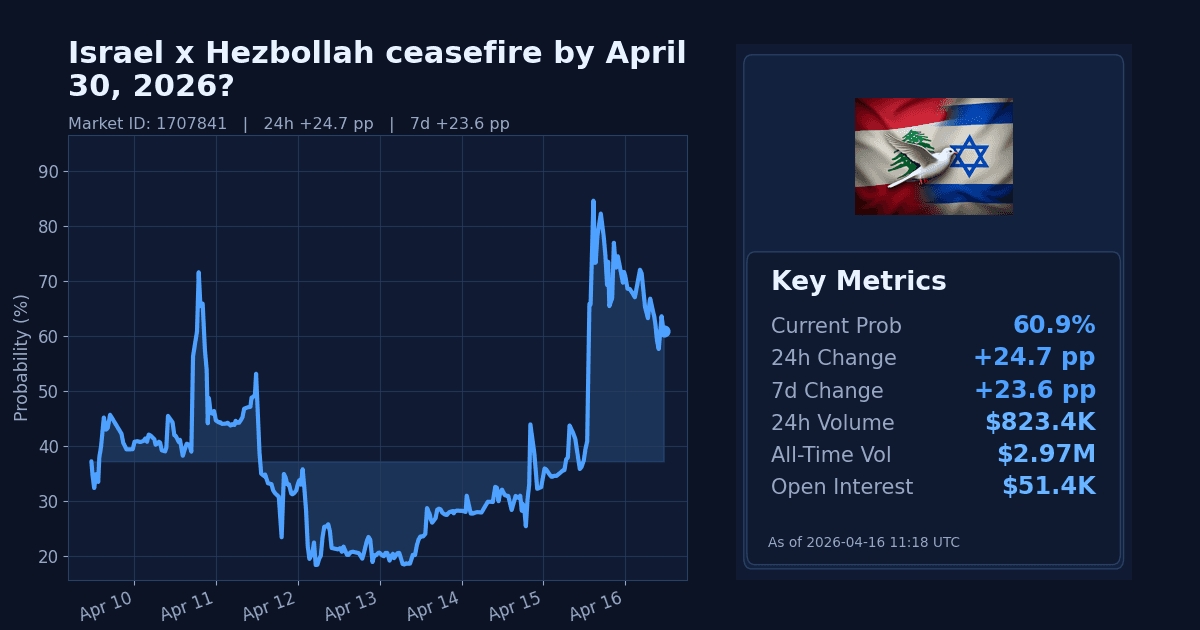
The Polymarket contract on whether Israel and Hezbollah will reach an official ceasefire by April 30, 2026 rose sharply to 60.9%. Over the past 24 hours, pricing climbed by 24.7 percentage points, with a 7‑day gain of 23.65pp.
This repricing occurs two weeks before the market’s end date (April 30, 2026, 11:59 PM ET), within a narrow window where any formal agreement announced prior to expiry would resolve the market “Yes,” even if it takes effect later.
Why It Likely Moved
- The jump appears driven by news of new direct talks between Lebanon and Israel, mediated by the United States, primarily on maritime boundaries and framed as risk reduction amid Hezbollah’s presence, according to AP News on April 15, 2026 (AP News).
- Repricing follows an April 14, 2026 joint statement on Lebanon by foreign ministers from multiple countries published by the UK government, signaling coordinated diplomatic attention to the Lebanon file (UK government, 14 Apr 2026).
- Markets reacted to increased EU institutional scrutiny, including European Parliament written questions on Israel’s recent attacks on Lebanon (Apr 13, 2026) and on EU–Israel relations (Apr 14, 2026), which underline external political pressure on the conflict environment (European Parliament, 13 Apr 2026; European Parliament, 14 Apr 2026).
- Macro context is not signaling a new regional risk premium: Brent crude sits at $95.72/bbl, roughly flat over 7 days (-0.21%), which is consistent with the market reading of reduced immediate escalation risk in the region (Yahoo Finance).
- With the contract ending April 30, traders may be more sensitive to incremental diplomatic signals that could produce a late-breaking, formally announced ceasefire.
How Strong the Move Is
The 24-hour move is extreme by historical standards for this market (z-score ~97), indicating a sharp, event-driven repricing rather than routine drift. The 7‑day change is also characterized as sharp (z-score ~2.61).
Given the contract’s short remaining window and the magnitude of the single-day gain, this looks like a spike catalyzed by new diplomatic signals, rather than a slow trend. Follow-through will likely depend on the emergence of explicit, mutual ceasefire language between Israel and Hezbollah within the contract window.
Cross-Market Confirmation
- “Military action against Iran ends by April 17, 2026?”: +24.45pp (7d). This aligns with broader de-escalation pricing; 24h change not reported.
- “US × Iran permanent peace deal by April 30, 2026?”: +7.0pp (24h), +24.5pp (7d). Directionally supportive of a diplomacy-led shift.
- “US × Iran permanent peace deal by April 22, 2026?”: -5.0pp (24h), +5.0pp (7d). Short-term divergence, though weekly change remains slightly positive.
Overall, related markets mostly confirm a de-escalatory tilt over the week, with minor near-term dispersion.
News & Real-World Context
AP News reported on April 15, 2026 that Lebanon and Israel opened new direct talks, mediated by the United States, focused on maritime boundary issues and offshore energy, and framed by officials as a way to reduce escalation risk amid Hezbollah’s presence in Lebanon (AP News, 15 Apr 2026).
Government signals have been active. On April 14, 2026, the UK government published a joint statement on Lebanon by foreign ministers from a broad group of countries, marking coordinated diplomatic messaging on the situation (UK government, 14 Apr 2026). Within the EU, written questions recorded by the European Parliament addressed Israel’s recent attacks on Lebanon (Apr 13, 2026) and broader EU–Israel policy considerations (Apr 14, 2026), indicating heightened scrutiny from EU institutions (European Parliament, 13 Apr 2026; European Parliament, 14 Apr 2026).
While not determinative of ceasefire outcomes, these developments collectively increase the visibility of diplomatic processes that could affect cross-border hostilities within the contract window.
Bottom Line
Pricing for an Israel–Hezbollah ceasefire by April 30, 2026 has spiked on tangible diplomatic signals: renewed Israel–Lebanon talks and multiple official statements focusing on Lebanon. The move appears event-driven and near-term; confirmation would require explicit, mutual ceasefire language from Israel and Hezbollah before the deadline.
Market Conditions at Time of Writing
- Current Probability: 60.9%
- 24h Change: +24.7pp
- 7d Change: +23.65pp
- Volume (24h, $): 823,386
- Open Interest ($): 51,352.84
- Spread (pp): 0.6
- Z-score (24h): 97.0