What Moved the Market
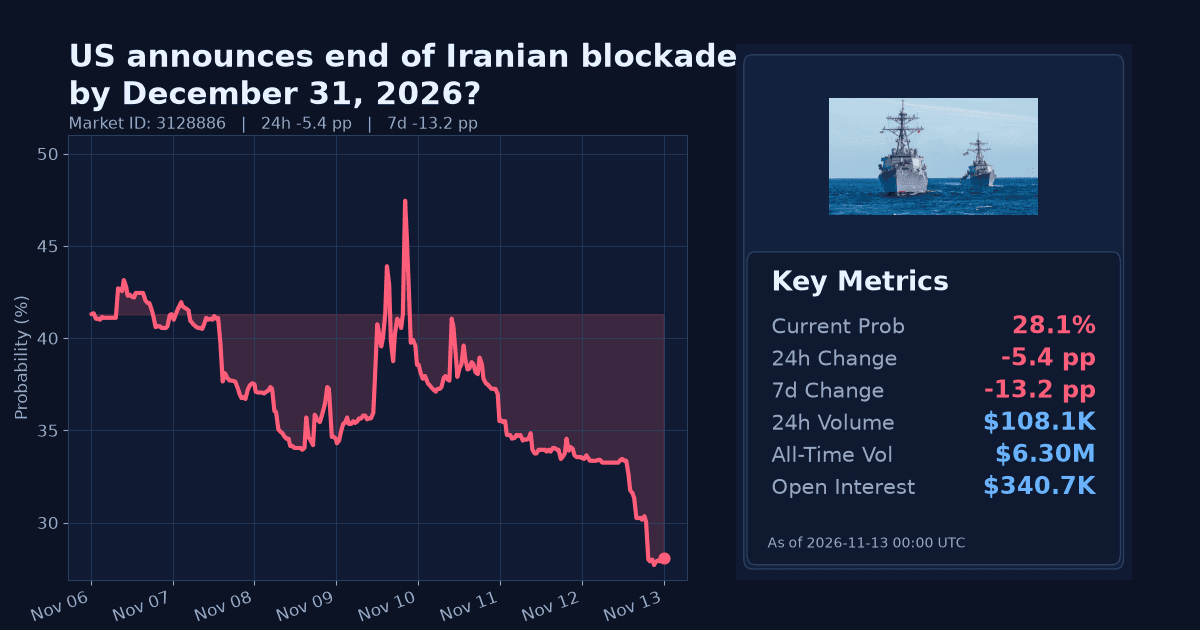
The Polymarket contract asks whether the United States will officially announce the end, lifting, termination, or suspension of its naval blockade on Iranian ships and ships of Iranian customers by December 31, 2026. The contract window runs from market creation on July 27, 2026, through 11:59 PM ET on December 31, 2026.
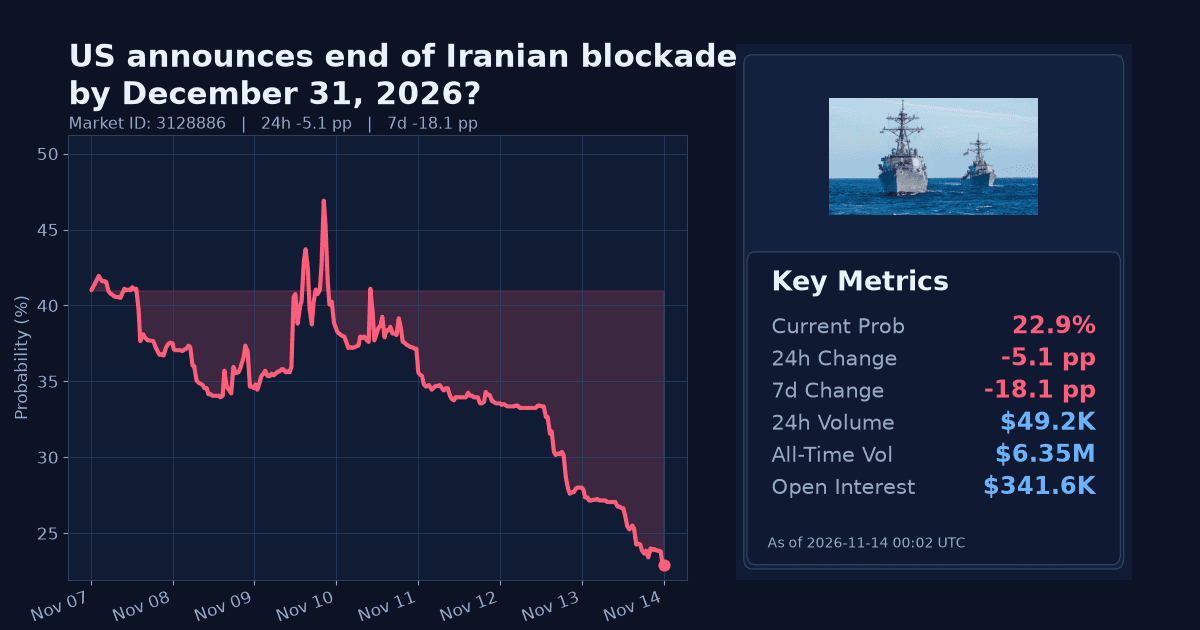
The Yes price moved lower over the latest trading window, with the market now pricing a materially lower chance of a qualifying US announcement before the deadline. The move extends a broader week-long decline rather than standing as a one-off intraday adjustment.
Why It Likely Moved
- The repricing appears driven by the absence, in the supplied context, of any official US announcement that would satisfy the market’s resolution criteria. This market resolves on a clear US government statement, not on third-party reporting or inferred policy change.
- Markets reacted to official allied policy signals that remain confrontational toward Iran. Canada announced on November 10 that it was reimposing sanctions on 11 Iranian entities, including entities tied to proliferation-sensitive nuclear activity and ballistic missile programs.
- The decline also appears linked to weaker adjacent diplomacy pricing. A related US-Iran final nuclear deal market by December 31, 2026, also moved lower, which is directionally consistent with reduced expectations for a broader negotiated de-escalation.
- The contract’s deadline is now close enough that time decay matters: with the end date fixed at December 31, 2026, each day without a qualifying US announcement reduces the remaining window for Yes resolution.
- Macro context does not show a clear oil-market stress signal that would independently support a rapid blockade reversal. Brent crude was at $95.78/bbl as of November 12, down 2.55% over seven days, according to the supplied market data.
How Strong the Move Is
This is a significant downside move. The 24-hour z-score is classified as extreme to the downside, indicating that the latest fall is unusually large relative to this market’s recent trading history.
The seven-day signal is also extreme to the downside, so the move is best characterized as a sharp trend continuation rather than noise or a clean reversal. The available price series begins on November 6, so the statistical comparison is based on a short recent trading window, but both short- and week-long measures point in the same direction.
Cross-Market Confirmation
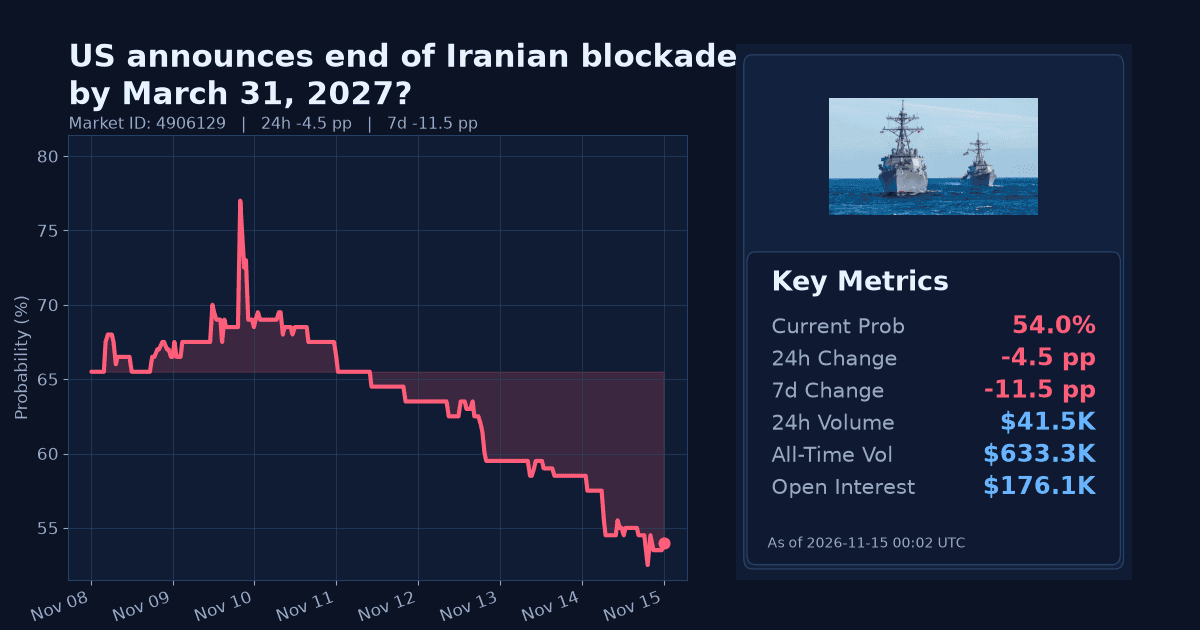
- The November 30, 2026 version of the same blockade-end question confirms the main move: it fell 3.0 pp over 24 hours and 13.0 pp over seven days, showing similar pressure on nearer-dated resolution odds.
- The November 15, 2026 version also confirms the direction, though with a smaller remaining probability base: it moved down 1.05 pp over 24 hours and 6.85 pp over seven days.
- The US-Iran final nuclear deal market by December 31, 2026 diverges slightly on the weekly horizon but confirms the immediate direction, falling 5.0 pp over 24 hours and 1.0 pp over seven days.
News & Real-World Context
The clearest official policy development in the supplied context is Canadian. On November 10, the Government of Canada announced the reimposition of sanctions against 11 Iranian entities previously delisted in 2016. A companion announcement from Foreign Affairs Minister Anita Anand stated that the entities were sanctioned under the Special Economic Measures (Iran) Regulations for contributing to Iran’s proliferation-sensitive nuclear activities, ballistic missile program, or financing of malign activities, according to the Canadian government.
Other official diplomatic material in the supplied set is less directly tied to Iran. The UK government published a November 12 joint statement on humanitarian access into Gaza, and France’s foreign ministry noted a November 12 G7 foreign-ministerial engagement involving Marco Rubio, according to France Diplomatie. Recent news items in the supplied context focus mostly on Ukraine and US support dynamics, including comments attributed to Emmanuel Macron that there is “no more US support” for Ukraine reported by Ground News, and reporting on renewed Starshield-related disruption claims by Ukraine in Ars Technica. These items indicate a broader security-policy news cycle but do not themselves establish an Iran blockade reversal.
Bottom Line
The market’s decline looks tied to a lack of qualifying US action and to official allied signals that remain restrictive toward Iran. Cross-market pricing broadly confirms the direction of the move. The repricing appears short-term and deadline-sensitive, though the repeated downside across related markets makes it more than routine noise.
Market Conditions at Time of Writing
- Current Probability (%): 28.1
- 24h Change (pp): -5.4
- 7d Change (pp): -13.2
- Volume (24h, $): 108119.6
- Open Interest ($): 340693.93
- Spread (pp): 0.2
- Z-score (24h): 21.6