
G7
A forum of major advanced democracies coordinating on economic policy, sanctions, security, climate, technology, and development
The G7 is an informal forum of major advanced democracies that coordinates on economic policy, sanctions, security, climate, technology, development, and global agenda-setting.
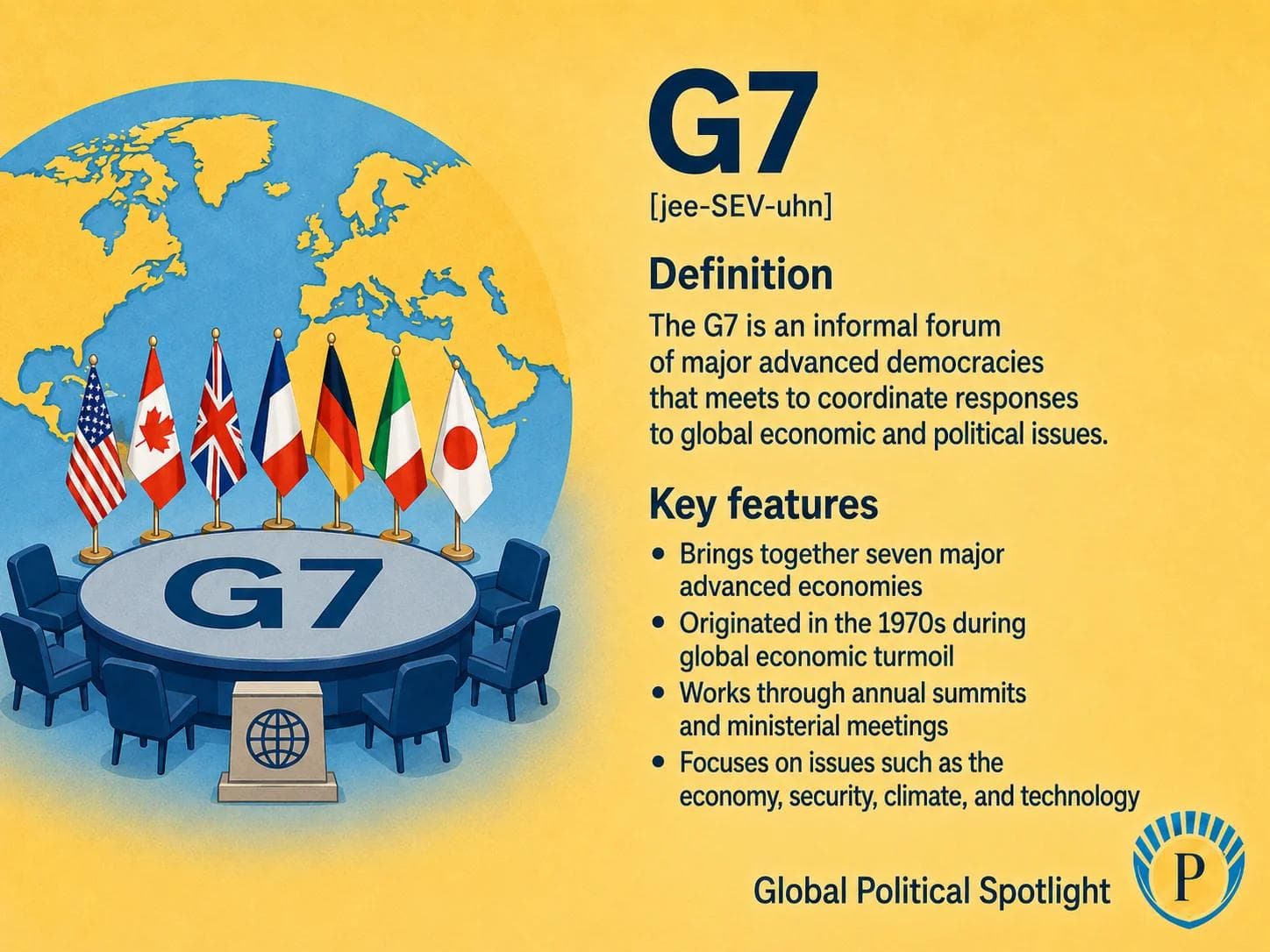
Definition
The G7, or Group of Seven, is an informal forum of major advanced democracies: Canada, France, Germany, Italy, Japan, the United Kingdom, and the United States. The European Union also participates in G7 work, although it is not counted as one of the seven member states.
The forum grew out of 1970s economic coordination among major industrialized economies and now covers a broad agenda that includes macroeconomic policy, financial stability, sanctions, development finance, energy security, climate policy, technology governance, health, and international security.
The G7 is not a treaty organization and does not have a permanent legal enforcement mechanism. Its influence comes from summit diplomacy, ministerial coordination, shared financial power, policy alignment, and the ability of its members to coordinate national measures through their own governments and institutions.
Why It Matters
The G7 matters because its members control large advanced economies, major reserve currencies, leading financial systems, advanced technology sectors, and significant diplomatic and military capabilities. When they coordinate, they can shape sanctions, export controls, development finance, debt relief, climate commitments, and global regulatory standards.
Its sanctions coordination has become especially important in crises involving Russia, Iran, North Korea, and other security issues. G7 alignment can amplify financial restrictions, trade controls, price caps, asset freezes, and technology limits because member states sit at the center of global banking, insurance, shipping services, and high-end supply chains.
The G7 also functions as an agenda-setting club. Even without formal enforcement power, its communiqués and leader statements often signal what advanced democracies will push in the G20, IMF, World Bank, OECD, WTO, NATO, UN climate talks, and other institutions.
GPS should track the G7 as a high-impact coordination forum for advanced democratic economies. Key watchpoints include sanctions packages, Russia-related asset and finance decisions, China-related economic security language, technology and export-control coordination, climate finance, development initiatives, debt policy, supply-chain resilience, and whether G7 positions translate into wider G20 or multilateral outcomes.
Key Facts
- Type
- Informal summit forum of major advanced democracies
- Members
- Canada, France, Germany, Italy, Japan, the United Kingdom, and the United States
- European Union role
- The European Union participates in G7 work but is not counted as one of the seven member states
- Origins
- Formed in the 1970s as a forum for major industrialized economies to coordinate on economic and financial policy
- Core tools
- Leader summits, ministerial meetings, communiqués, working groups, coordinated national policies, and joint political commitments
- Strategic role
- Coordinates advanced democracies on sanctions, financial policy, economic security, climate, technology, development, and security issues
- Financial relevance
- G7 members include major reserve-currency issuers, financial centers, donor governments, and influential shareholders in global financial institutions
- Institutional limit
- The G7 has no treaty-based enforcement authority and depends on political alignment and national implementation
FAQ
What is the G7?
The G7 is an informal forum of major advanced democracies: Canada, France, Germany, Italy, Japan, the United Kingdom, and the United States. The European Union also participates in G7 discussions.
What does the G7 do?
The G7 coordinates political positions and policy commitments on economic policy, sanctions, security, climate, technology, development, health, energy, and financial stability. It works through summits, ministerial meetings, joint statements, and national implementation by member governments.
Is the G7 a formal international organization?
No. The G7 is an informal forum rather than a treaty-based organization. It does not have a permanent enforcement mechanism, but its members have enough economic and financial power to make coordinated decisions influential.
Why does the G7 matter for sanctions?
The G7 matters for sanctions because its members control major financial systems, reserve currencies, technology suppliers, insurance markets, shipping services, and export-control regimes. Coordinated G7 measures can significantly restrict access to capital, equipment, markets, and financial infrastructure.
How is the G7 different from the G20?
The G7 is a smaller forum of advanced democracies, while the G20 includes a broader mix of advanced and emerging economies such as China, India, Brazil, South Africa, Indonesia, and Saudi Arabia. The G7 is more politically aligned; the G20 is more globally representative.
What are the limits of the G7?
The G7's limits come from its informal structure, lack of direct enforcement power, and narrower membership compared with the G20 or United Nations. Its influence depends on member unity, domestic implementation, coordination with allies, and whether non-G7 states accept or resist its agenda.
Recent Developments
G7 leaders agreed to use extraordinary revenues from immobilized Russian assets to support Ukraine
At the Apulia Summit, G7 leaders announced a plan to make approximately 50 billion dollars available for Ukraine by using future extraordinary revenues from immobilized Russian sovereign assets. The decision showed how G7 financial coordination can shape sanctions policy, reconstruction finance, and wartime economic support.
G7 ItalyG7 leaders emphasized economic security and resilience at the Hiroshima Summit
G7 leaders issued statements on economic resilience and economic security, reflecting growing concern about coercive economic practices, supply-chain vulnerabilities, critical technologies, and overdependence in strategic sectors. The language helped formalize economic security as a central G7 agenda item.
G7 JapanSources6 references
- G7 Italy
Official 2024 G7 presidency website with summit information, documents, and communiqués.
- G7 Research Group
Reference overview of the G7's history, membership, and institutional development.
- European Council
Official European Council explanation of the G7 and the European Union's participation.
- G7 Italy
Official Apulia G7 Leaders' Communiqué from the 2024 summit.
- G7 Japan
Official Hiroshima Summit document archive, including economic security and leaders' statements.
- OECD
OECD overview of its support and analytical work connected to G7 and G20 processes.

GPSNews App
Read GPSNews on iPhone
Daily geopolitical briefings, government updates, and prediction signals in one focused app.
Newsletter
Stay Ahead Of The Next Signal
Get briefings in your inbox when new analysis and reports are published.