What Moved the Market
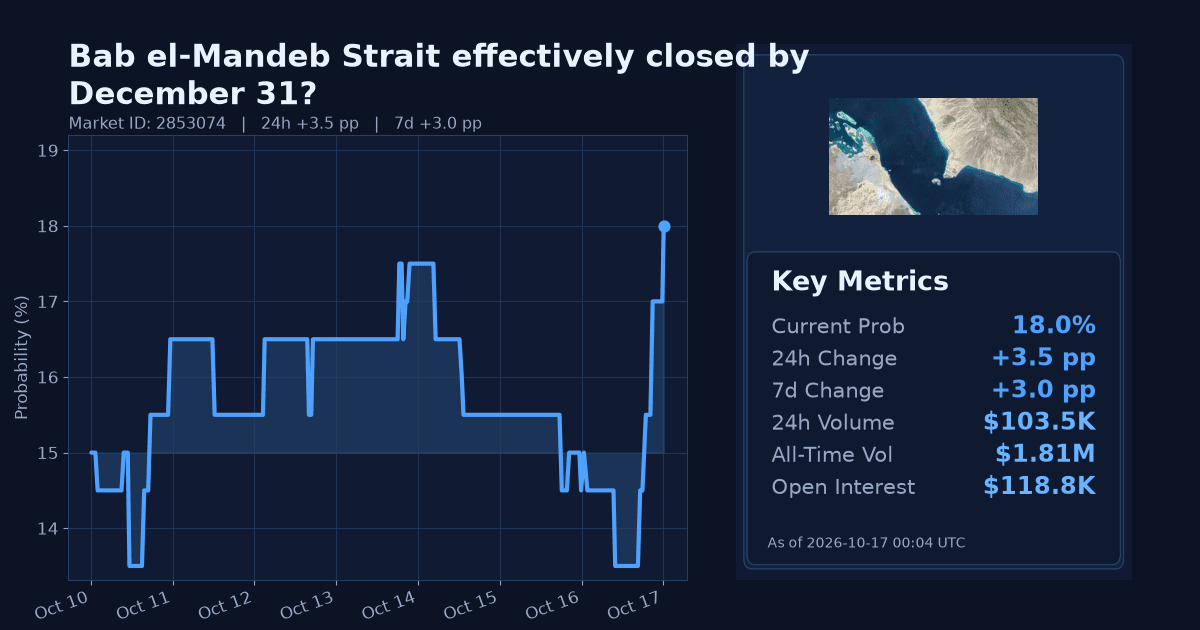
The Polymarket contract asks whether the Bab el-Mandeb Strait will be “effectively closed” by December 31, based on IMF PortWatch publishing a 7-day moving average of transit calls, measured as “Arrivals of Ships,” at or below 10. The contract window runs from market creation on July 9, 2026 through the listed end date of January 1, 2027, with resolution tied to whether the threshold is reached for any qualifying date before the deadline.
The Yes probability moved higher to 18.0%. The increase was concentrated in the latest trading window, with the market adding 3.5 percentage points over 24 hours and 3.0 percentage points over seven days.
Why It Likely Moved
- The repricing appears driven by a cluster of official and market signals focused on maritime chokepoints and supply-chain vulnerability, rather than a single reported closure event at Bab el-Mandeb.
- Markets reacted to official European Union attention to chokepoint disruptions, including a European Parliament written question on October 16 about the supply-chain impact of disruptions in the Strait of Hormuz. That is a different waterway, but it is a relevant official signal of concern around strategic sea-lane risk.
- The move also appears connected to energy-security headlines: the IEA said it would speed up oil-stock releases, including more than 20 million barrels of diesel, according to a Reuters report carried by Ground News.
- Broader macro conditions supported risk-sensitive repricing. Brent crude was at $109.69 per barrel as of October 16 and was up 4.75% over seven days, while the VIX was at 19.99 and up 34.70% over the same period.
- Related Polymarket contracts showed partial confirmation, with later-dated closure risk moving more than the near-term October contract, consistent with traders assigning more risk to the remaining contract window than to an immediate threshold breach.
How Strong the Move Is
This is a significant upside spike. The 24-hour z-score is 10.0, and the supplied interpretation labels the move “extreme” relative to the market’s recent trading history. The 7-day z-score is 8.0 and is also classified as “extreme” to the upside.
The pattern looks more like a sharp repricing than a slow trend continuation. The one-day change exceeds the full seven-day change, indicating that the latest session accounted for most of the recent move.
Cross-Market Confirmation
- The November 30 Bab el-Mandeb closure market rose to 11.0%, with delta_24h at +1.0 pp and delta_7d unavailable. That confirms some nearer-term upward pressure, though at a lower absolute probability than the December market.
- The October 31 Bab el-Mandeb closure market is at 3.9%, with delta_24h at +0.05 pp and delta_7d at -0.95 pp. This diverges from the main move and suggests traders are not pricing an imminent October trigger.
- The “US announces end of Iranian blockade by October 31, 2026?” market is at 6.0%, with delta_24h unavailable and delta_7d at -12.0 pp. That does not directly confirm the PortWatch-based closure market, but the weekly decline is directionally consistent with reduced confidence in a near-term de-escalation announcement.
News & Real-World Context
On October 16, the European Parliament published a priority written question to the Commission on the impact of disruptions in the Strait of Hormuz on supply chains. The item does not address Bab el-Mandeb directly, but it is an official EU policy signal that maritime chokepoint disruption is on the institutional agenda. Also on October 16, the European Parliament said its president and Gulf Cooperation Council speakers had reaffirmed stronger strategic ties and deeper parliamentary cooperation.
U.S. policy signals also emphasized Iran-linked security and sanctions concerns. On October 15, the U.S. Department of State announced sanctions on Cuban state-owned Banco Internacional de Comercio, citing links involving Iran’s Karafarin Bank and describing broader efforts to target financial and security interconnections with Iran. This is not a Bab el-Mandeb closure announcement, but it adds to the official context around Iran-related security risk.
In energy markets, the IEA’s accelerated stock-release plan was reported on October 16, including more than 20 million barrels of diesel, according to Ground News. Separately, a joint statement on Yemen warned that fighting was intensifying and civilian lifelines were at risk, according to the Norwegian Refugee Council on October 15.
Bottom Line
The market move is best read as an extreme short-term repricing of closure risk, not evidence that the IMF PortWatch trigger has occurred. The supporting signals are indirect but thematically aligned: official chokepoint concerns, energy-stock action, elevated oil prices, and mixed confirmation from related markets.
Whether this becomes structural remains uncertain. The October contract’s weak response points against an immediate closure scenario, while the December contract leaves more time for the PortWatch threshold to be reached.
Market Conditions at Time of Writing
- Current Probability (%): 18.0
- 24h Change (pp): +3.5
- 7d Change (pp): +3.0
- Volume (24h, $): 103,526.33
- Open Interest ($): 118,810.09
- Spread (pp): 2.0
- Z-score (24h): 10.0