What Moved the Market
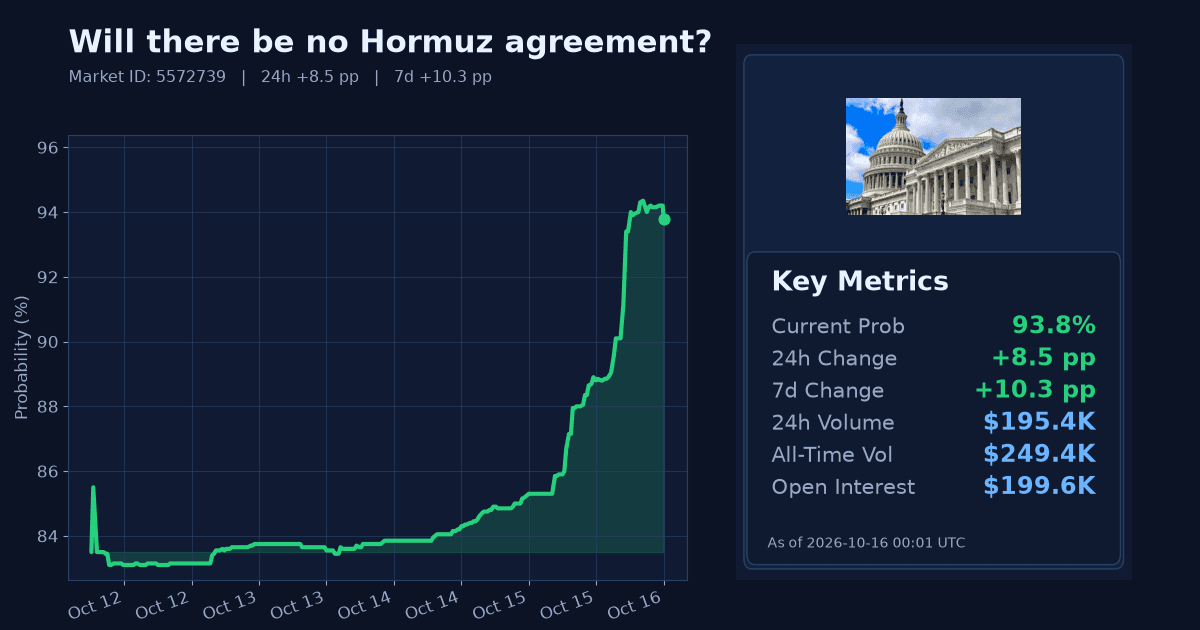
Polymarket’s “Will there be no Hormuz agreement?” outcome moved higher. The contract concerns whether the United States and Iran announce a qualifying diplomatic agreement by November 2, 2026, to permit, restore, or increase shipping traffic through the Strait of Hormuz. The market window began October 11, 2026, and is listed to end November 4, 2026.
At the time of writing, the “No Hormuz Agreement” outcome was priced at 93.8%, up 8.5 percentage points over 24 hours and 10.3 points over seven days. The opposing outcomes — a Hormuz agreement paired with either Republican or Democratic Senate control after the 2026 midterms — both moved lower.
Why It Likely Moved
- The repricing appears driven by the absence, in the supplied evidence, of any qualifying U.S.–Iran diplomatic announcement accepting a Hormuz agreement before the contract’s November 2 deadline.
- Markets reacted to an official U.S. military signal pointing toward continued maritime confrontation: U.S. Central Command said forces disabled a cargo vessel in the Gulf of Oman after it attempted to violate an ongoing naval blockade against Iran.
- The move also appears reinforced by cross-market pricing: both “Hormuz agreement” outcomes fell sharply, while a simpler “no Hormuz agreement” market rose.
- A shipping-related news item about possible easing of sanctions on “shadow fleet” tankers may have sharpened attention on maritime traffic and freight costs, but it did not describe a U.S.–Iran Strait of Hormuz agreement.
- Macro conditions keep the issue salient: WTI crude was at $96.17 per barrel, up 5.1% over seven days, while the VIX was 16.46, up 6.8% over the same period.
How Strong the Move Is
This was a significant short-term spike. The 24-hour change was +8.5 percentage points, and the market’s 24-hour z-score was 35.4. The supplied interpretation labels that move “extreme,” meaning it is far outside this market’s recent trading history.
The seven-day change was also positive at +10.3 percentage points, but the supplied seven-day interpretation is “normal” and “flat,” with a z-score of 0.0. That combination points to an abrupt one-day repricing within a very short trading history, rather than a well-established multi-day trend.
Cross-Market Confirmation
- The “Hormuz agreement and Republicans win the Senate” outcome confirms the main move, falling 4.75 points over 24 hours to 1.9%; its seven-day change is N/A.
- The “Hormuz agreement and Democrats win the Senate” outcome also confirms the move, falling 5.4 points over 24 hours to 3.0%; its seven-day change is N/A.
- A separate “Will there be no Hormuz agreement?” market aligns directionally, rising 2.85 points over 24 hours to 96.0%; its seven-day change is N/A.
News & Real-World Context
On October 13, 2026, U.S. Central Command stated that U.S. forces disabled a commercial cargo vessel in the Gulf of Oman after its crew ignored warnings and attempted to run an ongoing naval blockade against Iran. For this contract, that is an important official signal because it describes enforcement activity in the relevant maritime theater, not diplomatic acceptance of a Hormuz shipping agreement.
Other official foreign-affairs signals in the supplied context do not point to a qualifying U.S.–Iran Hormuz deal. On October 14, 2026, the European Parliament published a written question concerning death sentences in Iran, reflecting continued official scrutiny of Iran. On October 15, the European Parliament announced a briefing on the October 19–22 plenary session, and separately published a press kit for the October 15–16 European Council covering foreign-affairs and defence priorities. The UK government stated on October 14 that Libyan parties should honor commitments to security, economic opportunity, and democratic freedom; that item is a regional diplomatic signal but not about Hormuz.
In news coverage, an October 15 report said the U.S. was considering easing sanctions on “shadow fleet” tankers to reduce freight rates, and that oil prices fell as markets assessed possible changes to shipping constraints, according to Ground News. The report is relevant to maritime-cost context, but it does not satisfy the contract’s requirement for an announced U.S.–Iran diplomatic agreement on Strait of Hormuz traffic.
Bottom Line
The market is pricing “no Hormuz agreement” as the dominant outcome, and the latest move appears tied to official evidence of blockade enforcement plus the absence of a qualifying agreement announcement. The move looks short-term and sharp rather than structurally confirmed, because the 24-hour signal is extreme while the seven-day volatility interpretation remains normal.
Market Conditions at Time of Writing
- Current Probability (%): 93.8
- 24h Change (pp): +8.5
- 7d Change (pp): +10.3
- Volume (24h, $): $195,413.94
- Open Interest ($): $199,637.98
- Spread (pp): 0.7
- Z-score (24h): 35.4