What Moved the Market
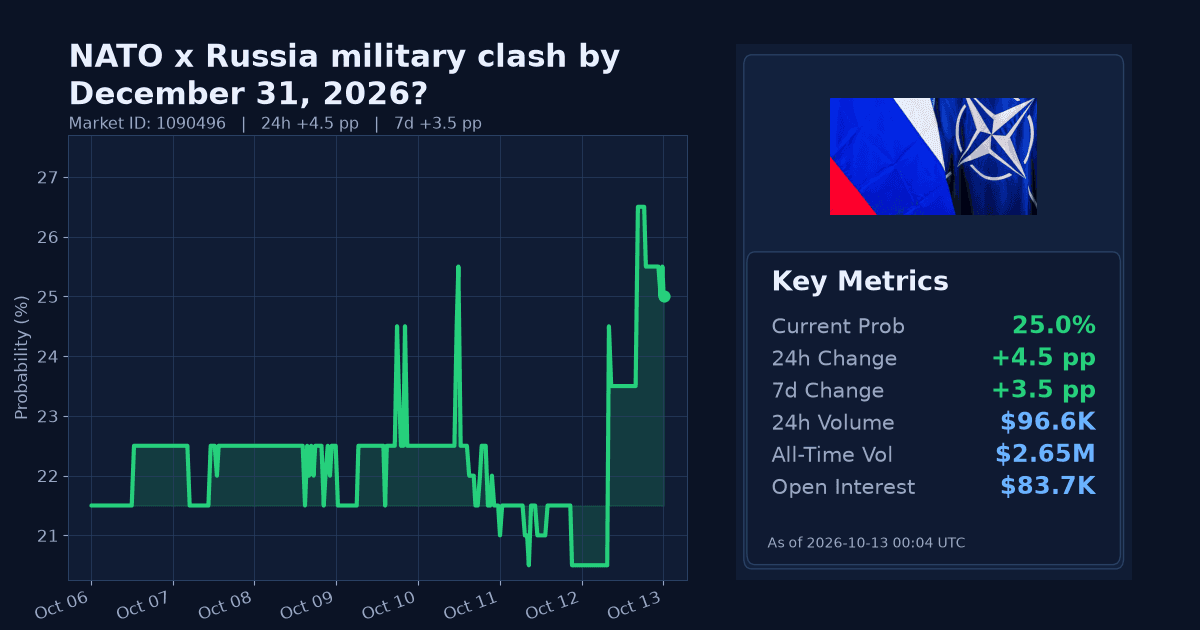
Polymarket traders repriced the contract “NATO x Russia military clash by December 31, 2026?” sharply higher over the last 24 hours. The probability rose 4.5 percentage points to 25.0% as of October 13, 2026.
The market covers any direct use of force between NATO and Russian military forces occurring between January 2 and December 31, 2026, 11:59 PM ET. Over the past 7 days, the contract is up 3.5 percentage points.
Why It Likely Moved
- Repricing appears driven by conflicting official messaging around an “energy ceasefire.” On October 12, the European Commission reported that President von der Leyen “fully supported” President Zelenskyy’s call for a ceasefire to protect food and energy infrastructure in Ukraine and Russia, following their call (European Commission, Oct 12, 2026).
- Canada’s government readout noted Prime Minister Mark Carney thanked U.S. President Donald J. Trump for leadership toward securing an energy ceasefire and urged Russia to uphold it (Prime Minister of Canada, Oct 11, 2026). Markets reacted to the juxtaposition of these endorsements with continued reports of strikes.
- NPR reported on October 12 that President Trump said Russia and Ukraine agreed to an “energy ceasefire,” but Kyiv reported Russian strikes on energy infrastructure after the statement, and there was no independent confirmation (NPR, Oct 12, 2026). The apparent disconnect likely kept perceived escalation risk elevated.
- Reuters-sourced reporting stated Russia said it struck vessels carrying military cargo to Ukraine’s ports, without independent verification (Ground News/Reuters, Oct 12, 2026). This reinforces ongoing hostilities during the market window.
- A Bloomberg-cited figure, reported by Ground News, that Russia suffered over 50,000 casualties in September per a NATO official underscores intensity on the battlefield, which may affect tail-risk assessments (Ground News, Oct 12, 2026).
How Strong the Move Is
The 24-hour change (+4.5 pp) and 7-day change (+3.5 pp) both register as extreme relative to recent trading, with z-scores of +20.0 (24h) and +16.0 (7d). This is best characterized as a sharp spike rather than routine noise.
Macro risk gauges offer limited confirmation: over the past week, Gold is up 0.94% to $4,195.7/oz, while the VIX fell about 2.0% to 15.21 and EUR/USD slipped 0.49% to 1.1162. The absence of a broader risk-off move suggests the repricing is event-driven and market-specific rather than systemic.
Cross-Market Confirmation
- NATO x Russia clash by October 31, 2026: 5.0% (−1.0 pp 24h; −2.5 pp 7d). Diverges — near-term odds declined even as the broader 2026 window rose.
- U.S. invade Iran before 2027: 17.0% (+1.0 pp 24h; +3.0 pp 7d). Partial confirmation — modest rise in another conflict-risk market.
- China invade Taiwan by end of 2026: 2.1% (+0.05 pp 24h; −0.25 pp 7d). Neutral to softening — does not confirm a generalized escalation bid.
News & Real-World Context
- The European Commission stated on October 12 that President von der Leyen “fully supported” President Zelenskyy’s call for a ceasefire to protect energy and food infrastructure in both Ukraine and Russia, highlighting high-level EU engagement on de-escalation messaging (European Commission, Oct 12, 2026).
- Canada’s government reported on October 11 that Prime Minister Mark Carney spoke with President Donald J. Trump, supported securing an energy ceasefire, urged Russia to uphold it, and reiterated continued support for Ukraine’s defenses (Prime Minister of Canada, Oct 11, 2026).
- NPR reported President Trump’s October 12 claim that Russia and Ukraine agreed to an “energy ceasefire,” while noting Kyiv’s report of subsequent Russian strikes and the lack of independent confirmation (NPR, Oct 12, 2026).
- Reuters-linked reporting said Russia claimed strikes on vessels carrying military cargo to Ukraine’s ports, without independent verification (Ground News/Reuters, Oct 12, 2026). Separately, a NATO-official-cited casualty tally suggested over 50,000 Russian casualties in September (Ground News, Oct 12, 2026).
Bottom Line
The jump to 25% appears to be a short-term, event-driven spike tied to mixed ceasefire messaging from governments and contemporaneous reports of continued strikes during the market’s 2026 window. Cross-market signals are mixed, and broader macro risk remains contained, pointing to a repricing of specific tail risks rather than a structural shift.
Market Conditions at Time of Writing
- Current Probability (%): 25.0
- 24h Change (pp): +4.5
- 7d Change (pp): +3.5
- Volume (24h, $): 96,588.12
- Open Interest ($): 83,652.10
- Spread (pp): 1.0
- Z-score (24h): +20.0