What Moved the Market
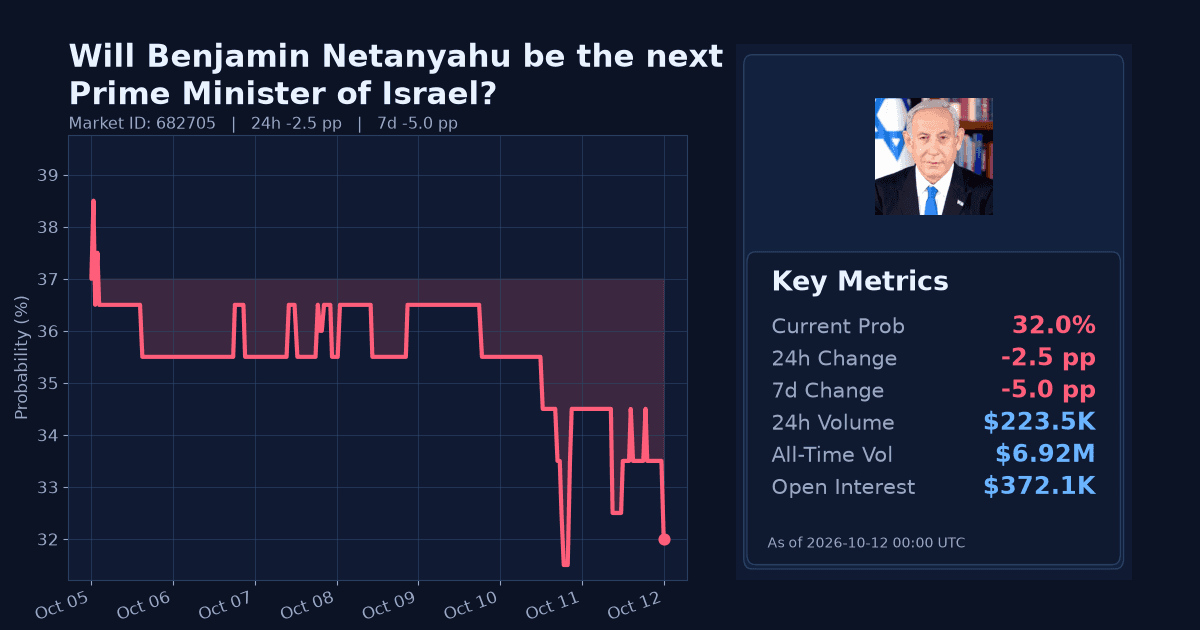
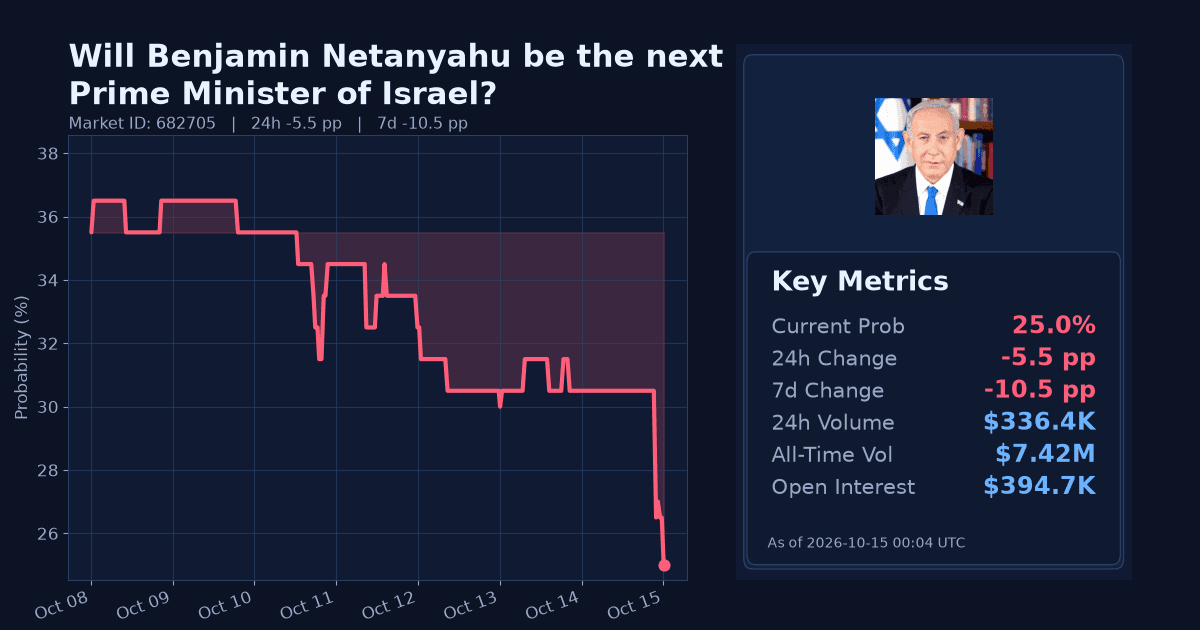
Polymarket’s contract on whether Benjamin Netanyahu will be the next Prime Minister of Israel sold off sharply. The market covers the next individual formally appointed and sworn in as Israeli prime minister following the 2026 parliamentary election, or following an earlier election if one is called.
The contract window runs from Nov. 15, 2025 to Oct. 28, 2026, with the underlying election scheduled for Oct. 27, 2026. Interim or caretaker prime ministers do not count for resolution; the winner must be formally sworn in.
Why It Likely Moved
- The repricing appears driven by official diplomatic attention to election legitimacy and governance in the Israel-Palestine file, including statements from multiple governments on postponed Palestinian elections and conditions for credible governance.
- Markets reacted to an official European Parliament written question concerning an alleged attempt to bar political forces from running in Israel’s parliamentary elections, a signal directly tied to the electoral process relevant to this contract.
- Regional-risk markets also shifted toward a less constructive diplomatic outcome around Hormuz, suggesting traders were marking up Middle East political-risk scenarios rather than isolating the move to one Israeli domestic headline.
- The available news set contains little Netanyahu-specific positive catalyst; the most directly Israel-related article concerned cultural-property repatriation rather than coalition arithmetic or election polling.
- Macro risk conditions were not the primary evidence, but they add context: Brent crude was at $105.65/bbl and up 5.44% over seven days, while the VIX was 16.87 and up 11.87% over seven days, consistent with a firmer risk-premium backdrop.
How Strong the Move Is
This is a significant downside repricing, not normal noise. The 24-hour z-score is classified as extreme to the downside, indicating the one-day move is highly unusual relative to the market’s recent trading history.
The seven-day z-score is also classified as extreme to the downside, so the move looks like a continuation of a broader weekly decline rather than a single isolated tick. Given the current probability remains meaningfully above zero, the market is repricing Netanyahu lower, not eliminating the scenario.
Cross-Market Confirmation
- The related market “Will there be no Hormuz agreement?” moved higher by 3.95 pp over 24 hours, with seven-day change unavailable. That confirms a more pessimistic regional-diplomacy signal.
- The related market “Will there be a Hormuz agreement and the Republicans win the Senate?” moved lower by 1.75 pp over 24 hours, with seven-day change unavailable. That aligns directionally with weaker expectations for an agreement-linked outcome.
- The related market “Will there be a Hormuz agreement and the Democrats win the Senate?” moved lower by 2.10 pp over 24 hours, with seven-day change unavailable. That also confirms the shift away from agreement scenarios, though it is only indirectly related to Israeli leadership.
News & Real-World Context
On Oct. 13, the UK government published a joint statement from the foreign ministers of Australia, Canada, France and the United Kingdom expressing regret over the postponement of Palestinian legislative and presidential elections to September 2027. The statement said credible elections are part of Palestinian Authority reform, called for elections without further delay, reiterated that Hamas should have no role in future Palestinian governance, and called on Israel to refrain from actions that could impede election arrangements.
The same policy line was also issued by Australia on Oct. 12, with the Australian Foreign Minister emphasizing democratic renewal, accountable governance and the institutional basis for a two-state solution. France separately carried related announcements on Oct. 11 and Oct. 13 via France Diplomatie, reinforcing that this was an official multi-government diplomatic signal rather than a single-country media line.
A more directly Israel-election-related official item came on Oct. 12, when the European Parliament published a written question titled “Unacceptable attempt to bar political forces from running in parliamentary elections in Israel.” The supplied text does not provide the underlying facts beyond the title and procedural description, but the item is relevant because it concerns political participation in Israel’s parliamentary elections, the election cycle that anchors this market.
The recent news feed was thinner on Israeli domestic politics. The closest Israel-specific article reported that Israel returned ancient Greek artifacts to Greece after provenance reviews and cooperation between authorities, according to Ground News on Oct. 14. That article provides bilateral context but does not itself explain the Netanyahu repricing.
Bottom Line
The selloff appears tied to election-governance and regional-risk signals rather than a single Netanyahu-specific news event. The move is extreme by the market’s own recent history, but whether it becomes structural depends on further evidence about Israeli electoral rules, coalition positioning, or an early-election scenario.
Market Conditions at Time of Writing
- Current Probability (%): 25.0
- 24h Change (pp): -5.5
- 7d Change (pp): -10.5
- Volume (24h, $): 336,382.68
- Open Interest ($): 394,692.47
- Spread (pp): 1.0
- Z-score (24h): 20.0