
Bab-el-Mandeb Strait
A critical Red Sea chokepoint linking the Gulf of Aden to the Suez Canal route
The Bab-el-Mandeb Strait is a narrow maritime chokepoint between Yemen and Djibouti/Eritrea that connects the Red Sea with the Gulf of Aden and the wider Indian Ocean.
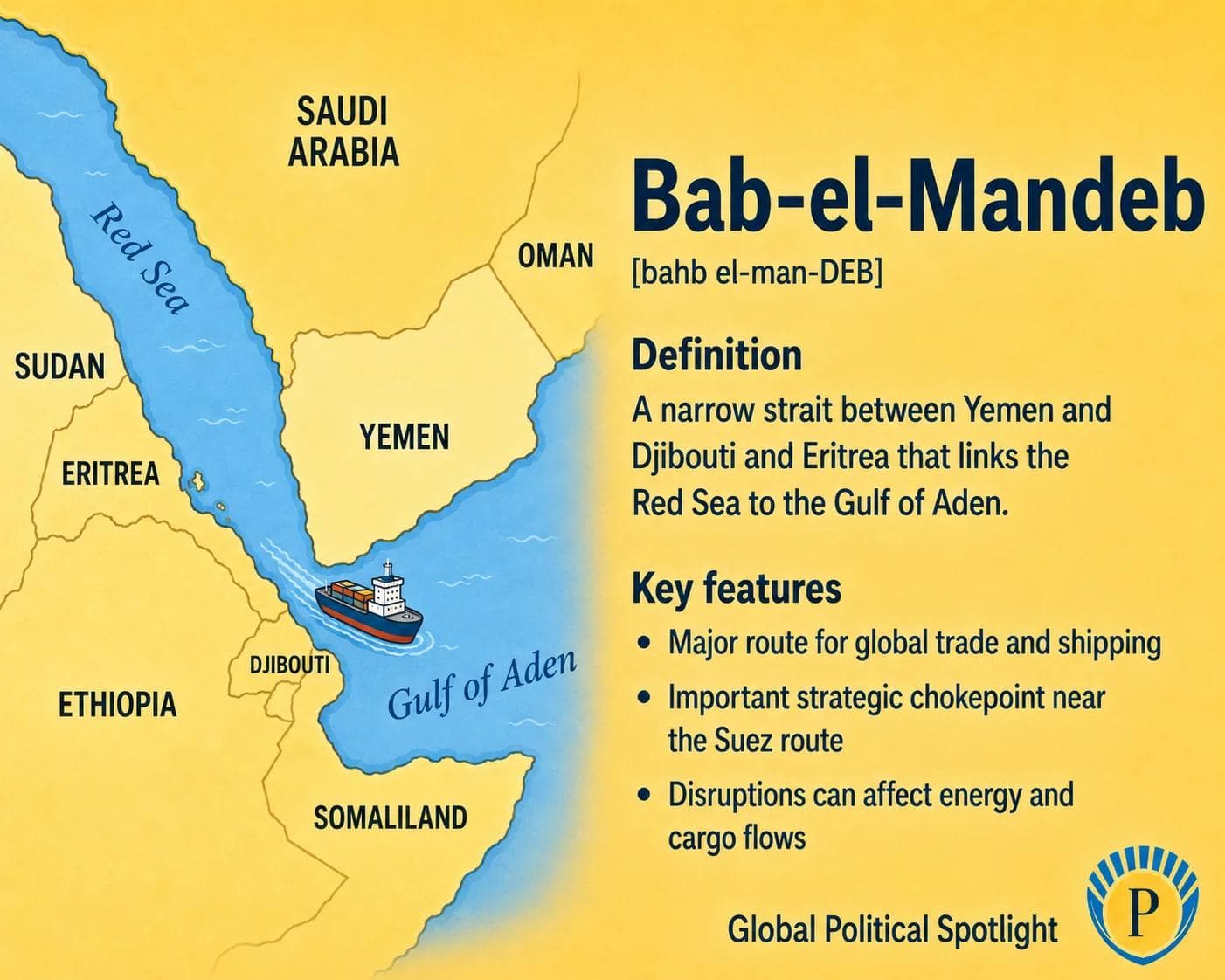
Definition
The Bab-el-Mandeb Strait is a narrow maritime passage at the southern entrance to the Red Sea. It lies between Yemen on the Arabian Peninsula and Djibouti and Eritrea on the Horn of Africa, connecting the Red Sea to the Gulf of Aden and onward to the Arabian Sea and Indian Ocean.
The strait is strategically important because it sits on the main sea route between the Indian Ocean, the Red Sea, the Suez Canal, and the Mediterranean. Ships moving between Asia and Europe often use this route instead of sailing around the Cape of Good Hope.
Its importance comes from both geography and vulnerability. The passage is narrow, close to conflict-affected areas, and essential for container shipping, energy cargoes, naval movements, and trade flows linking Europe, the Middle East, Africa, and Asia.
Why It Matters
The Bab-el-Mandeb Strait matters because it is one of the world’s most important maritime chokepoints. Disruption can affect traffic through the Red Sea and Suez Canal corridor, raising shipping costs, lengthening voyages, and delaying goods moving between Europe and Asia.
The strait also matters for energy security. Oil, refined products, liquefied natural gas, and other cargoes that move between the Gulf, Asia, Europe, and North America can be exposed to disruption if ships avoid the Red Sea route.
For maritime security, the area connects local conflict dynamics in Yemen and the Horn of Africa with global trade risk. Naval deployments, piracy concerns, missile and drone threats, insurance costs, and port security all shape the reliability of this route.
The Bab-el-Mandeb Strait is a core GPS chokepoint for monitoring Red Sea security, Suez Canal traffic, energy flows, shipping insurance, naval deployments, Yemen-related conflict dynamics, and supply-chain disruption. GPS should watch vessel traffic trends, attacks or threats against commercial shipping, rerouting around the Cape of Good Hope, regional naval coalitions, port access, and the connection between local instability and global trade exposure.
Key Facts
- Type
- Maritime chokepoint
- Location
- Between Yemen on the Arabian Peninsula and Djibouti/Eritrea on the Horn of Africa
- Connects
- The Red Sea with the Gulf of Aden, Arabian Sea, and Indian Ocean
- Route role
- Part of the main Asia-Europe shipping route through the Red Sea and Suez Canal
- Strategic value
- Supports container shipping, energy transport, naval mobility, and trade between Europe, Asia, Africa, and the Middle East
- Nearby actors
- Yemen, Djibouti, Eritrea, Saudi Arabia, Egypt, Gulf states, international navies, and commercial shipping firms
- Main vulnerability
- Narrow geography and proximity to conflict zones make shipping exposed to attacks, piracy, blockages, and military escalation
- Alternative route
- Ships can reroute around the Cape of Good Hope, but this adds distance, time, fuel costs, and supply-chain delays
FAQ
What is the Bab-el-Mandeb Strait?
The Bab-el-Mandeb Strait is a narrow maritime passage between Yemen and Djibouti/Eritrea that connects the Red Sea with the Gulf of Aden and the wider Indian Ocean.
Why is the Bab-el-Mandeb Strait important?
It is important because it sits on the main shipping route between Asia, the Red Sea, the Suez Canal, and Europe. Disruption can affect container traffic, energy flows, naval movement, shipping insurance, and supply-chain reliability.
Which countries border the Bab-el-Mandeb Strait?
The strait lies between Yemen on the northeastern side and Djibouti and Eritrea on the southwestern side.
How does the Bab-el-Mandeb Strait connect to the Suez Canal?
Ships traveling between the Indian Ocean and the Mediterranean usually pass through the Gulf of Aden, the Bab-el-Mandeb Strait, the Red Sea, and then the Suez Canal. This makes the strait a southern gateway to the Suez route.
What happens if the Bab-el-Mandeb Strait is disrupted?
Ships may avoid the Red Sea and reroute around the Cape of Good Hope. This can increase voyage distance, fuel use, insurance costs, delivery times, and freight prices.
Why is the Bab-el-Mandeb Strait a security concern?
The strait is close to conflict-affected Yemen and the Horn of Africa. Maritime security risks can include missile and drone threats, piracy, sabotage, military escalation, and attacks on commercial shipping.
Recent Developments
Red Sea attacks disrupted Suez Canal trade
The IMF reported that Red Sea attacks had sharply disrupted trade through the Suez Canal route in early 2024, illustrating how insecurity near the Bab-el-Mandeb Strait can affect global supply chains.
International Monetary FundOil product flows through Bab-el-Mandeb fell sharply in 2024
The U.S. Energy Information Administration reported that crude oil and petroleum product flows through the Bab-el-Mandeb fell by more than half in the first eight months of 2024 as many tankers avoided the Red Sea route.
U.S. Energy Information AdministrationSources6 references
- Encyclopaedia Britannica
Reference background on the strait’s location and geographic role connecting the Red Sea with the Gulf of Aden and Indian Ocean.
- U.S. Energy Information Administration
Institutional source on global oil transit chokepoints, including Bab-el-Mandeb and recent Red Sea disruption effects.
- U.S. Energy Information Administration
Reference background on Bab-el-Mandeb as an oil and natural gas transit chokepoint between the Horn of Africa and the Middle East.
- International Monetary Fund
Institutional analysis of Red Sea trade disruption and effects on Suez Canal traffic and global supply chains.
- International Maritime Organization
Official maritime organization source on Red Sea security and commercial shipping safety.
- Suez Canal Authority
Official source on the Suez Canal, the northern part of the Red Sea route connected to Bab-el-Mandeb.

GPSNews App
Read GPSNews on iPhone
Daily geopolitical briefings, government updates, and prediction signals in one focused app.
Newsletter
Stay Ahead Of The Next Signal
Get briefings in your inbox when new analysis and reports are published.