What Moved the Market
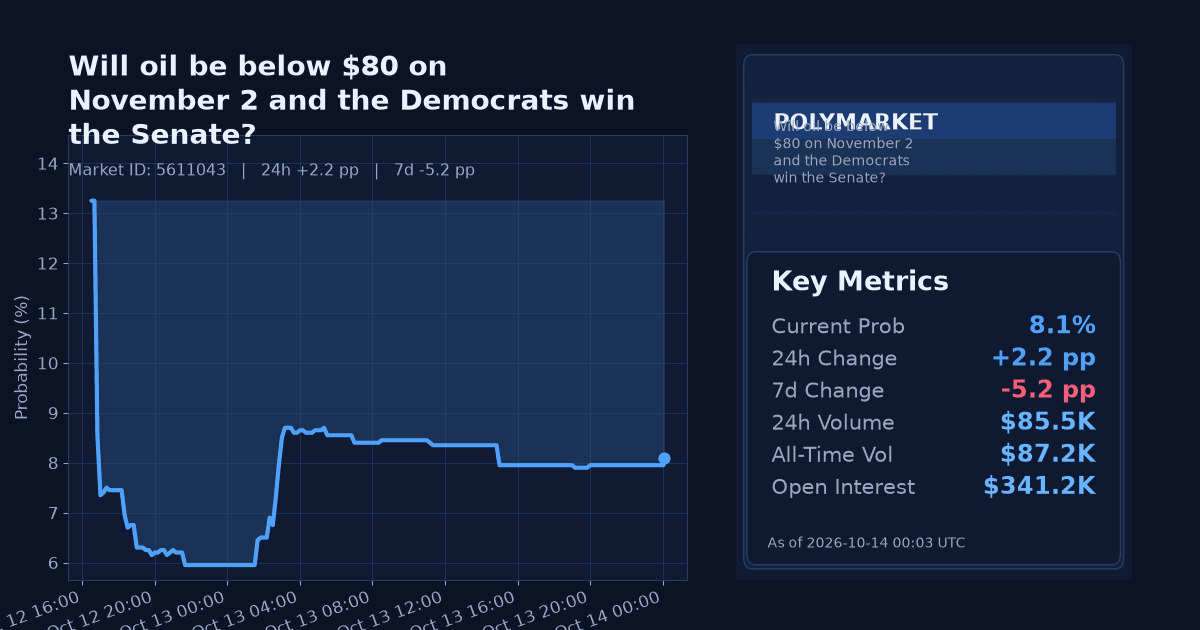
Polymarket’s contract on “Oil < $80; D Senate” moved higher. The market pays if WTI crude oil is below $80 at the close of trading on November 2, 2026, and Democrats win control of the U.S. Senate in the 2026 midterm election cycle. The broader contract window runs from October 12, 2026 to November 4, 2026.
At the time of writing, the outcome was priced at 8.1%, up 2.15 percentage points over 24 hours. Over seven days, however, it remained lower by 5.15 percentage points, leaving the latest move as an upward short-term repricing inside a weaker recent path.
Why It Likely Moved
-
The repricing appears driven by renewed attention to the oil-price leg of the contract. The outcome requires WTI to settle below $80 on November 2, 2026, and recent market/news flow focused directly on oil prices and energy costs.
-
Markets reacted to energy-price context that was not one-directional. Macro data showed WTI crude at $94.86/bbl as of October 13, with a 6.06% seven-day gain but a 5.19% 30-day decline, keeping both the level and recent volatility relevant for an oil-threshold contract.
-
The move also appears linked to U.S. Senate-control positioning rather than oil alone. A same-threshold Republican Senate version also rose, but by less, suggesting some bid for the sub-$80 oil condition across Senate outcomes while the Democratic-control leg received the larger move.
-
Recent political reporting kept Senate control in focus. AP reported on October 13 that the 2026 midterms could determine whether Democrats keep control of the Senate and affect Chuck Schumer’s leadership position, reinforcing attention to the election component of the contract.
How Strong the Move Is
The 24-hour move is significant and best classified as a spike. The supplied z-score framework labels the 24-hour move as “extreme” to the upside, with a z-score of 8.0, meaning the daily change is unusually large relative to this market’s short trading history.
The seven-day picture is not a trend confirmation. The seven-day z-score is 0.0 and classified as normal/flat, while the market is still down on the week. That combination points to an abrupt short-term bounce rather than a clearly established reversal.
Cross-Market Confirmation
-
The related “oil below $80 and Republicans win the Senate” market rose 1.2 percentage points over 24 hours, with seven-day change unavailable. That confirms some broader demand for the below-$80 oil leg, not only the Democratic Senate version.
-
The “oil at least $85 and Democrats win the Senate” market rose 0.5 percentage points over 24 hours, with seven-day change unavailable. That partially diverges from a clean low-oil interpretation, because a higher-oil Democratic Senate outcome also gained modestly.
-
The “oil below $85 and Democrats win the Senate” market slipped 0.2 percentage points over 24 hours, with seven-day change unavailable. That divergence cautions against reading the main move as a uniform repricing of all lower-oil Democratic outcomes.
News & Real-World Context
Official and news signals both kept energy costs and election outcomes in view. On October 13, the European Parliament published a written question on the setting of fuel prices and measures to curb their rise, an official EU policy signal that energy-price pressure remains a live political issue. The same day, the European Parliament announced a conference with Gulf Cooperation Council speakers on strategic ties and parliamentary cooperation, adding an official foreign-affairs channel involving a key energy-producing region.
Market coverage also pointed to oil as a live cross-asset input. A Reuters-linked report carried by Ground News on October 13 said European shares opened higher as lower oil prices lifted sentiment. Separately, AP News reported on October 13 that Senate Democratic leadership dynamics remain tied to the 2026 midterm outcome. In the diplomatic backdrop, the UK government and French foreign ministry published October 13 statements on postponed Palestinian elections; those are official foreign-policy signals, though the supplied material does not establish a direct link to this market move.
Bottom Line
The move is a sharp short-term repricing in a two-part contract: oil below $80 on November 2, 2026, plus Democratic Senate control. Cross-market evidence supports some movement in the below-$80 oil leg, but mixed related outcomes prevent a clean single-factor interpretation.
The move appears short-term and uncertain rather than structural. The 24-hour spike is unusually large, but the weekly profile has not confirmed a sustained reversal.
Market Conditions at Time of Writing
- Current Probability (%): 8.1
- 24h Change (pp): +2.15
- 7d Change (pp): -5.15
- Volume (24h, $): 85,543.75
- Open Interest ($): 341,150.90
- Spread (pp): 0.5
- Z-score (24h): 8.0