What Moved the Market
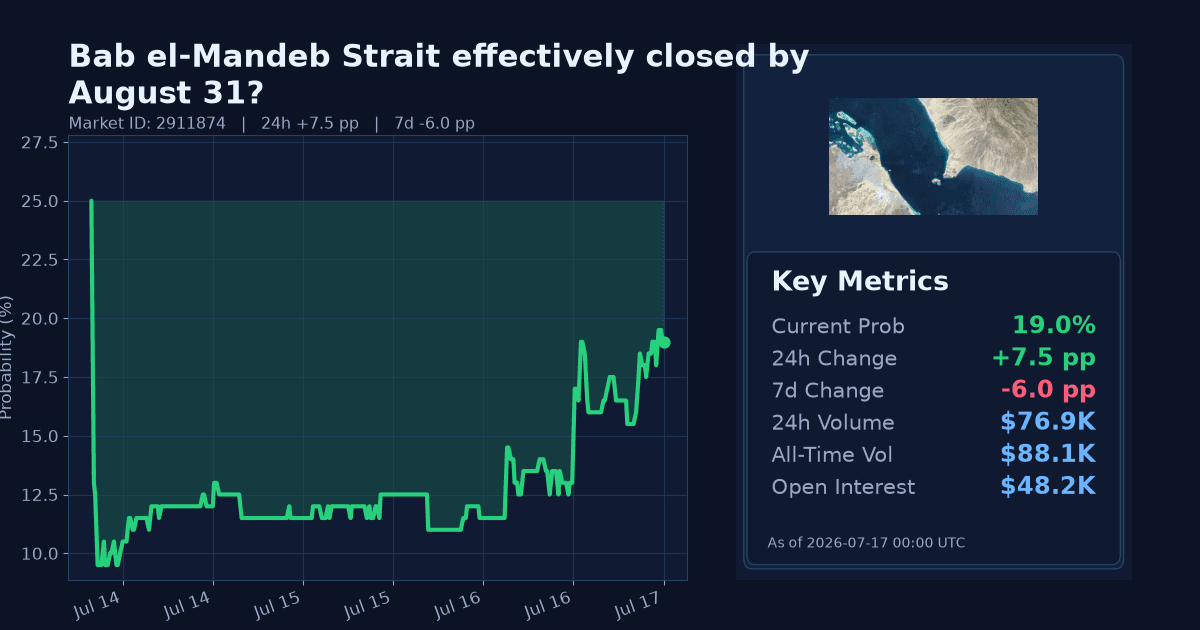
The Polymarket contract on whether the Bab el‑Mandeb Strait will be “effectively closed” by August 31 rose to 19%, up 7.5 percentage points over the past 24 hours. The 24h move is classified as extreme by the market’s own z-score metric.
Over the past week, the contract is down 6.0 percentage points, leaving the 7-day move within normal bounds of recent volatility. The contract resolves “Yes” if IMF PortWatch’s 7‑day moving average of Bab el‑Mandeb transit calls (Arrivals of Ships) is ≤10 on any date between market creation (July 13, 2026) and August 31, 2026.
Why It Likely Moved
- Repricing appears driven by reports that an Iran‑backed Houthi leader in Yemen threatened escalation with Saudi Arabia, heightening concern over Red Sea shipping corridors adjacent to Bab el‑Mandeb, according to AP News (July 16, 2026).
- Markets reacted to intensified fighting around the Strait of Hormuz, raising broader fears of spillover to regional maritime chokepoints, per AP News (July 16, 2026) and NPR (July 16, 2026).
- The repricing follows official emphasis on the economic impact of chokepoint closures and the need to maintain free navigation, highlighted by Australia’s Assistant Minister for Foreign Affairs and Trade on July 16 in an ABC NewsRadio interview (Department of Foreign Affairs and Trade), referencing the closure of the Strait of Hormuz and wider maritime security cooperation.
- A stronger energy risk backdrop may have reinforced sensitivity to shipping disruptions: Brent crude at $84.95 is up 11.3% week‑over‑week and 33.2% over six months (as of July 16, 2026), per market data.
How Strong the Move Is
The 24-hour jump of 7.5 percentage points to 19% is an extreme daily move (24h z-score: 32.0). That qualifies as a sharp, headline-driven spike rather than routine noise.
On a 7-day basis, the contract is still down 6.0 percentage points with a normal volatility profile, indicating the latest move is a rebound within the weekly range, not yet a sustained trend reversal.
Cross-Market Confirmation
- Bab el‑Mandeb “effectively closed by September 30” rose to 23%, up 7.0 pp (24h) and 9.0 pp (7d), confirming broader elevation in closure risk further out in time.
- “Kharg Island no longer under Iranian control by August 31” fell 2.75 pp (24h) to 6.8% while the July 31 variant slipped 0.4 pp (24h) to 2.7%, a divergence suggesting markets are focusing on chokepoint disruption risk rather than territorial control changes.
News & Real-World Context
- The Iran‑backed Houthi movement in Yemen threatened escalation against Saudi Arabia, raising concerns about security and potential maritime route disruptions near the Red Sea and Bab el‑Mandeb, per AP News (July 16, 2026).
- Fighting around the Strait of Hormuz intensified even as diplomatic channels remained open, according to AP News (July 16, 2026), and the situation drew sustained attention in U.S. media coverage, per NPR (July 16, 2026).
- Government signals underscored policy focus on maritime security and trade resilience: Australia’s Department of Foreign Affairs and Trade emphasized the economic impact of chokepoint closures and cooperation to keep sea lanes open in a July 16, 2026 interview. The European Commission (July 15, 2026) announced an upgraded import monitoring mechanism to track trade imbalances, adding to the policy backdrop of close monitoring of global flows.
Bottom Line
This is a sharp, news‑led repricing of near‑term closure risk for Bab el‑Mandeb, with confirmation from the longer‑dated September market. The move appears headline‑driven rather than structural; resolution still depends on IMF PortWatch data showing a 7‑day arrivals average ≤10 before August 31.
Market Conditions at Time of Writing
- Current Probability (%): 19.0
- 24h Change (pp): +7.5
- 7d Change (pp): -6.0
- Volume (24h, $): 76,942.75
- Open Interest ($): 48,190.75
- Spread (pp): 1.0
- Z-score (24h): 32.0