What Moved the Market
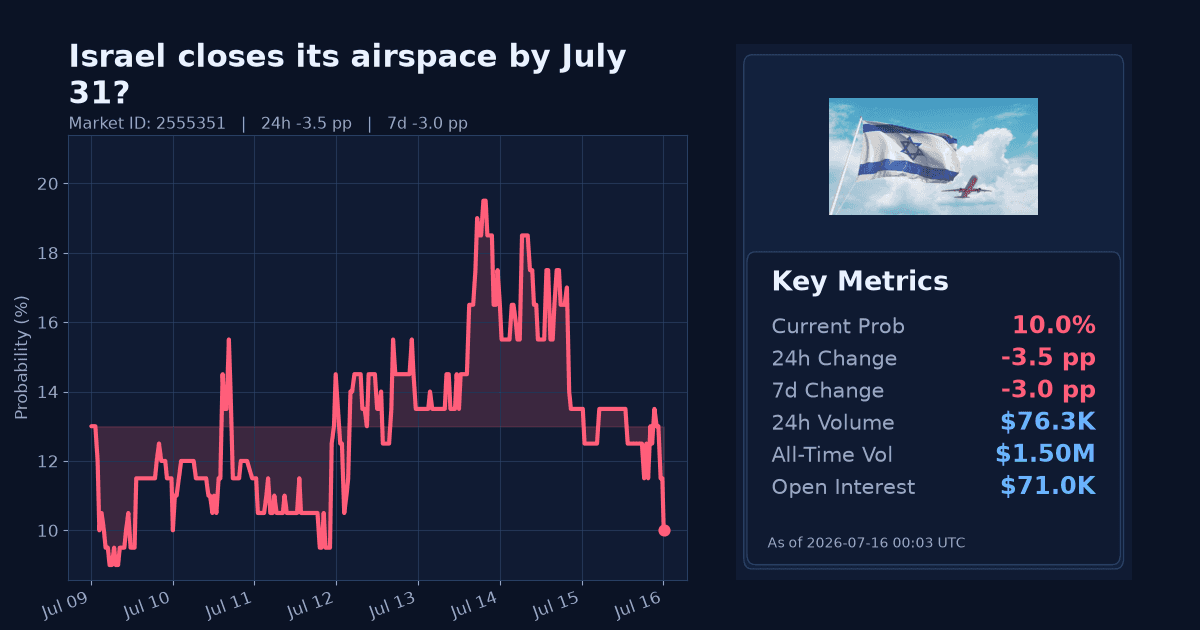
The Polymarket market “Israel closes its airspace by July 31?” fell 3.5 percentage points over the past 24 hours to 10.0%. The 7‑day move is −3.0 percentage points. The contract covers closures initiated by Israeli authorities through 11:59 PM ET on 2026‑07‑31, with trading active since 2026‑06‑15.
Trading volumes were brisk, with $76,293 changing hands in the past 24 hours and open interest at $71,010. The quoted spread is 2.0 percentage points.
Why It Likely Moved
- Markets reacted to reporting that Israel and Lebanon are “moving toward implementing a withdrawal agreement” with pilot zones along the border to clarify lines and reduce the risk of clashes, as described by U.S. officials on July 15 AP News.
- The repricing follows an apparent distinction traders are making between ongoing hostilities and the threshold for a nationwide, Israeli‑ordered airspace shutdown; intensified Gaza strikes reported July 15 do not themselves constitute a blanket closure (AP News).
- Official signaling has recently emphasized regional incidents outside Israeli airspace, such as the E3 (UK, France, Germany) condemnation of “Iranian attacks in the Strait of Hormuz and countries in the region” on July 12, which does not indicate imminent Israeli domestic airspace restrictions (the UK government).
How Strong the Move Is
The 24‑hour decline is classified as extreme relative to recent trading (z‑score 12.0), indicating an unusually sharp repricing for this market’s history. The 7‑day move is down and described as elevated (z‑score 1.46), suggesting a sustained, though less exceptional, drift lower over the week.
Taken together, price action looks like a sharp, statistically extreme daily drop embedded within a broader week‑long easing in near‑term closure odds.
Cross-Market Confirmation
- Divergence by maturity: The related “Israel closes its airspace by August 31?” market is up +7.5pp over 7d to 29.0%, while the July contract is down −3.0pp over 7d. This suggests risk may be getting pushed into the later window rather than removed.
- Regional escalation proxy: “Will the U.S. invade Iran before 2027?” rose +2.0pp (24h) and +6.0pp (7d) to 22.0%, a move that does not confirm the July airspace de‑risking and instead reflects broader geopolitical uncertainty on a longer horizon.
- Maritime flashpoint: “Kharg Island no longer under Iranian control by July 31?” is little changed (+0.1pp 24h, +0.3pp 7d to 2.8%), offering no strong confirmation of immediate, cross‑theater escalation risk.
- Macro risk backdrop: The VIX stands at 15.67, down 7.28% over 7d, indicating no broad volatility spike that would align with an imminent aviation shutdown (source: Yahoo Finance).
News & Real-World Context
- On July 15, U.S. officials said Israel and Lebanon are moving toward implementing a Rome‑brokered withdrawal agreement with pilot zones along their border to reduce clashes, though responses by armed groups remain uncertain (AP News, 2026‑07‑15).
- Also on July 15, Israel intensified strikes in Gaza, including an attack on a police compound, reflecting continued hostilities but not an airspace policy change by Israeli authorities (AP News, 2026‑07‑15).
- The E3 issued an official condemnation of Iranian attacks in the Strait of Hormuz and in regional countries on July 12, underscoring allied focus on maritime and regional security rather than domestic Israeli airspace restrictions (the UK government, 2026‑07‑12).
Bottom Line
Traders marked down the probability of an Israeli‑ordered, nationwide airspace closure by July 31, likely on signs of near‑term de‑escalation along the Lebanon border. Cross‑market signals point to a timing shift rather than full de‑risking, with later‑dated closure odds and broader regional escalation proxies still elevated.
Market Conditions at Time of Writing
- Current Probability: 10.0%
- 24h Change: −3.5pp
- 7d Change: −3.0pp
- Volume (24h): $76,292.58
- Open Interest: $71,010.03
- Spread: 2.0pp
- Z-score (24h): 12.0 (extreme down)