
Ports of Los Angeles / Long Beach
America’s largest Pacific container gateway and a critical node in trans-Pacific supply chains
The Ports of Los Angeles and Long Beach form the San Pedro Bay port complex, a major U.S. container gateway linking Asian manufacturing, Pacific shipping, rail, trucking, and American consumer markets.
Definition
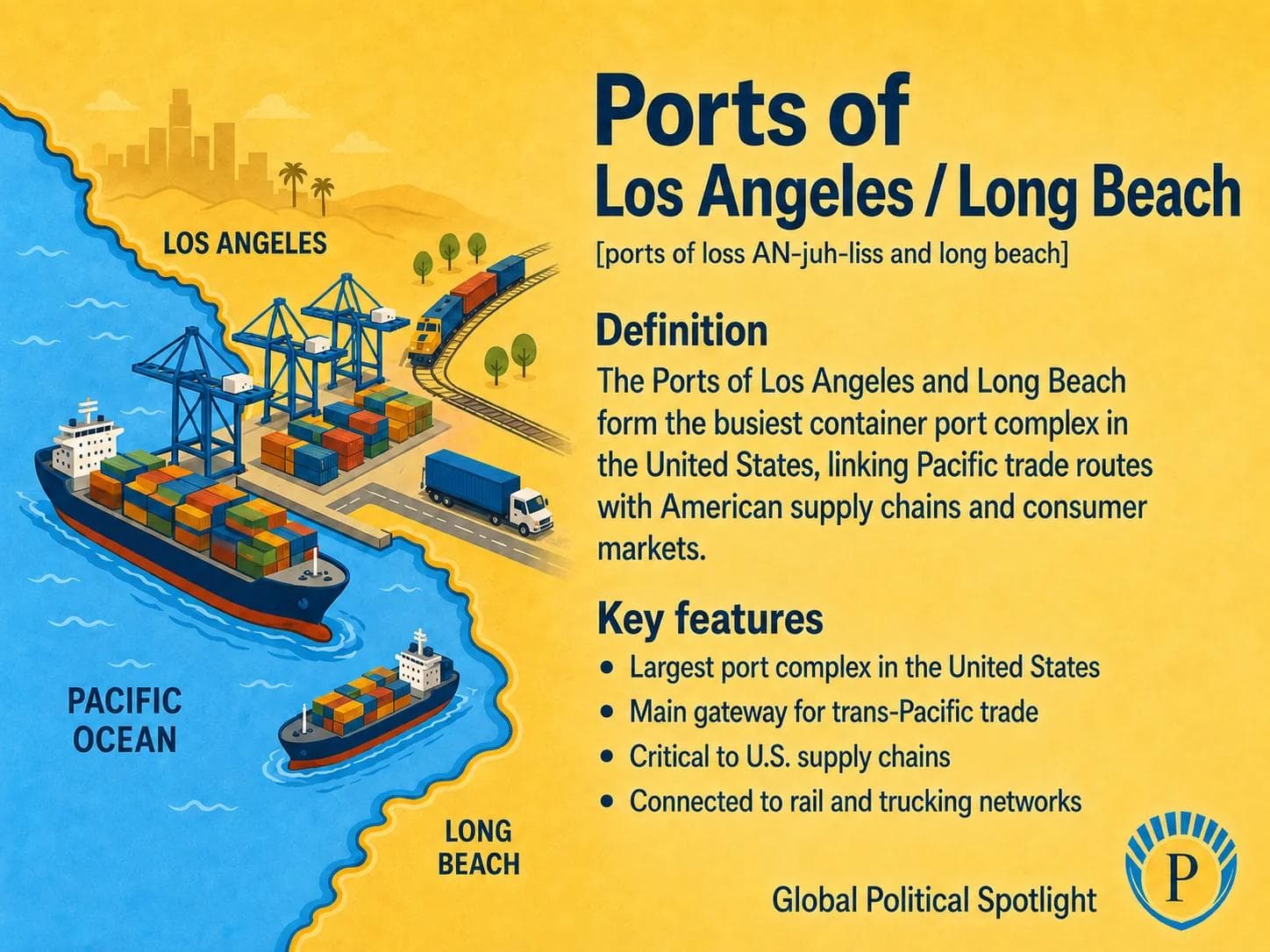
The Ports of Los Angeles and Long Beach are neighboring container ports in San Pedro Bay, Southern California. Together, they form the largest port complex in the United States and one of the most important maritime gateways for trans-Pacific trade.
The complex links Asian manufacturing centers with U.S. importers, retailers, manufacturers, warehouses, rail networks, trucking corridors, and inland distribution hubs. Its operations affect consumer supply chains, agricultural exports, industrial inputs, and the wider U.S. logistics system.
Although the two ports are separately governed by the City of Los Angeles and the City of Long Beach, they are often analyzed together because they share geography, carrier networks, labor exposure, air-quality challenges, rail and trucking connections, and national supply-chain significance.
Why It Matters
The port complex matters because it is a key physical chokepoint in U.S.-Asia trade. Disruptions from congestion, labor disputes, cyber incidents, extreme weather, equipment shortages, customs bottlenecks, or rail and trucking delays can ripple through retail inventories, manufacturing schedules, export flows, and consumer prices.
It also matters for geopolitical resilience. U.S.-China trade tensions, tariff shifts, shipping-route disruptions, supply-chain diversification, port automation, clean-energy requirements, and security screening all affect how this gateway functions as part of the national economic-security system.
GPS should track the Ports of Los Angeles and Long Beach as a strategic logistics node connecting Pacific trade, U.S. consumer markets, China-linked supply chains, rail and trucking capacity, labor relations, port security, customs enforcement, climate policy, and supply-chain resilience. The key analytical issue is whether the port complex can absorb shocks while remaining competitive, secure, clean, and efficient.
Key Facts
- Type
- Container port complex
- Location
- San Pedro Bay, Southern California, on the U.S. Pacific coast
- Core role
- Major U.S. gateway for trans-Pacific container trade, especially with Asia
- Main ports
- Port of Los Angeles and Port of Long Beach
- Governance
- Separate municipal harbor departments, often coordinated on environmental and supply-chain issues
- Strategic links
- Container terminals, shipping lines, rail intermodal yards, trucking corridors, warehouses, and inland distribution networks
- Risk exposure
- Congestion, labor negotiations, cyber risk, equipment shortages, rail and trucking bottlenecks, emissions rules, and trade-policy shocks
- Environmental policy
- The San Pedro Bay Ports Clean Air Action Plan targets major reductions in port-related emissions
FAQ
Why are the Ports of Los Angeles and Long Beach important?
They form the largest U.S. container port complex and a central gateway for trans-Pacific trade. Goods arriving through these ports move into national rail, trucking, warehousing, retail, and manufacturing networks.
Are the Ports of Los Angeles and Long Beach the same port?
No. They are separate ports with different municipal governance structures, but they sit next to each other in San Pedro Bay and are often analyzed together because they share trade routes, infrastructure, labor exposure, and environmental challenges.
What goods move through the Los Angeles and Long Beach port complex?
The port complex handles containerized trade including consumer goods, electronics, furniture, apparel, auto parts, industrial inputs, machinery, and exports such as agricultural products and manufactured goods.
Why did these ports matter during the supply-chain crisis?
During the pandemic-era supply-chain disruption, congestion at San Pedro Bay became a visible bottleneck for U.S. imports. Delays showed how port capacity, trucking, rail, warehouses, labor, and consumer demand are connected.
How do these ports affect geopolitics?
They affect geopolitics because they connect the U.S. economy to Asian manufacturing networks. Trade tensions, tariffs, shipping disruptions, port security, China-linked supply chains, and logistics resilience all make the port complex strategically important.
What are the main vulnerabilities of the port complex?
Key vulnerabilities include congestion, labor stoppages, cyberattacks, rail and trucking constraints, emissions compliance costs, extreme weather, customs delays, container imbalances, and dependence on long-distance Pacific shipping networks.
Recent Developments
U.S. supply-chain policy focused on port congestion and data sharing
The U.S. Department of Transportation described port congestion measures, trucking actions, pop-up container yards, 24/7 operations, and the Freight Logistics Optimization Works data-sharing initiative as part of broader supply-chain resilience efforts.
U.S. Department of TransportationEPA highlighted the San Pedro Bay Ports clean-air program
The U.S. Environmental Protection Agency described the Clean Air Action Plan at the Ports of Los Angeles and Long Beach as a major port-emissions program, underlining the link between trade infrastructure, local air quality, and climate policy.
U.S. Environmental Protection AgencySources6 references
- Port of Los Angeles
Official port statistics and facts on the Port of Los Angeles as a major container gateway.
- Port of Long Beach
Official facts and frequently asked questions for the Port of Long Beach.
- San Pedro Bay Ports Clean Air Action Plan
Official joint clean-air planning framework for the Ports of Los Angeles and Long Beach.
- Port of Los Angeles
Official overview of the San Pedro Bay Ports Clean Air Action Plan and emissions-reduction targets.
- U.S. Department of Transportation
Official U.S. government reference on port congestion, trucking actions, data sharing, and supply-chain resilience.
- U.S. Environmental Protection Agency
Official EPA reference on the San Pedro Bay Ports Clean Air Action Plan and port-emissions policy.

GPSNews App
Read GPSNews on iPhone
Daily geopolitical briefings, government updates, and prediction signals in one focused app.
Newsletter
Stay Ahead Of The Next Signal
Get briefings in your inbox when new analysis and reports are published.