
Port of Singapore
A major global transshipment and bunkering hub at the crossroads of Asian sea lanes
The Port of Singapore is a major maritime hub linking the Malacca Strait, Singapore Strait, South China Sea, and Indian Ocean routes, making it central to container shipping, tanker traffic, bunkering, and global supply chains.
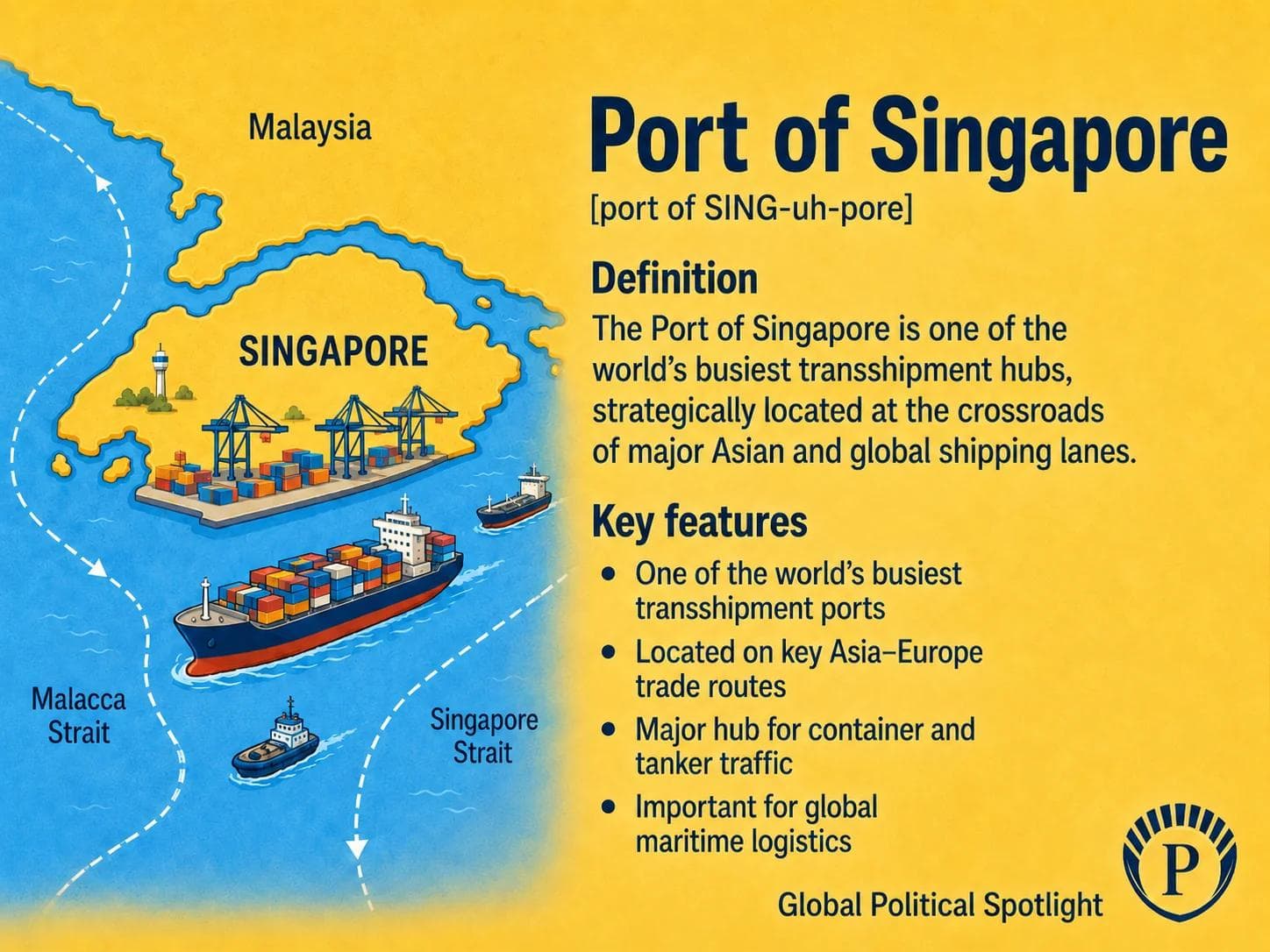
Definition
The Port of Singapore is a major global port complex located at the southern tip of the Malay Peninsula, next to the Singapore Strait and close to the Strait of Malacca. Its position places it on the main maritime corridor between the Indian Ocean and the South China Sea.
The port is especially important as a transshipment hub, where containers are transferred between vessels rather than only loaded or unloaded for Singapore's domestic market. It is also a major bunkering center, supplying marine fuel to ships operating across Asian and global routes.
Why It Matters
Singapore's port matters because it sits beside one of the world's busiest maritime corridors. Disruption around the Malacca Strait, Singapore Strait, or nearby South China Sea routes can affect container schedules, tanker movements, insurance costs, and the resilience of global supply chains.
Its role as a logistics, bunkering, and maritime services hub gives Singapore strategic weight beyond its small land area. Shipping companies, energy traders, navies, and regional governments all have an interest in the port's reliability, regulation, and infrastructure development.
GPS should monitor the Port of Singapore as a structural indicator of global trade resilience, Southeast Asian maritime security, fuel supply chains, and shipping rerouting pressures. Key watch areas include congestion, digital port regulation, alternative marine fuels, Malacca Strait risk, and competition from other regional ports.
Key Facts
- Type
- Global port, transshipment hub, and bunkering center
- Location
- Singapore Strait, near the southern entrance to the Strait of Malacca
- Strategic corridor
- Links Indian Ocean routes with the South China Sea and wider Pacific trade network
- Primary role
- Container transshipment, tanker support, bunkering, logistics, and maritime services
- Regulator
- Maritime and Port Authority of Singapore
- Energy relevance
- Singapore is one of the world's most important marine fuel bunkering ports
- Security relevance
- Port reliability depends on open sea lanes through the Malacca Strait, Singapore Strait, and nearby regional waters
- Long-term development
- Singapore is consolidating major container operations at Tuas Port to expand capacity and automation
FAQ
What is the Port of Singapore?
The Port of Singapore is a major global port complex that handles container transshipment, tanker support, bunkering, and maritime logistics. It is located beside the Singapore Strait, close to the Strait of Malacca.
Why is the Port of Singapore geopolitically important?
It is important because it sits on a key sea-lane junction between the Indian Ocean and the South China Sea. Its reliability affects global shipping schedules, energy flows, marine fuel supply, and Southeast Asian maritime security.
What is transshipment at the Port of Singapore?
Transshipment means cargo is moved from one ship to another at an intermediate port. Singapore's location and port services make it a natural hub for redistributing containers across Asia and long-distance global routes.
Why is bunkering important in Singapore?
Bunkering is the supply of fuel to ships. Singapore's bunkering role matters because vessels using Asian and global routes often need reliable fuel supply, documentation, quality standards, and port services during long voyages.
Is the Port of Singapore the same as the Strait of Malacca?
No. The Port of Singapore is a port hub within Singapore, while the Strait of Malacca is a nearby maritime chokepoint between the Malay Peninsula and Sumatra. The port's importance is closely tied to traffic moving through that wider corridor.
Are there alternatives to the Port of Singapore?
Ships can use other regional ports or, in some cases, alternative routes, but Singapore's combination of location, scale, bunkering, regulation, and maritime services makes it difficult to replace fully in global logistics networks.
Recent Developments
Singapore moved toward default digital bunkering documentation
Singapore began requiring bunker suppliers to provide digital bunkering services and issue electronic bunker delivery notes as the default, a policy designed to improve transparency, efficiency, and trust in marine fuel transactions.
Maritime and Port Authority of SingaporeSingapore reported record port performance for 2025
Singapore's maritime authorities reported record port performance for 2025, reinforcing the port's continuing role as a major container, vessel-arrival, and bunkering hub in global shipping.
Maritime and Port Authority of SingaporeSources6 references
- Maritime and Port Authority of Singapore
Official regulator and promoter of Singapore's port and maritime sector.
- Maritime and Port Authority of Singapore - Bunkering
Official information on Singapore's bunkering system, licensing, standards, and statistics.
- Maritime and Port Authority of Singapore - Record Port Performance 2025
Official 2026 update on Singapore's 2025 port performance and maritime readiness.
- World Bank - Container Port Traffic
Reference data series for Singapore's container port traffic measured in TEUs.
- U.S. Energy Information Administration - World Oil Transit Chokepoints
Institutional reference on maritime chokepoints, including the Malacca Strait's role in oil transit.
- Port of Singapore Authority
Operator reference for Singapore's container terminal and port services.

GPSNews App
Read GPSNews on iPhone
Daily geopolitical briefings, government updates, and prediction signals in one focused app.
Newsletter
Stay Ahead Of The Next Signal
Get briefings in your inbox when new analysis and reports are published.