
Port of Rotterdam
Europe's largest seaport and a major gateway for trade, energy, and inland logistics
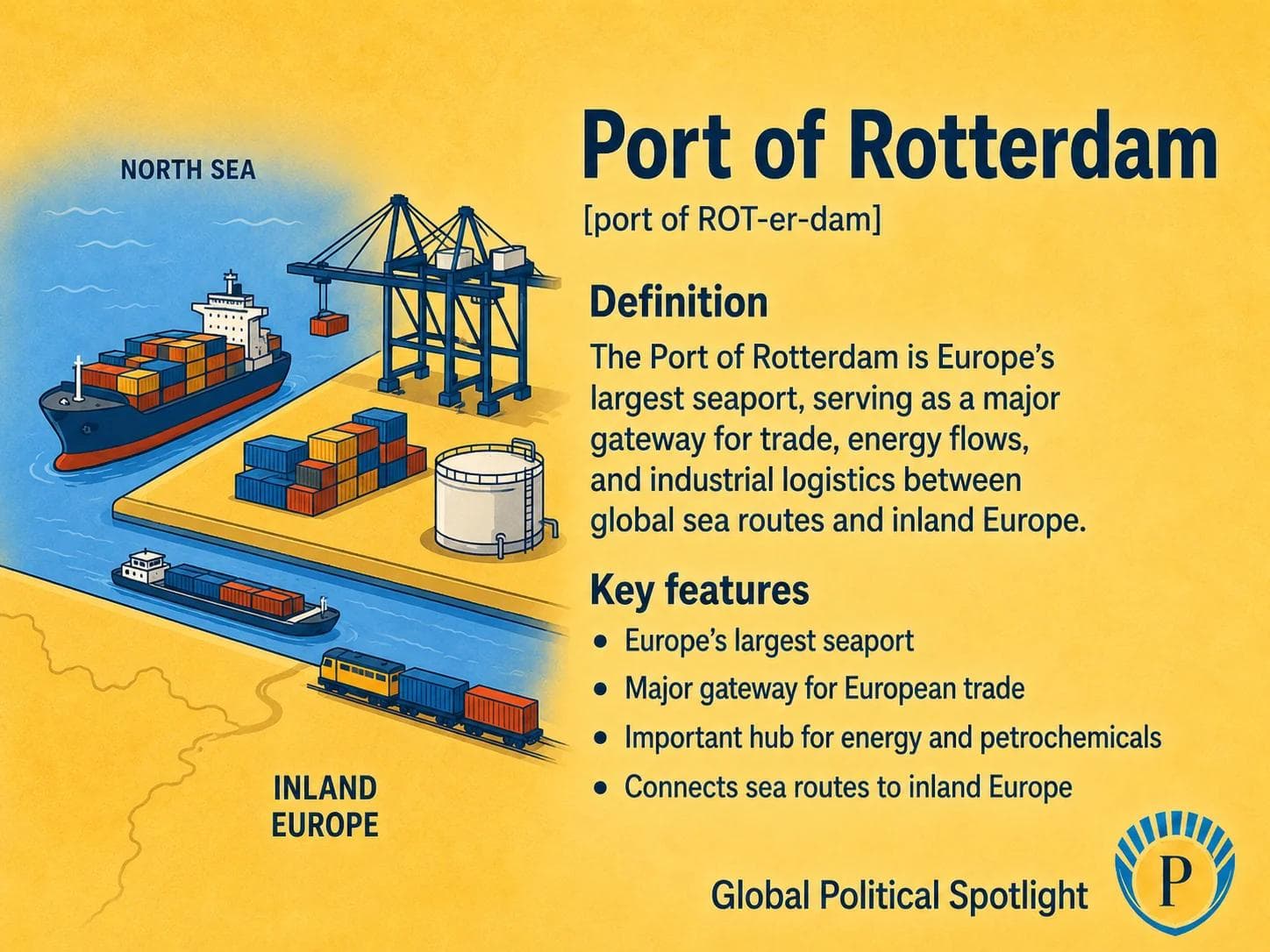
The Port of Rotterdam is Europe's largest seaport, linking North Sea shipping routes to the Rhine, inland Europe, container terminals, energy infrastructure, petrochemicals, and industrial supply chains.
Definition
The Port of Rotterdam is Europe's largest seaport and one of the world's most important maritime logistics hubs. Located in the Netherlands on the North Sea, it connects deep-sea shipping routes with inland European markets through the Rhine, rail corridors, roads, pipelines, and barge networks.
The port handles containers, crude oil, refined products, liquefied natural gas, chemicals, dry bulk, agricultural goods, and industrial inputs. It is closely tied to Rotterdam's petrochemical cluster, European energy infrastructure, and supply chains serving Germany, Belgium, France, Switzerland, and Central Europe.
Because the port links global trade flows to Europe's industrial heartland, it is not only a commercial asset but also a strategic infrastructure node. Its resilience affects energy security, supply-chain reliability, customs enforcement, sanctions implementation, cyber risk, and the European transition toward lower-carbon logistics and fuels.
Why It Matters
The Port of Rotterdam matters because it is a gateway between global maritime trade and inland Europe. Disruption at Rotterdam can affect container flows, fuel supplies, industrial inputs, agricultural exports, manufacturing schedules, and logistics costs across several European economies.
Its energy role is especially important. Rotterdam hosts major oil, gas, LNG, petrochemical, pipeline, storage, and refining infrastructure, making it relevant to European energy security, sanctions enforcement, fuel markets, strategic reserves, and the shift toward hydrogen, carbon capture, and alternative fuels.
For geopolitics, the port illustrates how trade infrastructure becomes economic security infrastructure. Maritime chokepoints, shipping shocks, customs controls, cyberattacks, labor disruptions, climate adaptation, and industrial policy can all turn a commercial port into a strategic risk indicator.
GPS should track the Port of Rotterdam as a strategic European trade and energy gateway. Key watchpoints include container throughput, North Sea shipping disruptions, Rhine water levels, energy infrastructure, LNG and oil flows, sanctions enforcement, cyber resilience, industrial decarbonization, customs security, and links between port logistics and European economic security.
Key Facts
- Type
- Strategic seaport and logistics hub
- Location
- Rotterdam, Netherlands, on the North Sea and the Rhine-Meuse-Scheldt delta
- Regional role
- Europe's largest seaport by cargo throughput
- Inland connection
- Links North Sea trade to the Rhine corridor, Germany's industrial regions, and wider inland Europe
- Main cargo areas
- Containers, crude oil, refined products, LNG, chemicals, dry bulk, breakbulk, and agricultural goods
- Energy role
- Major European hub for oil, gas, petrochemicals, storage, pipelines, refining, LNG, and emerging low-carbon energy infrastructure
- Strategic relevance
- Important for European trade resilience, energy security, industrial supply chains, sanctions enforcement, and customs control
- Key vulnerabilities
- Exposure to shipping disruptions, cyber risks, labor constraints, Rhine water-level problems, energy shocks, climate adaptation costs, and infrastructure bottlenecks
FAQ
What is the Port of Rotterdam?
The Port of Rotterdam is Europe's largest seaport and a major logistics, energy, and industrial hub in the Netherlands. It connects North Sea shipping routes to the Rhine and inland European markets.
Why is the Port of Rotterdam important?
It is important because it handles large volumes of containers, energy products, chemicals, bulk cargo, and industrial inputs. Its connections to the Rhine, railways, roads, pipelines, and inland terminals make it central to European trade and supply-chain resilience.
How does Rotterdam connect to inland Europe?
Rotterdam connects to inland Europe through the Rhine river system, barge transport, rail freight corridors, roads, inland terminals, and pipeline networks. These links help move goods to Germany, Belgium, France, Switzerland, and Central Europe.
Why does the port matter for energy security?
Rotterdam hosts major infrastructure for crude oil, refined fuels, LNG, petrochemicals, storage, pipelines, and refining. This makes it important for European fuel supply, industrial production, sanctions enforcement, and the energy transition.
What are the main risks facing the Port of Rotterdam?
Key risks include shipping disruptions, cyberattacks, congestion, labor shortages, organized crime, customs pressure, energy shocks, low Rhine water levels, climate adaptation, and dependence on global supply-chain stability.
Is the Port of Rotterdam only important for the Netherlands?
No. Although it is located in the Netherlands, Rotterdam serves a much larger European hinterland. It is especially important for Germany's industrial regions and for wider European trade, energy, and logistics networks.
Recent Developments
Rotterdam continued positioning itself as a European energy transition hub
Port of Rotterdam Authority reporting and strategy materials continued to emphasize hydrogen, carbon capture, shore power, alternative fuels, and industrial decarbonization, reflecting the port's long-term role in Europe's shift from fossil fuel logistics toward lower-carbon energy systems.
Port of Rotterdam AuthorityEuropean supply-chain security kept major ports in strategic focus
EU and national discussions on economic security, customs enforcement, critical infrastructure resilience, and organized crime continued to highlight the importance of major ports such as Rotterdam as entry points for trade, energy flows, and security risks.
European CommissionSources6 references
- Port of Rotterdam Authority - Facts and figures
Official port data and reference information on throughput, infrastructure, and port activity.
- Port of Rotterdam Authority - Energy transition
Official overview of Rotterdam's role in hydrogen, carbon capture, alternative fuels, and industrial decarbonization.
- Port of Rotterdam Authority - Port map
Official geographic and infrastructure reference for the port area.
- European Commission - Ports
EU institutional context on the role of ports in European transport networks and maritime policy.
- Rhine-Alpine Corridor - European Commission
EU reference on the Rhine-Alpine transport corridor connecting major North Sea ports to inland Europe.
- International Energy Agency - The Netherlands energy profile
Reference context for the Netherlands' energy system and its relevance to European energy infrastructure.

GPSNews App
Read GPSNews on iPhone
Daily geopolitical briefings, government updates, and prediction signals in one focused app.
Newsletter
Stay Ahead Of The Next Signal
Get briefings in your inbox when new analysis and reports are published.