
Panama Canal
A strategic waterway linking the Atlantic and Pacific Oceans
The Panama Canal is a man-made waterway across Panama that connects the Atlantic and Pacific Oceans, shortening global shipping routes and serving as a major strategic chokepoint for world trade.
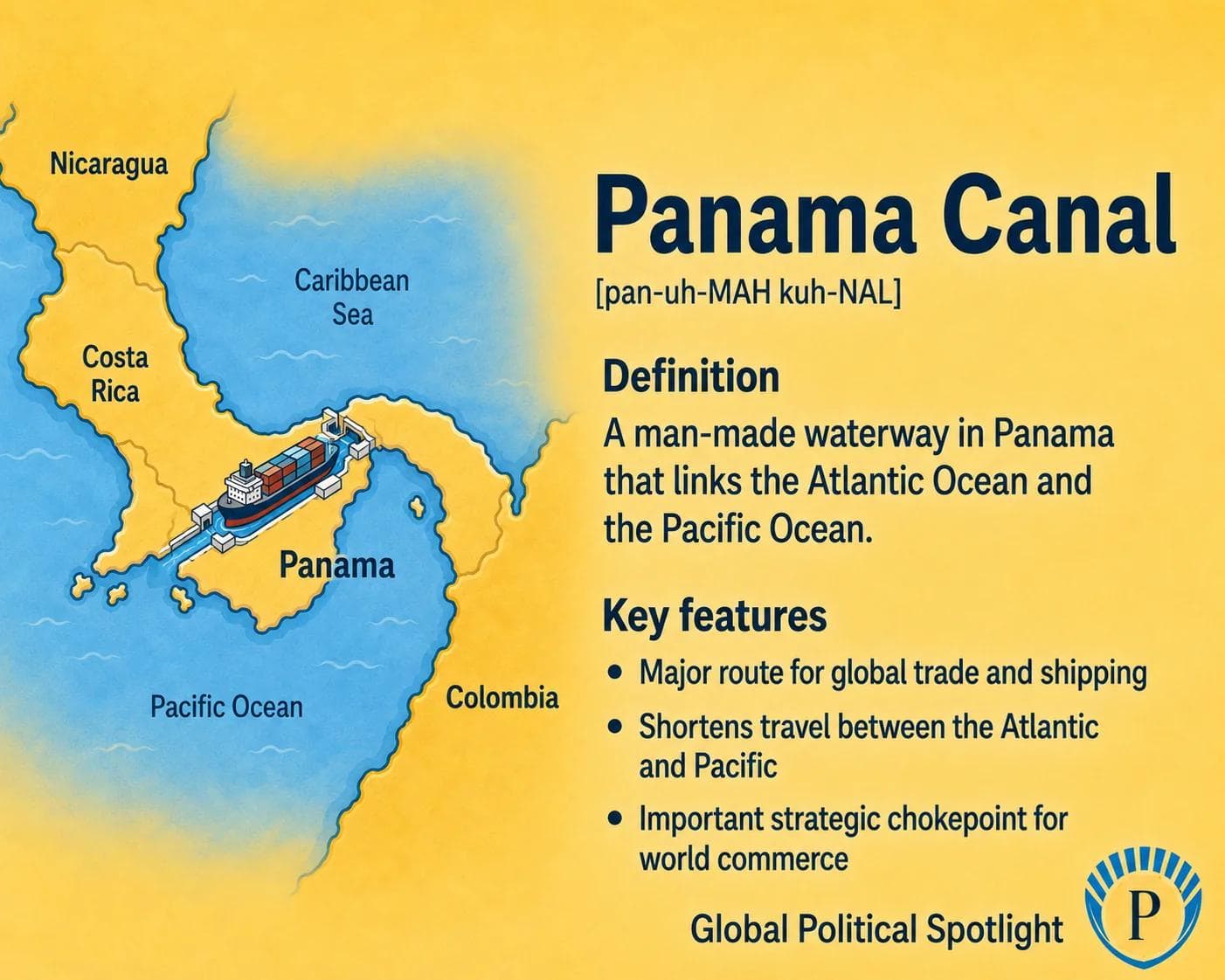
Definition
The Panama Canal is an artificial waterway in Panama that connects the Atlantic Ocean, through the Caribbean Sea, with the Pacific Ocean. It allows ships to cross Central America without sailing around South America's southern tip.
The canal operates through a system of locks, channels, and artificial lakes that raise and lower vessels across the Isthmus of Panama. Its location gives it enduring importance in maritime logistics, naval mobility, and global supply chains.
Why It Matters
The Panama Canal matters because it compresses global distance. By shortening routes between the Atlantic and Pacific Oceans, it reduces travel time, fuel costs, and logistical complexity for commercial shipping.
As a strategic chokepoint, disruption or capacity limits at the canal can affect container shipping, energy cargoes, grain exports, naval planning, and the resilience of global trade networks.
GPS should watch the Panama Canal as a long-term indicator of maritime chokepoint risk, supply-chain resilience, U.S.-China commercial exposure, climate-related water constraints, and Panama's strategic role between the Atlantic and Pacific trade systems.
Key Facts
- Type
- Artificial maritime canal and strategic chokepoint
- Location
- Isthmus of Panama, Central America
- Connects
- Atlantic Ocean and Pacific Ocean
- Opened
- 1914
- Operator
- Panama Canal Authority
- Strategic role
- Shortens major trade routes between the Americas, Asia, and Europe
- Infrastructure
- Uses locks, channels, and Gatun Lake to move ships across the isthmus
- Core vulnerability
- Traffic capacity can be affected by water availability, ship size limits, congestion, and maintenance constraints
FAQ
What is the Panama Canal?
The Panama Canal is a man-made waterway in Panama that connects the Atlantic and Pacific Oceans, allowing ships to avoid the much longer route around South America.
Why is the Panama Canal important?
It is important because it shortens major global shipping routes, lowers transport costs, and functions as a strategic chokepoint for trade between the Americas, Asia, and Europe.
Who controls the Panama Canal?
The canal is controlled by Panama and operated by the Panama Canal Authority. The United States built and administered the canal for much of the twentieth century before control was transferred to Panama at the end of 1999.
How does the Panama Canal affect global trade?
The canal affects global trade by shaping shipping routes for containers, agricultural goods, energy cargoes, manufactured products, and naval movements. Capacity limits or delays can ripple through supply chains.
Are there alternatives to the Panama Canal?
Alternatives include sailing around Cape Horn, using the Suez Canal for some routes, relying on intermodal rail links, or using other maritime passages depending on origin and destination. These options can be slower, costlier, or less efficient.
What are the Panama Canal's main limits?
Its main limits include lock dimensions, water availability, daily transit capacity, congestion, toll costs, and vulnerability to drought or operational disruptions.
Recent Developments
Drought conditions highlighted the canal's water constraints
Low rainfall and water-management pressures in the Panama Canal watershed contributed to transit restrictions, underscoring how climate and freshwater availability can affect global shipping capacity.
Panama Canal AuthorityExpanded canal opened for larger vessels
The Panama Canal expansion added a new lane of traffic and larger locks, enabling the transit of bigger Neopanamax vessels and increasing the canal's role in global container and energy trade.
Panama Canal AuthoritySources5 references
- Panama Canal Authority
Official source for canal operations, history, infrastructure, and transit information.
- Panama Canal Authority - Expanded Canal
Official information on the canal expansion and larger vessel capacity.
- Encyclopaedia Britannica
Reference background on the canal's history, geography, construction, and strategic significance.
- U.S. Department of State - Office of the Historian
Historical background on the Panama Canal treaties and the transfer of canal control to Panama.
- World Bank
Country context for Panama's economy, infrastructure, and development environment.

GPSNews App
Read GPSNews on iPhone
Daily geopolitical briefings, government updates, and prediction signals in one focused app.
Newsletter
Stay Ahead Of The Next Signal
Get briefings in your inbox when new analysis and reports are published.