
Luzon Strait
A strategic passage between Taiwan and the northern Philippines
The Luzon Strait is a strategic waterway between Taiwan and the northern Philippines, linking the South China Sea with the Philippine Sea and the wider Pacific Ocean.
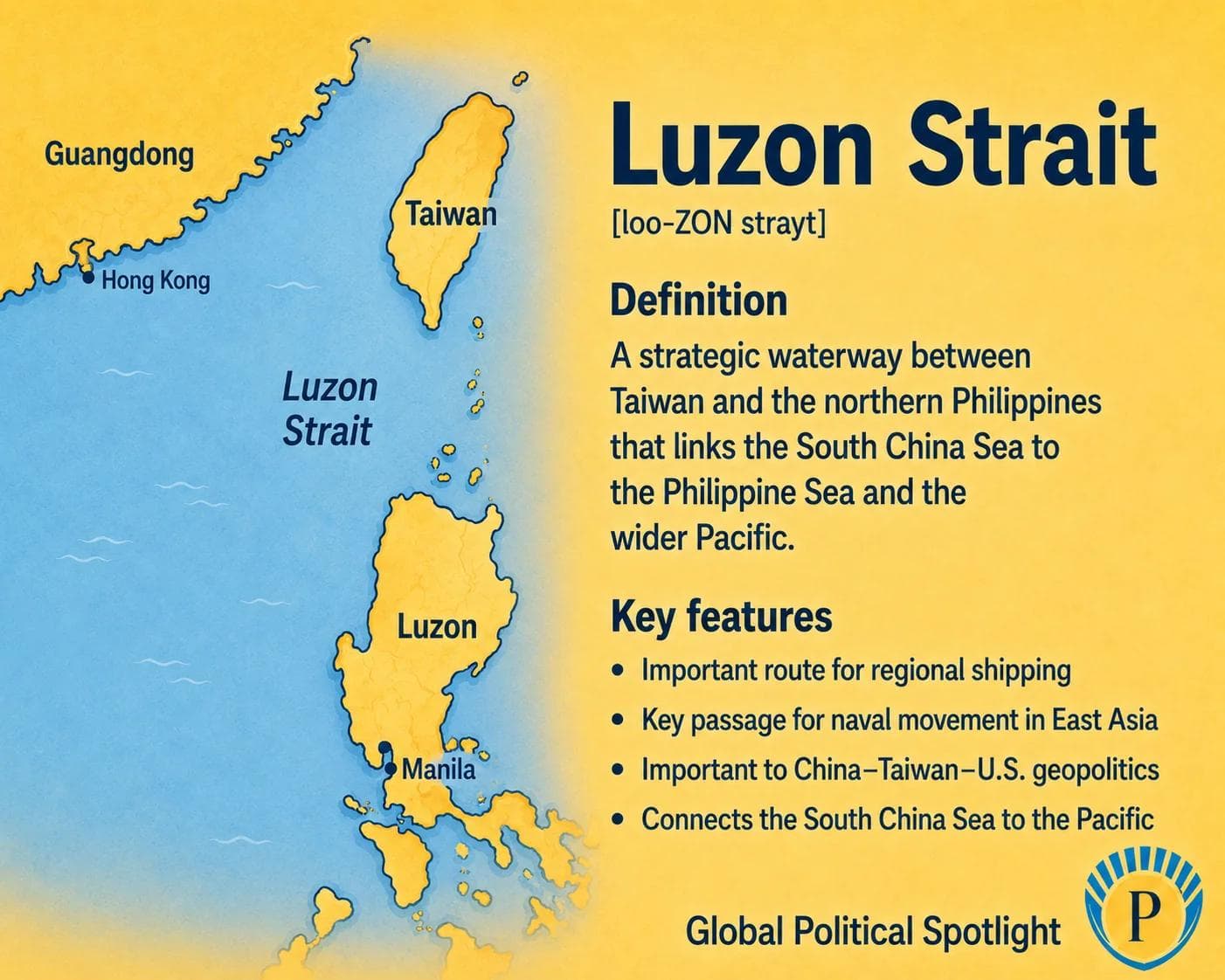
Definition
The Luzon Strait is a waterway in the western Pacific located between Taiwan to the north and Luzon, the largest island of the Philippines, to the south. It links the South China Sea with the Philippine Sea and the wider Pacific Ocean.
The strait includes island groups and channels such as the Batanes Islands and the Babuyan Islands, making it both a geographic passage and a strategically sensitive maritime space in East Asia.
Why It Matters
The Luzon Strait matters because it is one of the key routes connecting the South China Sea to the open Pacific. Commercial shipping, undersea cables, naval movement, and military planning all intersect in this maritime corridor.
Its location between Taiwan and the Philippines makes it important to regional deterrence, Taiwan contingency planning, U.S. alliance strategy, Chinese naval access, and the broader balance of power in the Indo-Pacific.
GPS should watch the Luzon Strait as a key East Asian maritime passage where geography, alliance politics, naval access, undersea infrastructure, and Taiwan-related security dynamics overlap. Its importance rises whenever tensions involve Taiwan, the South China Sea, the Philippines, China, or U.S. regional posture.
Key Facts
- Type
- Strategic maritime passage
- Location
- Between Taiwan and northern Luzon in the Philippines
- Connects
- South China Sea, Philippine Sea, and the wider Pacific Ocean
- Nearby islands
- Batanes Islands, Babuyan Islands, Taiwan, and Luzon
- Primary actors
- Philippines, Taiwan, China, and the United States
- Strategic role
- Supports naval access between the South China Sea and the western Pacific
- Market relevance
- Important for regional shipping routes and undersea communications infrastructure
- Security relevance
- Central to East Asian maritime security, Taiwan contingency planning, and Indo-Pacific military mobility
FAQ
What is the Luzon Strait?
The Luzon Strait is a strategic waterway between Taiwan and the northern Philippines. It connects the South China Sea to the Philippine Sea and the wider Pacific Ocean.
Why is the Luzon Strait important?
It is important because it is a major maritime route for shipping and naval movement between the South China Sea and the Pacific, and it sits near Taiwan and the northern Philippines.
Where is the Luzon Strait located?
It lies between Taiwan to the north and Luzon in the Philippines to the south, with the Batanes and Babuyan island groups located within or near the strait.
How does the Luzon Strait affect China, Taiwan, and the United States?
The strait is relevant to Chinese naval access to the Pacific, Taiwan-related security planning, and U.S. alliance cooperation with the Philippines. Its geography makes it important in any regional military or maritime crisis.
Is the Luzon Strait part of the South China Sea?
The Luzon Strait is best understood as a connecting passage between the South China Sea and the Philippine Sea. It sits at the edge of these maritime zones rather than being only one or the other.
What are the main vulnerabilities around the Luzon Strait?
Key vulnerabilities include military escalation risk, pressure on shipping routes, surveillance competition, undersea cable exposure, and the difficulty of managing maritime activity near multiple sensitive territories and alliance commitments.
Recent Developments
Philippines identified additional U.S. access sites under EDCA
The Philippines announced additional sites under the Enhanced Defense Cooperation Agreement, including locations in northern Luzon, reinforcing the strategic importance of the area near the Luzon Strait for regional security planning.
U.S. Department of DefenseUnited States, Japan, and the Philippines emphasized maritime cooperation
A trilateral leaders' statement highlighted maritime security, freedom of navigation, and cooperation in the Indo-Pacific, reflecting the growing strategic relevance of waters around the Philippines and nearby regional passages.
The White HouseSources6 references
- Encyclopaedia Britannica
Reference background on the geography and location of the Luzon Strait.
- CIA World Factbook - Philippines
Reference context on the Philippines' geography and maritime position.
- CIA World Factbook - Taiwan
Reference context on Taiwan's geography and position near the Luzon Strait.
- U.S. Department of Defense
Official statement on additional U.S.-Philippines EDCA sites, including sites relevant to northern Luzon and regional security.
- The White House
Official trilateral statement on maritime cooperation and Indo-Pacific security.
- United Nations Convention on the Law of the Sea
Legal framework relevant to navigation rights, maritime zones, and international maritime passage.

GPSNews App
Read GPSNews on iPhone
Daily geopolitical briefings, government updates, and prediction signals in one focused app.
Newsletter
Stay Ahead Of The Next Signal
Get briefings in your inbox when new analysis and reports are published.