
Strait of Malacca
A critical Asian maritime chokepoint linking the Indian Ocean to the South China Sea
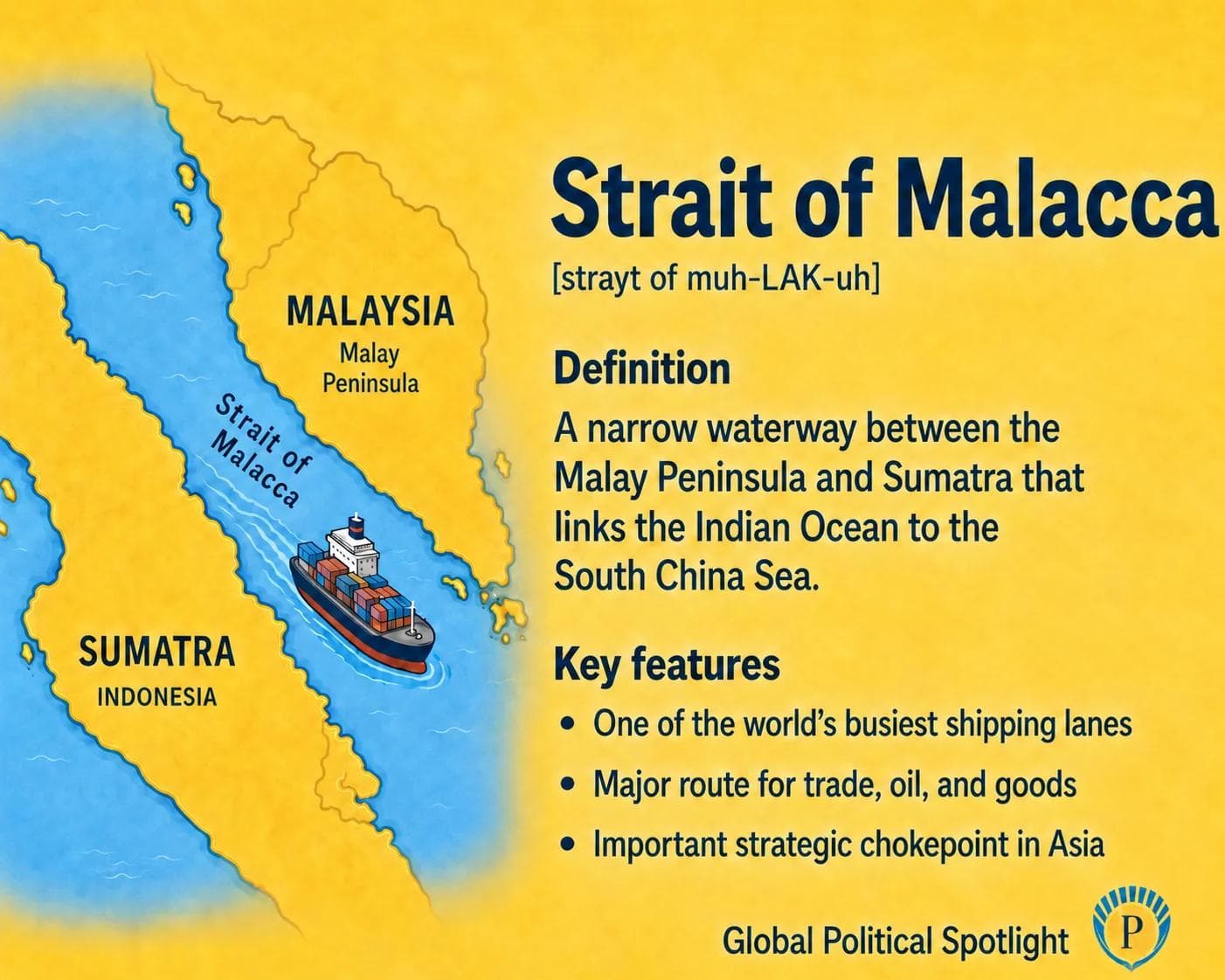
The Strait of Malacca is a narrow waterway between the Malay Peninsula and Sumatra that connects the Indian Ocean to the South China Sea and carries a major share of global trade and energy shipping.
Definition
The Strait of Malacca is a narrow maritime passage between the Malay Peninsula and the Indonesian island of Sumatra. It links the Indian Ocean with the South China Sea through the wider route between the Andaman Sea, Singapore Strait, and major ports in Southeast Asia.
The strait is one of the most important commercial sea lanes in the world. It carries container ships, tankers, bulk carriers, and regional traffic moving between the Middle East, South Asia, Southeast Asia, East Asia, Europe, and global markets.
Why It Matters
The Strait of Malacca matters because it concentrates a very large volume of trade through a narrow and busy route. Oil, LNG, manufactured goods, food, raw materials, and containerized cargo all move through the corridor, making it central to supply-chain resilience and energy security.
Its geopolitical relevance comes from the dependence of many Asian economies on reliable passage through the strait. Disruption could raise shipping costs, affect energy-importing states, increase pressure on alternative routes, and intensify naval and coast guard attention around Southeast Asian waters.
GPS should watch the Strait of Malacca as an enduring indicator of Asian maritime security, global trade exposure, energy-import vulnerability, Singaporean port relevance, China and India sea-lane strategy, piracy and safety risks, and the strategic value of alternative routes through Indonesia and the wider Indo-Pacific.
Key Facts
- Type
- Maritime chokepoint
- Location
- Between the Malay Peninsula and Sumatra
- Connects
- Indian Ocean and South China Sea maritime routes
- Nearby states
- Malaysia, Indonesia, Singapore, and Thailand
- Strategic role
- Major route for trade between Europe, the Middle East, South Asia, Southeast Asia, and East Asia
- Energy relevance
- Important route for oil and LNG moving toward energy-importing Asian economies
- Commercial relevance
- One of the busiest shipping lanes in the world for container and tanker traffic
- Main vulnerability
- Congestion, accidents, piracy risk, maritime disputes nearby, and limited practical alternatives for high-volume shipping
FAQ
What is the Strait of Malacca?
The Strait of Malacca is a narrow waterway between the Malay Peninsula and Sumatra. It connects the Indian Ocean with the South China Sea through one of the worlds most important maritime trade routes.
Why is the Strait of Malacca important?
It is important because it carries a major share of global shipping, including oil, LNG, containerized goods, and raw materials. Many Asian economies depend on it for trade and energy imports.
Which countries border the Strait of Malacca?
The strait lies mainly between Malaysia and Indonesia, with Singapore located near its southeastern end and Thailand connected to the wider regional geography near the northern approaches.
Why is the Strait of Malacca considered a chokepoint?
It is considered a chokepoint because large volumes of shipping pass through a relatively narrow route. Disruption, congestion, accidents, or security threats can affect trade flows across Asia and beyond.
Are there alternatives to the Strait of Malacca?
Ships can use alternative Indonesian passages such as the Sunda Strait, Lombok Strait, or Makassar Strait, but these routes can be longer, less direct, or less efficient for many voyages.
How does the Strait of Malacca affect geopolitics?
It affects geopolitics by linking sea-lane security, energy imports, port strategy, naval planning, and trade resilience. China, India, Japan, Singapore, Malaysia, Indonesia, and many trading states have strong interests in stable access.
Recent Developments
Energy agencies continued to identify Malacca as a major oil transit chokepoint
Energy-market analysis continued to treat the Strait of Malacca as a core oil transit route because large volumes of petroleum move through the corridor toward East Asian import markets.
U.S. Energy Information AdministrationMaritime safety remained central to Southeast Asian sea-lane governance
Regional and international maritime institutions continued to emphasize safe navigation, port connectivity, and security cooperation in crowded Southeast Asian shipping corridors including the Strait of Malacca.
International Maritime OrganizationSources5 references
- U.S. Energy Information Administration
Official energy source for global oil transit chokepoints and the Strait of Malacca role in petroleum flows.
- International Maritime Organization
Institutional source for maritime safety, shipping governance, navigation standards, and sea-lane security.
- United Nations Conference on Trade and Development
Institutional source for maritime transport, global trade routes, shipping costs, and supply-chain analysis.
- Encyclopaedia Britannica
Reference source for basic geography, location, and historical background on the Strait of Malacca.
- Maritime and Port Authority of Singapore
Official Singapore source for port operations, maritime services, and regional shipping context near the strait.

GPSNews App
Read GPSNews on iPhone
Daily geopolitical briefings, government updates, and prediction signals in one focused app.
Newsletter
Stay Ahead Of The Next Signal
Get briefings in your inbox when new analysis and reports are published.