
Port of Shanghai
The world’s busiest container port and a core gateway for Chinese manufacturing and global trade
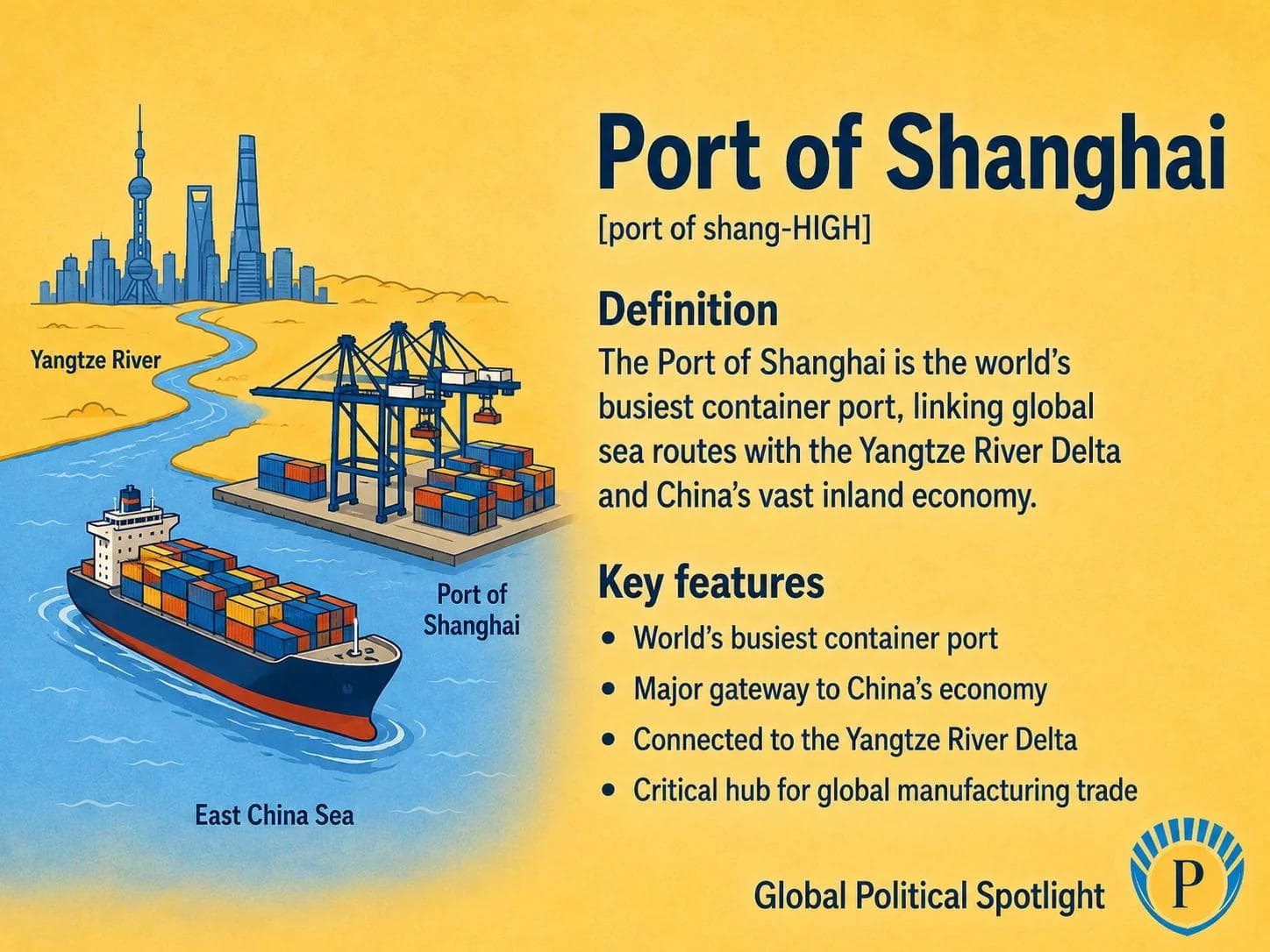
The Port of Shanghai is the world’s busiest container port, linking the Yangtze River Delta’s manufacturing base to global shipping routes through the East China Sea and wider Pacific trade network.
Definition
The Port of Shanghai is a major Chinese seaport located where the Yangtze River system connects with the East China Sea. It includes deep-water and river-linked port facilities that serve Shanghai and the wider Yangtze River Delta, one of the world’s most important manufacturing, finance, and logistics regions.
The port is widely recognized as the world’s busiest container port by annual container throughput. Its terminals handle large flows of manufactured goods, intermediate inputs, machinery, electronics, consumer products, vehicles, chemicals, and other cargo tied to China’s export economy and regional industrial clusters.
Shanghai’s port system is not only a transport facility; it is a strategic node in global commerce. Its performance depends on shipping lanes, hinterland rail and road links, customs systems, warehouse capacity, factory output, energy supply, labor availability, and wider trade conditions between China and the rest of the world.
Why It Matters
The Port of Shanghai matters because it connects Chinese industrial production to global consumers, firms, and supply chains. Disruption at Shanghai can affect container availability, delivery schedules, manufacturing inputs, export prices, and logistics planning across Asia, Europe, North America, and other regions.
The port is geopolitically important because it demonstrates how China’s economic power is tied to maritime infrastructure, export capacity, and control over logistics networks. It sits at the intersection of domestic industrial policy, international trade, shipping finance, customs administration, and strategic competition over supply-chain resilience.
Shanghai also matters for risk analysis. Pandemic controls, typhoons, labor constraints, port congestion, customs delays, sanctions, trade disputes, energy shortages, or military tensions in nearby waters can all affect the flow of goods through one of the world economy’s most important maritime gateways.
The Port of Shanghai should be tracked as a critical node in global container shipping and Chinese export supply chains. GPS should watch container throughput, congestion, customs and logistics delays, Yangtze River Delta industrial output, China trade policy, U.S.-China and EU-China trade frictions, maritime security in East Asian waters, climate and weather disruptions, and how firms diversify supply chains away from or around China while still depending on Shanghai’s scale.
Key Facts
- Type
- Major container port and global trade gateway
- Country
- China
- Location
- Shanghai, at the mouth of the Yangtze River and near the East China Sea
- Regional economy
- Serves the Yangtze River Delta, one of China’s most important manufacturing, finance, and logistics hubs
- Global rank
- Widely recognized as the world’s busiest container port by annual container throughput
- Strategic role
- Connects Chinese factories and inland supply chains to global maritime trade routes
- Main cargo relevance
- Containerized exports, industrial inputs, consumer goods, electronics, machinery, chemicals, and logistics-linked cargo
- Key vulnerability
- Port congestion, weather disruptions, policy restrictions, trade tensions, and supply-chain shocks can affect global shipping schedules
FAQ
What is the Port of Shanghai?
The Port of Shanghai is a major Chinese seaport and container port located around Shanghai and the Yangtze River Delta. It is a central gateway for Chinese exports, imports, industrial logistics, and global maritime trade.
Why is the Port of Shanghai important?
The Port of Shanghai is important because it handles enormous container flows tied to Chinese manufacturing and global supply chains. Its performance affects shipping schedules, factory inputs, export deliveries, freight costs, and trade flows across multiple regions.
Is the Port of Shanghai the world’s busiest port?
Shanghai is widely recognized as the world’s busiest container port by annual container throughput. Rankings can vary by metric, such as total cargo tonnage versus containers, but Shanghai is the dominant global container port.
Where is the Port of Shanghai located?
The Port of Shanghai is located in eastern China, around Shanghai and the mouth of the Yangtze River, with access to the East China Sea. It serves the wider Yangtze River Delta industrial region.
How does the Port of Shanghai affect global supply chains?
The port connects factories, warehouses, trucking networks, rail links, river transport, and ocean carriers. Delays or disruptions can ripple through global supply chains by slowing the movement of components, finished goods, and container equipment.
What are the main risks to the Port of Shanghai?
Risks include congestion, typhoons, policy restrictions, customs delays, labor or logistics constraints, energy shortages, trade disputes, sanctions, and wider geopolitical tensions affecting East Asian shipping routes or Chinese export demand.
Recent Developments
Shanghai remained a leading global container port
Port industry reporting and official Chinese port data continued to identify Shanghai as the world’s top container port by throughput, underscoring its enduring role as a gateway for China’s export economy and global container flows.
Shanghai International Port GroupGlobal shipping reports continued to highlight China’s port dominance
International shipping and port statistics continued to show Chinese ports occupying many of the top positions in global container throughput rankings, with Shanghai central to China’s role in manufacturing, logistics, and maritime commerce.
World Shipping CouncilSources6 references
- Shanghai International Port Group
Official port operator source for Shanghai port operations, terminal information, and port-related updates.
- Shanghai Municipal People's Government
Official municipal source for Shanghai’s economy, infrastructure, logistics, and trade-related policy context.
- World Shipping Council Top 50 Ports
Industry reference source for global container port throughput rankings.
- UNCTAD Review of Maritime Transport
Institutional source for global maritime trade, container shipping, port performance, and supply-chain trends.
- World Bank Logistics Performance Index
Institutional source for logistics performance, trade facilitation, infrastructure, and supply-chain connectivity.
- China Ministry of Transport
Official Chinese government source for transport policy, port infrastructure, and national logistics context.

GPSNews App
Read GPSNews on iPhone
Daily geopolitical briefings, government updates, and prediction signals in one focused app.
Newsletter
Stay Ahead Of The Next Signal
Get briefings in your inbox when new analysis and reports are published.